

Choosing Board and Laminate for Kerala Humidity: A Specifier's Guide
Kerala is a hard place for furniture. Relative humidity stays high for most of the year, the monsoon is long, and coastal districts add salt to the air. Material choices that work perfectly well in a dry inland climate fail here, often within two or three years, and almost always at an edge or a joint.
This is a specifier's guide to choosing board, laminate and edge banding for those conditions, and to writing a schedule precise enough that the factory cannot substitute.
How moisture actually damages furniture
Engineered boards are wood fibre or veneer held together with adhesive. Moisture enters, the fibres swell, the adhesive bond is stressed, and the board loses thickness stability and fastener grip.
It rarely enters through a laminated face. It enters through an unsealed edge, a drilled hole, a cut-out for plumbing, or the bottom of a carcass sitting on a wet floor. That is why edge sealing and the detail at the floor matter more than the headline board grade.
The board options, ranked for Kerala
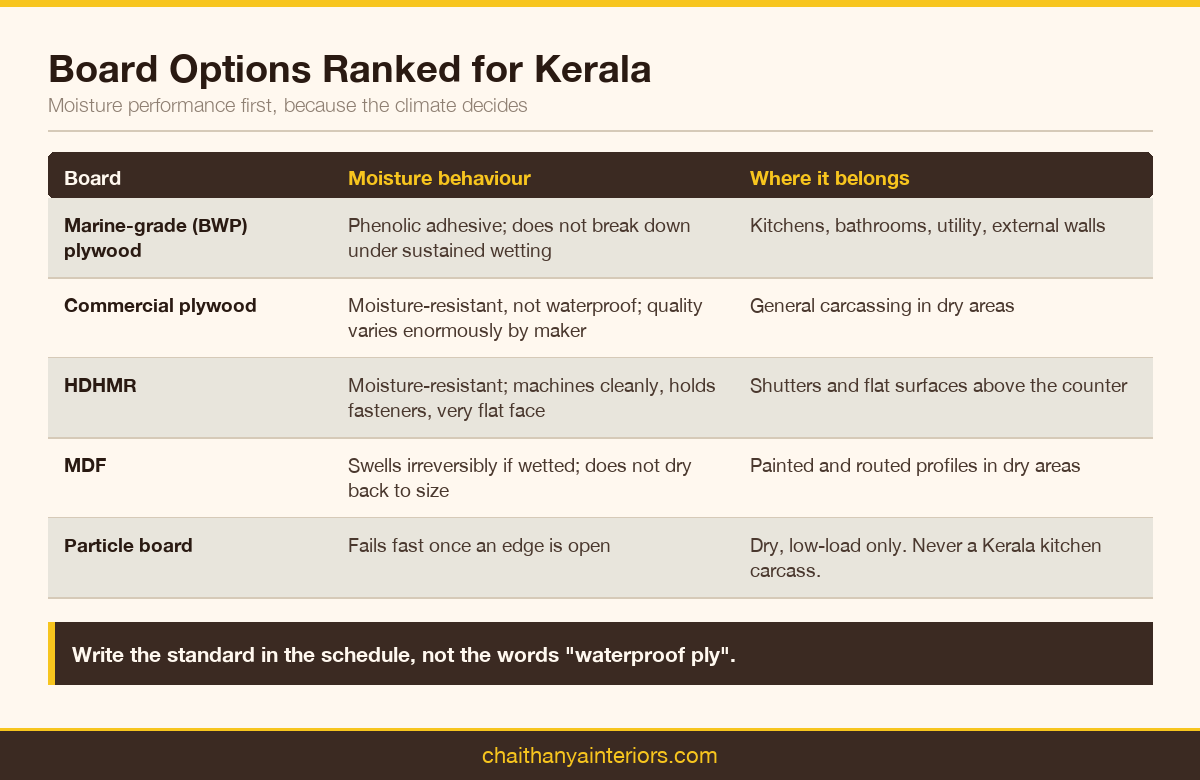
Marine-grade plywood
Boiling-waterproof plywood is the default for anything in a kitchen, a bathroom, a utility area, or against an external wall. It uses a phenolic adhesive that does not break down under sustained moisture.
It is the most expensive common option and worth it in wet zones. Specifying it throughout a whole house is usually over-specification; specifying it in the kitchen is not.
Commercial plywood
Moisture-resistant rather than waterproof. Appropriate for carcassing in dry areas — bedroom wardrobes away from external walls, living room units, study furniture.
Quality varies enormously between manufacturers, more than in any other board category. Core gaps and uneven plies are common at the cheap end and they destroy screw holding. Buy on brand and standard, not on price alone.
HDHMR
High-density high-moisture-resistant board machines very cleanly, holds fasteners well, and gives a flatter face than plywood, which makes it attractive for shutters and for any surface where flatness is visible.
It is moisture resistant, not waterproof. It belongs above the counter rather than under the sink.
MDF
Excellent for painted finishes and for routed or moulded profiles, because it has no grain and takes a crisp edge. It is the correct choice for a painted shaker shutter and the wrong choice anywhere it may sit in water.
MDF that has absorbed water swells irreversibly. It does not dry back to size.
Particle board
Has a legitimate place in dry, low-load applications and in flat-pack furniture. It has no place in a Kerala kitchen carcass, and specifying it there is the most common false economy in budget modular work.
Standards to quote in the schedule
Do not write "waterproof ply". Write the standard. The the national standards body publishes the relevant specifications for plywood and for boiling-waterproof grades, and naming the standard in your schedule removes the ambiguity a supplier would otherwise resolve in their own favour.
For projects pursuing a green rating, low-emission requirements for boards and adhesives are set out in the green building material guidance, and formaldehyde emission class should then appear in the schedule alongside the grade. Where a client asks about responsible sourcing, certified timber sourcing is the recognised scheme to specify.
Laminate: the decisions that matter
Laminate choice is usually discussed as colour. Three other properties matter more for durability.
- Thickness. Around 0.8mm is the normal range for shutters and high-wear surfaces; around 0.6mm is acceptable for internal and vertical low-contact areas.
- Finish. Gloss shows every fingerprint and every scratch. Matt and suede hide both and are far more forgiving in a family kitchen.
- Texture and grain direction. On wood-grain finishes, grain direction must be specified per panel, or a wardrobe run will read as mismatched even though every sheet is identical.
Balance matters too. A shutter laminated on the show face only will cup, because the two faces absorb moisture differently. Specify backing laminate on shutters and do not let it be value-engineered out.
Edge banding: the highest-leverage line in the schedule
This is where Kerala furniture succeeds or fails. Specify the band material, thickness, and colour code, and specify that it is machine-applied.
Around 2mm for exposed, high-contact edges such as shutter perimeters and open shelf fronts. Around 0.8mm is acceptable for concealed internal edges. PVC banding is the usual choice; it is durable and available in matching codes for most laminate ranges.
Confirm the band code alongside the laminate code at specification stage. Assuming a match is how you end up with a nearly-right edge, which reads worse than a deliberately contrasting one.
Detailing that beats material choice
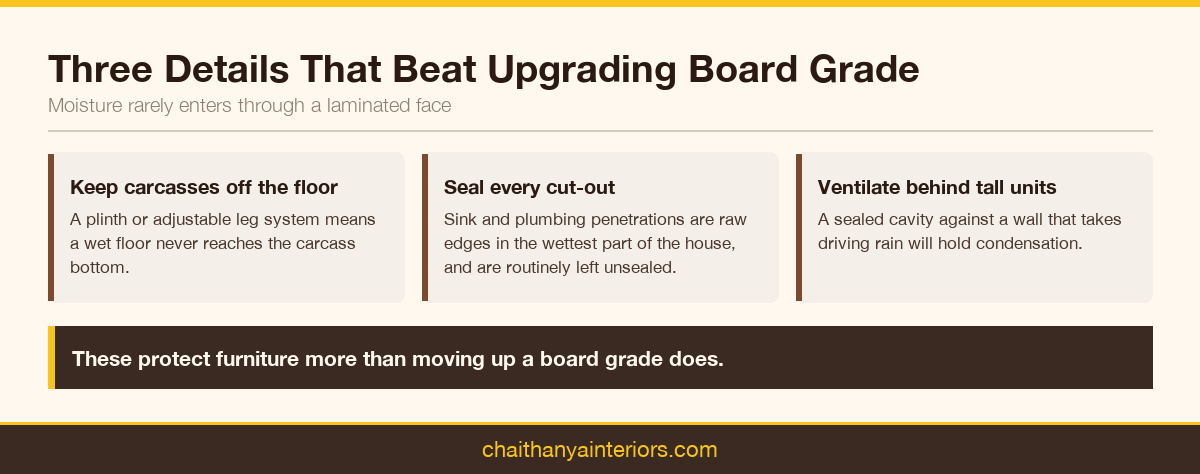
Three details protect furniture more than upgrading a board grade.
- Keep carcasses off the floor. A plinth or adjustable leg system means a wet floor never reaches the carcass bottom.
- Seal every cut-out. Sink and plumbing penetrations are raw edges in the wettest part of the house and are routinely left unsealed.
- Ventilate behind tall units on external walls. A sealed cavity against a wall that takes driving rain will hold condensation.
A schedule that cannot be substituted
For each element, name: board type and grade with standard, thickness, laminate manufacturer and code, laminate thickness and finish, backing laminate, edge band material, thickness and code, and hardware brand and series. Any blank is a decision you have delegated to whoever is loading the machine.
You can see the material and process side of this at our in-house production unit, review the full product range we manufacture, or send an enquiry with a schedule for review.
Reading a board's specification honestly
Board marketing is unusually loose. Terms like waterproof, water-resistant and moisture-resistant are used almost interchangeably in sales conversations and mean quite different things technically.
The distinction that matters is the adhesive. Boiling-waterproof grades use a phenolic resin that does not re-soften with prolonged moisture exposure. Moisture-resistant grades use adhesives that resist humidity but will eventually fail under sustained wetting. A board described as water-resistant without a stated grade is telling you nothing.
Ask for the grade and the standard, and ask to see it stamped on the board itself rather than stated on an invoice. Reputable manufacturers mark their product.
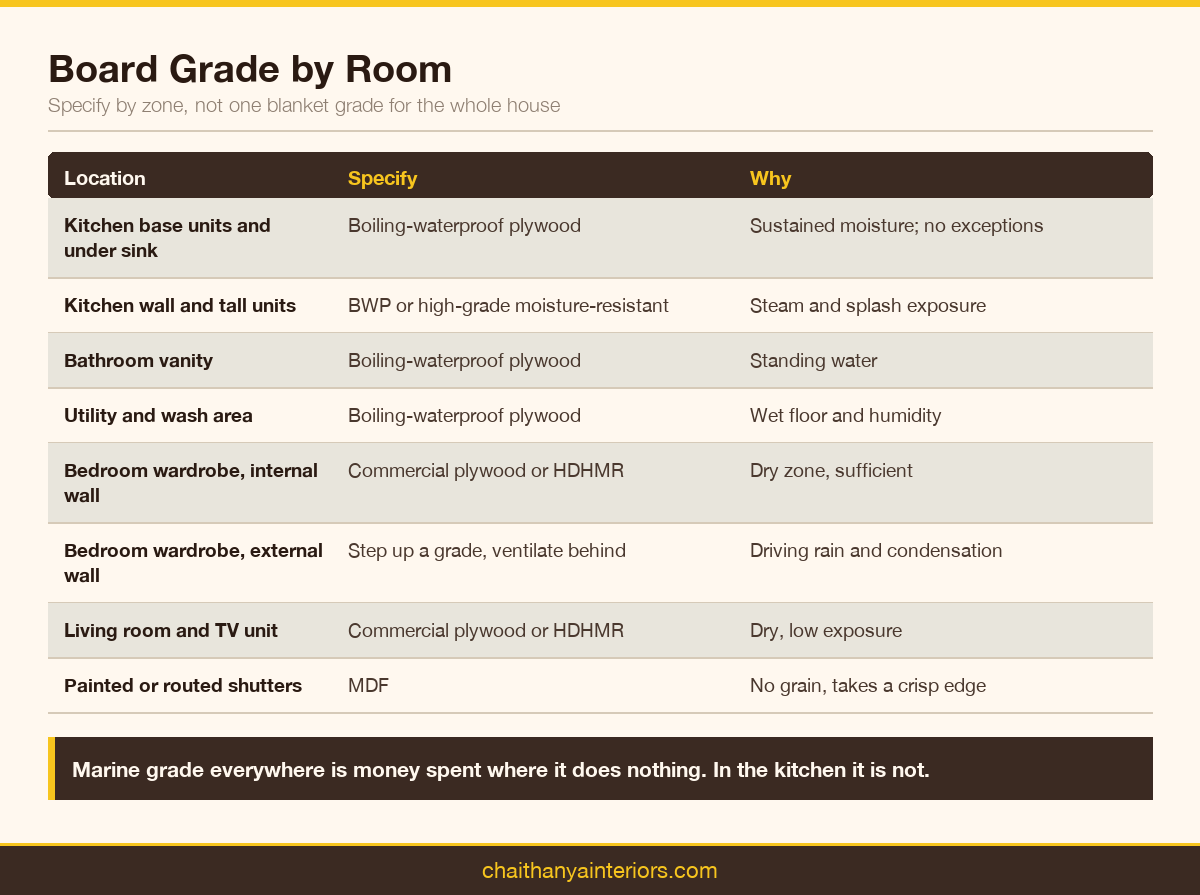
Where each board belongs, room by room
- Kitchen base units and anything under a sink: boiling-waterproof plywood, without exception
- Kitchen wall and tall units: boiling-waterproof or high-grade moisture-resistant depending on budget
- Bathroom vanities: boiling-waterproof plywood
- Utility and wash areas: boiling-waterproof plywood
- Bedroom wardrobes on internal walls: commercial plywood or HDHMR is generally sufficient
- Bedroom wardrobes against external walls: step up, and ventilate behind
- Living room and TV units: commercial plywood or HDHMR
- Painted shutters and routed profiles anywhere dry: MDF
- Lofts and overhead storage: commercial plywood, kept lighter where possible
Specifying by zone rather than by a single blanket grade is how you control cost without creating a failure point. A whole house in marine-grade is money spent where it does nothing; a kitchen in commercial ply is money saved that you will spend again.
Adhesives, sealing and the details that get skipped
Board grade is only half the moisture story. The other half is what happens at every opening in the board.
Every cut-out for a sink, a tap, a plumbing riser or a wire must be sealed after cutting. In practice this is the most commonly skipped step in the whole build, because it happens late, it is invisible once the unit is installed, and it takes a few minutes per opening that nobody has budgeted.
The back edge of a counter against a wall is the second common gap. Water runs there, sits, and enters the board from behind where nobody looks until the swelling shows at the front.
Finish choices that age well in Kerala
Beyond durability, some finishes simply suit the climate and the light better than others.
High gloss shows every fingerprint, and in a humid kitchen it shows condensation marks as well. Matt and suede finishes are far more forgiving and have the practical advantage of not needing constant wiping in a house where cooking produces steam and oil.
Very dark finishes show dust and water spotting more than mid tones. Very light finishes show turmeric and oil staining, which in a Kerala kitchen is a genuine consideration rather than a theoretical one. Mid-tone wood grains and warm neutrals are popular here for practical reasons, not only aesthetic ones.
A note on cost versus lifespan
The material conversation is usually had as a cost conversation, and it is worth reframing it once with the client.
The price difference between a properly specified kitchen and a cheaply specified one is real but bounded. The difference in service life is not bounded in the same way: a well-specified, machine-edge-banded kitchen in marine-grade board should serve well over a decade, while poorly sealed particle board in the same position can fail within three years.
Replacing a kitchen twice costs more than specifying it once. That argument lands with most clients when it is put in those terms and almost never lands when it is put as a recommendation to spend more.

 Speak with an Expert
 Bar Counter
  Bed Room Interior
  Book Shelfes
  Centre Table
  Crockery Shelf
  Dinig Table
  Dressing Units
  False Ceiling
  LCD Units
  Living - Dining Partition
  Living Room
  Edge Banding
  Hinge Holl Drilling
  Profile Handle Fixing