


Modular Furniture Lead Times in Kerala: What Designers Should Plan For
Lead time is the commitment a design firm is least able to control and most often judged on. A client forgives a small budget variation. They do not forgive a handover date that moves twice.
This is what actually consumes the time between an approved design and an installed unit, which parts of it can be compressed, and which cannot.
The stages, and what each one costs
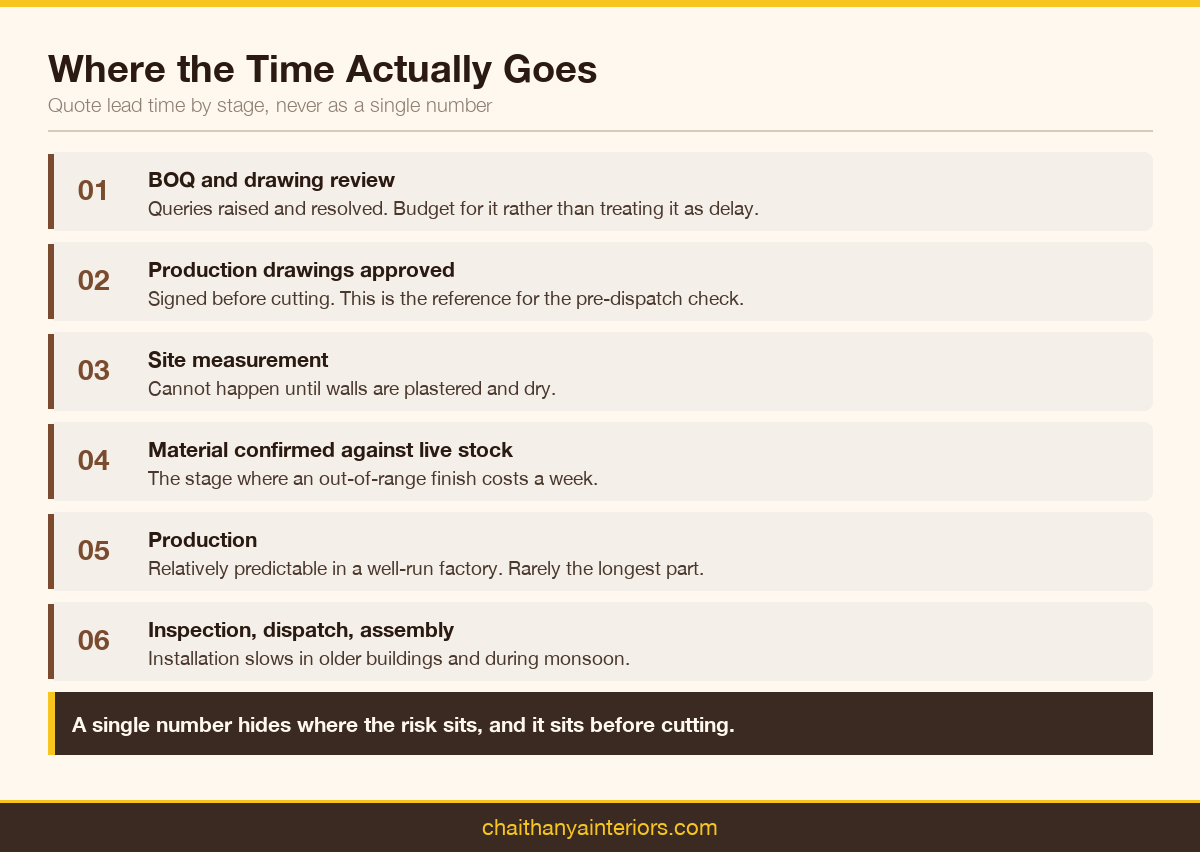
A modular order passes through a predictable sequence. The manufacturing itself is rarely the longest part.
- BOQ and drawing review, with queries resolved
- Production drawings prepared and approved
- Site measurement and reconciliation
- Material confirmation against live stock
- Cutting, edge banding, pressing, boring, grooving
- Pre-dispatch inspection
- Packing, transport and site assembly
Ask any supplier to quote lead time by stage rather than as a single number. A single number hides where the risk sits, and it is almost always in the stages before cutting.
What genuinely cannot be compressed
Some things take the time they take.
Adhesive cure after pressing. Pulling a panel out of the press early produces a bond that fails later, and the failure appears months after handover when it is expensive.
Material that is out of stock. If a specified laminate has to come from a distributor with no local stock, that is a supply chain problem, not a production one, and pressure on the factory will not fix it.
Site readiness. Modular units cannot be measured against a wall that has not been plastered or installed into a room without power.
What can be compressed, and how
Most recoverable time sits in decisions, not in machines.
Front-load the finish decision
The single largest avoidable delay is a client still choosing laminates after the BOQ is signed. Move that decision before sign-off, with physical samples, and a week or more comes back.
Run carcass and shutter production in parallel where possible
If carcass material is settled and only shutter finishes are outstanding, carcass production can sometimes start. Ask whether the supplier will split the order this way.
Specify hardware by series at the outset
Hardware allowed for as a lump sum becomes a decision later, and late hardware changes can force re-boring. Name the series in the schedule.
Batch your orders
Several small orders placed separately each carry their own setup. Consolidated into one release they move faster and usually cost less.
Seasonality in Kerala
Two patterns are worth building into a programme.
The pre-festival period compresses everything. Clients want handover before a festival date, so every manufacturer's order book is full at the same time and lead times stretch. Booking capacity early matters more than negotiating price in that window.
The monsoon affects transport and site work more than it affects factory production. Deliveries are harder to schedule reliably, and site assembly in an unfinished building is slower. Add contingency to installation rather than to manufacture.
Building a programme that holds
Three habits separate firms whose dates hold from those whose dates slip.
- Quote stage-by-stage lead times to the client, not one number, so a delay in client decision-making is visibly theirs
- Put the finish decision deadline in the contract, with a stated consequence for the programme
- Reserve factory capacity in writing for known peak periods rather than assuming availability
The first of those does more work than the other two combined. When a client can see that the drawing approval stage has been waiting on them for eleven days, the conversation about the handover date changes completely.
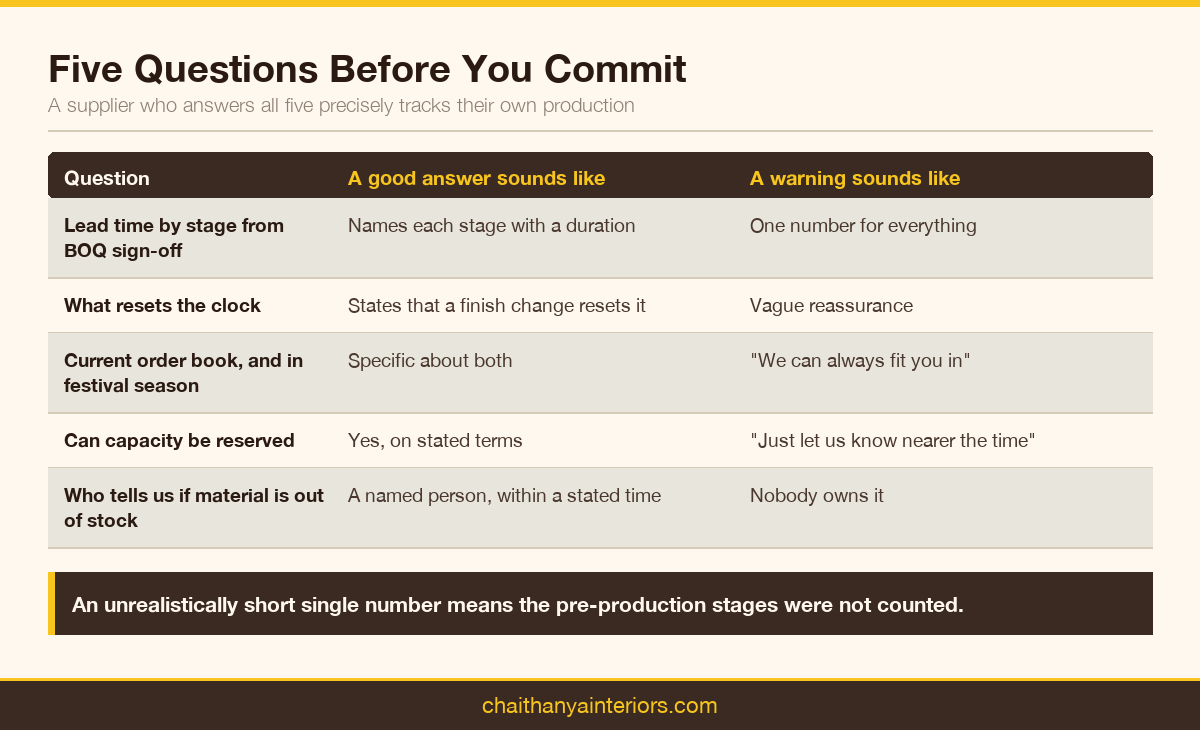
What to ask a supplier before you commit
- What is the lead time by stage, from BOQ sign-off
- What resets the clock, and is a finish change treated as a reset
- What is the current order book like, and what is it like in the festival season
- Can capacity be reserved in advance, and on what terms
- Who tells us if a specified material is out of stock, and how quickly
A supplier who answers all five precisely is a supplier who tracks their own production. One who answers in generalities is telling you something useful.
To discuss production scheduling on a specific project, start a conversation, or see our in-house production unit and completed project photographs first.
Why a single lead-time number is misleading
When a supplier quotes one figure, they are usually quoting production time and omitting everything around it. The client hears the single figure as the time until their kitchen exists, and the gap between those two readings is where trust is lost.
A stage-by-stage quote is more work to produce and much more useful. It also relocates responsibility accurately: when the drawing approval stage is shown separately, a client who took two weeks to choose a laminate can see that they took two weeks.
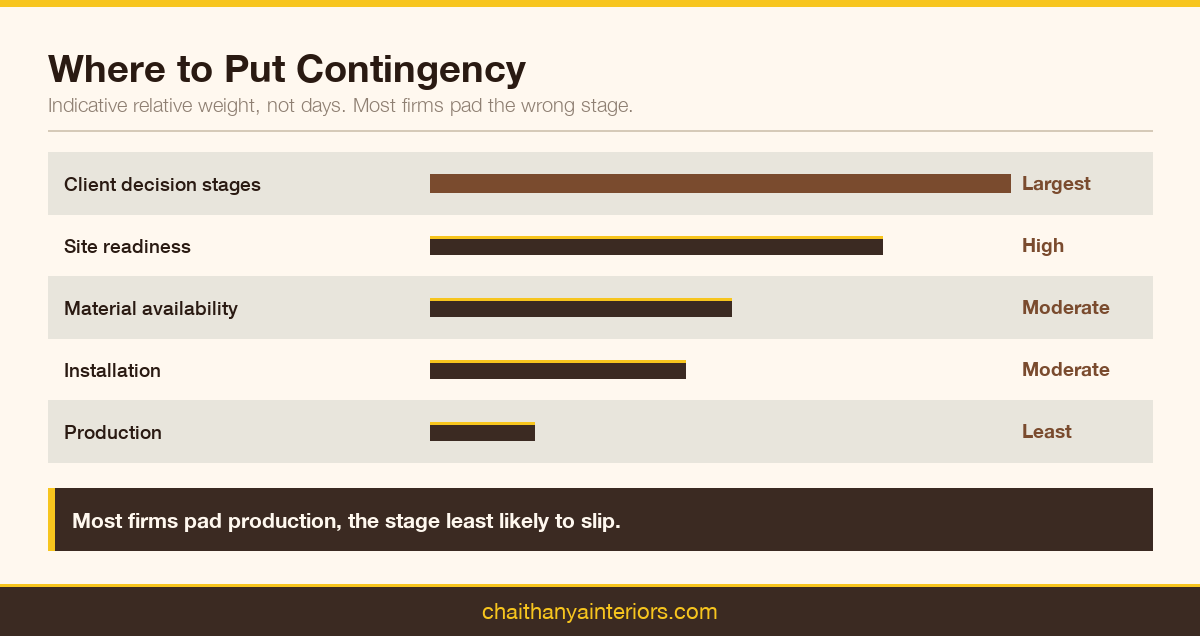
Building contingency in the right place
Contingency added as a flat percentage to the whole programme tends to get consumed early and provide no protection at the end. It works better placed against the specific stages that actually vary.
- Client decision stages: the largest and most variable, and worth the most contingency
- Material availability: moderate, and reducible by confirming stock early
- Site readiness: highly variable and largely outside your control
- Production: relatively predictable in a well-run factory, and needs least
- Installation: moderate, and rises in older buildings and during monsoon
Most firms do the opposite: they pad production, which is the stage least likely to slip, and leave client decisions unprotected.
Communicating a delay before it becomes a complaint
Delays happen. Whether they damage a relationship depends almost entirely on when the client hears about them.
A delay communicated when it is discovered, with a revised date and a reason, is usually accepted. The same delay communicated on the original handover date is a breach of trust, regardless of its cause. The information was available earlier and was withheld.
Put a simple reporting rhythm in place: a short weekly update during production, naming the current stage and the next milestone. It takes minutes and it prevents nearly every escalation.
Planning around Kerala's calendar
Beyond the general festival compression, a few practical patterns are worth knowing.
Handover dates cluster around auspicious dates, which means several clients want the same week. If a client has a fixed date in mind, book capacity against it early rather than assuming the schedule will accommodate it.
The monsoon affects transport reliability and site work more than factory output. Deliveries get rescheduled, site assembly slows, and finished units may need storage. Build that into the installation allowance rather than the production allowance.
Material supply also tightens ahead of festival periods, because everyone orders at once. Confirming board and laminate stock early in that window is worth more than negotiating on price.
What a realistic programme looks like
A well-run modular order is mostly waiting for decisions and mostly not waiting for machines. When you present a programme to a client, showing that split honestly does two things: it sets an accurate expectation, and it gives the client a reason to make their decisions promptly, because they can see their own name against the longest bar.
Tracking performance over time
Lead time promises are only as good as the record behind them. Studios that keep a simple log of quoted versus actual duration, by stage and by supplier, make much better scheduling decisions within a year.
The log does not need to be elaborate: order date, BOQ sign-off, drawing approval, production start, dispatch, installation complete. Six dates per project. After a dozen projects the pattern is clear, and you can quote clients from evidence rather than from a supplier's estimate.
It also makes supplier conversations factual. A supplier whose production stage is consistently accurate but whose dispatch slips has a logistics problem, not a capacity problem, and that is a solvable conversation.

 Speak with an Expert
 Bar Counter
  Bed Room Interior
  Book Shelfes
  Centre Table
  Crockery Shelf
  Dinig Table
  Dressing Units
  False Ceiling
  LCD Units
  Living - Dining Partition
  Living Room
  Edge Banding
  Hinge Holl Drilling
  Profile Handle Fixing