

Modular Interior Manufacturing in Kerala: A Factory Partner Guide for Design Firms
Most interior design firms in Kerala reach the same ceiling at the same point. The design work is good, the client list is growing, and then production becomes the constraint. Site carpentry is slow and inconsistent. Local fabricators take on more than they can finish. A handover slips by three weeks because one wardrobe came back with the wrong shutter thickness, and the studio absorbs the cost.
The answer most firms eventually reach is to stop making furniture themselves and start specifying it. That means finding a manufacturing partner. This guide is about how to choose one, what to ask, and what genuinely separates a factory from a large workshop calling itself one.
What modular interior manufacturing actually means
Modular manufacturing means furniture is produced as finished components in a controlled facility and assembled on site, rather than cut and built in the client's home. A wardrobe arrives as finished carcasses, shutters, and hardware. It is installed in hours, not days.
That distinction matters more than it sounds. Site carpentry is subject to weather, dust, available light, and whichever carpenter is free that week. Factory production is subject to a machine setting. The second is repeatable; the first is not. When a design firm delivers twenty apartments in one project, repeatability is the entire job.
India's furniture sector has been shifting this way for years, and the published figures on the Indian furniture sector show organised manufacturing taking share from unorganised site work steadily. Kerala has followed, though more slowly than metros, because the tradition of skilled site carpentry here is genuinely strong.
Factory or workshop? The questions that tell you apart
A great many suppliers describe themselves as a manufacturing unit. Some are. Others are a shed with a table saw and four carpenters. The difference shows up in a handful of specific questions.
Which machines are on the floor?
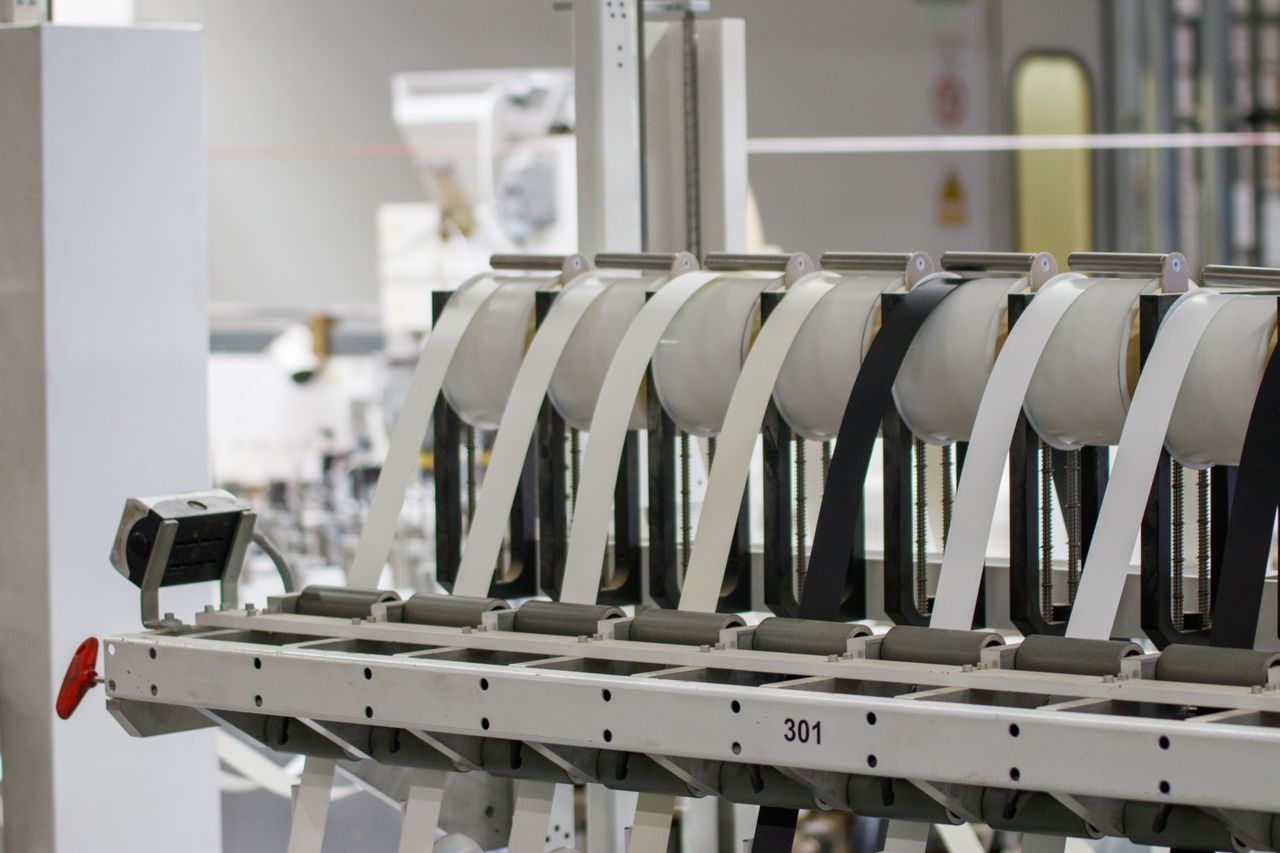
Ask for the machine list, not a description of capability. A genuine modular line has, at minimum, a panel saw or beam saw for accurate sizing, an edge banding machine, a hot press for surface bonding, a multi-boring machine for hinge and shelf-pin holes, and a router or grinder for grooving and profile handle work.
The multi-boring machine is the honest tell. It drills the full hole pattern in one pass, so every shelf pin and hinge cup lands in the same place on every panel. A workshop drills those by hand with a jig, which is fine for one wardrobe and a disaster across forty. Chaithanya Interiors runs German machinery for exactly this reason, and you can see how the units are actually built before you commit an order.
Is edge banding done by machine or by hand?
Every cut panel has four raw edges. Sealing them is what stops moisture entering the core, and in Kerala that is not a cosmetic question. A machine applies the edge band under heat and pressure, then trims and buffs it flush in one pass. Hand-applied banding with contact adhesive looks acceptable on day one and lifts within two monsoons.
If a supplier cannot show you a machine doing this, the furniture will not last in a Kerala home. It is the single most common failure point in budget modular work.
Can they work from your drawings?
A factory that only sells its own catalogue designs is a retailer. A manufacturing partner takes your drawings, your bill of quantities, and your material schedule and produces to them. Ask what file formats they accept, who checks the drawing for manufacturability, and what happens when a dimension on your drawing will not work in production.

The materials conversation
Board choice drives more of the outcome than any other decision, and Kerala's climate narrows the field considerably. Humidity here sits high for most of the year, and coastal districts add salt to the problem.
The main options, in rough order of moisture resistance:
- Marine-grade plywood, manufactured to the boiling-waterproof standard, for anything in a kitchen or bathroom or against an external wall
- Commercial plywood for general carcassing in dry areas
- HDHMR, which machines cleanly and holds fasteners well, for shutters and surfaces where a very flat face matters
- MDF, which is excellent for painted and routed profiles but must be kept away from standing water
- Particle board, which has a place in dry, low-load applications and no place in a Kerala kitchen
The relevant national specifications are published by the the national standards body, and any supplier should be able to tell you which standard their board is made to without looking it up. If you are specifying for a project with a green rating, the green building material guidance sets out the low-emission requirements that apply to boards and adhesives.
For clients who ask about responsible sourcing, certified timber sourcing is the recognised scheme, and it is worth knowing whether your supplier can provide it before the client asks rather than after.
How a manufacturing order actually runs
A well-run order moves through recognisable stages, and knowing them helps you set client expectations honestly.
- Drawing and BOQ received, then reviewed for manufacturability. Expect questions at this stage; silence here is a warning sign, not efficiency.
- Material schedule confirmed, including board type, laminate or finish codes, and hardware brand and series.
- Cutting list generated and optimised. Good factories nest panels to reduce waste, and that optimisation is part of what you are paying for.
- Production: cutting, edge banding, pressing, boring, grooving.
- Quality check against the drawing, before anything leaves the floor.
- Packing, dispatch, and site assembly.
The checkpoint that protects you is the one before dispatch. A factory that inspects against your drawing catches its own errors. A factory that inspects against its own cutting list catches only transcription errors, which is a much weaker test.

What to agree before the first order
Put these in writing, because every one of them becomes a dispute eventually if you do not.
- Who owns a dimensional error: the drawing or the production floor
- What the remake policy is, and who pays freight on a remake
- Whether hardware is supplied by you or by the factory, and which series
- How finish variation across batches is handled, particularly on wood-grain laminates
- Lead time from BOQ sign-off, and what resets the clock
- Site assembly: included, extra, or your responsibility
Why the factory relationship is worth building
A studio that has a dependable production partner can quote faster, commit to dates with more confidence, and take on projects that would otherwise be too large. It also changes what the studio is selling. You stop selling carpentry supervision and start selling design and delivery.
Chaithanya Interiors has manufactured residential interiors from its own unit in Kochi since 2002, and works with design firms, architects, contractors and builders across Kerala as well as directly with homeowners. You can see completed project photographs to judge finish quality, review the full product range we manufacture, or talk to the team about a specific project.
The commercial case, in plain numbers
The argument for a manufacturing partner is usually made on quality. The stronger argument is on utilisation, and it is worth setting out properly because it is the one that persuades a finance-minded partner.
A studio doing site carpentry carries a crew. That crew is paid whether or not there is work for them, and the work arrives in bursts. Three projects land in the same fortnight and the crew cannot absorb it, so the studio subcontracts at short notice and at a poor rate. Two months later the order book is thin and the same crew is underemployed.
Buying production converts that into a variable cost. You pay per order. In a thin month you pay nothing. In a heavy month you buy as much capacity as you need without recruiting, and the capacity is already trained.
The offset is that you give up the manufacturing margin. For a studio below steady volume that trade is almost always worth making, because the margin you give up is smaller than the cost of idle capacity plus the cost of rushed subcontracting.
How to run the first conversation with a factory
Walk in with three documents and the conversation goes somewhere useful: a drawing set from a recent project, your material schedule template, and a list of the questions below. Walk in with none and you will get a price per running foot and learn nothing.
- Which machines are on the floor, by name and function
- Is edge banding machine-applied on every edge, including internal ones
- Who prepares production drawings, and do we approve them before cutting
- What is inspected before dispatch, and against which document
- What is the lead time by stage, not as a single number
- What happens when a panel is wrong: who remakes, who pays freight, how long
- Can you hold board and laminate from one batch across a long project
- Do you work with other design firms, and how are enquiries through our drawings handled
The eighth question is the one most studios forget and most regret. Settle it in writing.
Common mistakes when firms first move to factory production
Treating the factory as a carpenter
Site carpenters absorb vague instructions and improvise. A factory produces exactly what the drawing says. That precision is the benefit you are buying, and it means the burden of being right moves upstream to your specification. Studios that keep issuing loose drawings get precisely built versions of their own ambiguity.
Changing specification after cutting starts
On site, a change mid-build costs a day. In a factory, once panels are cut to a finished size they cannot be uncut. Late changes mean remakes, and remakes mean both cost and schedule.
Skipping the site measurement
Modular furniture is built to a dimension. Kerala's concrete is rarely square to that tolerance. Skipping measurement to save a site visit reliably produces a gap at the wall that has to be covered with a filler nobody designed.
Underestimating access
A tall unit that will not fit through a stairwell or a lift is an expensive discovery on delivery day. Check access on anything built as a single large assembly, particularly in villas and older buildings.
What good looks like after a year
A settled factory relationship shows up in a few specific ways. Your quoting gets faster, because you know your rates. Your dates hold, because lead times are known rather than hoped for. Your senior people spend their time on design and client management rather than supervising carpentry.
And the studio's capacity stops being a function of how many carpenters you can keep busy. That is the change that lets a firm take on a twenty-unit project without a leap of faith.
The four kinds of manufacturing partner
"Manufacturer" covers several quite different commercial relationships, and confusion between them is a frequent source of mismatched expectations. It helps to know which one you are actually buying.
Job-work production
You supply the board and the hardware; the factory supplies machine time and labour. Common with firms that have established material supply and want only capacity.
It gives you complete control over material and removes any doubt about substitution. It also transfers material risk to you: if a board is defective, that is your problem, and any warranty on the finished unit will usually exclude material defects.
Full-service manufacturing
The factory supplies everything to your specification: board, hardware, finish, labour, machine time, and usually installation. This is the arrangement most design studios want, because it is a single point of responsibility.
The trade is that you are relying on the factory to buy the material you specified. This is precisely why the material schedule has to be complete and why a physical sample should be signed.
White-label supply
Full-service production delivered under your brand, with packaging, documentation and labelling carrying your identity rather than the manufacturer's.
OEM production
You define a product line, the factory tools up for it, and it is produced exclusively for you. This requires volume that few Kerala design studios reach, and it belongs to dealers and retail brands more than to project-based firms.

Assessing capacity honestly
Every factory says it can handle your project. Capacity is worth probing, because a supplier that over-commits damages your schedule, not theirs.
Useful questions: how many projects are running concurrently right now; what is the largest single project completed in the last year; how many shifts does the floor run and can it flex; what happens if two large orders land in the same week.
The most revealing question is what they turn down. A factory that has never declined an order is either very large or not being straight with you.
A short glossary for specifiers
Terms that appear routinely in production conversations and are rarely explained.
- Carcass — the box of a unit: sides, top, bottom, back. The structure, before shutters.
- Shutter — the door or drawer front. The visible face.
- Nesting — arranging panels across a board sheet to minimise offcut waste.
- Scribe — a thin filler strip cut to follow an uneven wall, closing the gap at a junction.
- Plinth — the recessed base a carcass sits on, keeping it clear of the floor.
- Balanced construction — laminating both faces of a panel so it does not cup.
- Boiling-waterproof — the adhesive grade that withstands sustained moisture.
- Multi-boring — drilling a full hole pattern in a single programmed pass.
- Edge band — the tape sealing a cut edge of a board.
- First fix and second fix — services installed before finishes, and fittings installed after.
Using these accurately in a first conversation with a factory changes how the conversation goes, because it signals that specification will be precise.
Where the Kerala market is heading
Two shifts are worth planning around.
The first is that homeowners increasingly arrive with material knowledge. Questions about board grade and hardware brand, which were rare a few years ago, are now common. Firms that can answer them precisely have an advantage over firms that deflect.
The second is that the organised share of furniture production continues to grow, as the published figures on the Indian furniture sector reflect. Site carpentry is not disappearing, but its share of new residential work is falling, and the firms best placed are those that have already built a reliable production route.
For a design studio the practical implication is straightforward. The production question will have to be answered eventually. Answering it deliberately, while the order book allows a pilot project and a settling-in period, is considerably easier than answering it under pressure when a large project has already been won.

 Speak with an Expert
 Bar Counter
  Bed Room Interior
  Book Shelfes
  Centre Table
  Crockery Shelf
  Dinig Table
  Dressing Units
  False Ceiling
  LCD Units
  Living - Dining Partition
  Living Room
  Edge Banding
  Hinge Holl Drilling
  Profile Handle Fixing