

How to Outsource Modular Production Without Losing Finish Quality
The fear that stops most design studios outsourcing production is simple and reasonable: if someone else builds it, the finish stops being yours. Every firm that has been burned once tends to retreat to site carpentry, where at least the mistakes are visible daily.
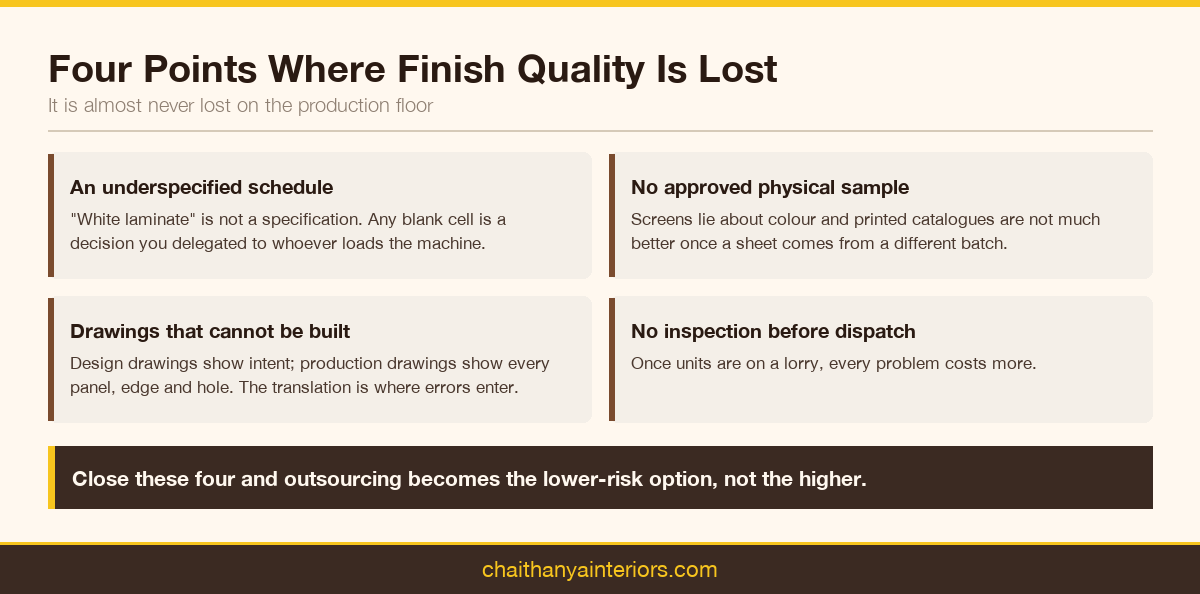
But finish quality is rarely lost on the production floor. It is lost in specification, at four predictable points. Close those and outsourcing becomes the lower-risk option, not the higher-risk one.
Failure point one: an underspecified material schedule
The most common cause of a disappointing result is a schedule that names a material without pinning it down. "White laminate" is not a specification. There are dozens of whites, in gloss, matt, suede and textured finishes, from several manufacturers, and they do not match each other.
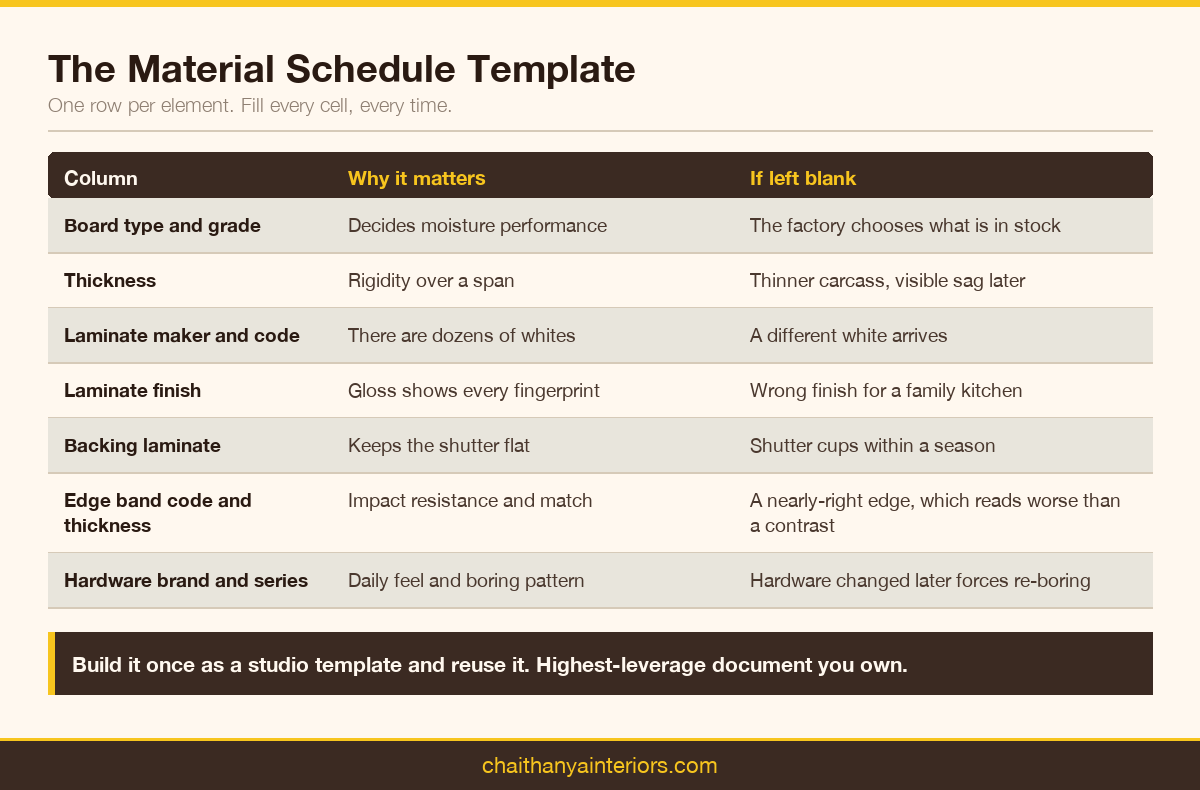
A complete schedule names, for every element: the board type and grade, the thickness, the laminate or finish manufacturer and code, the edge band code and thickness, and the hardware brand and series. If any of those is blank, someone on the production floor will make the choice for you, and they will choose whatever is in stock.
Build the schedule once as a studio template and reuse it. It is the highest-leverage document in the whole relationship.
Failure point two: no approved physical sample
Screens lie about colour, and printed laminate catalogues are not much better once a sheet has been produced in a different batch. Before a large order, get a physical sample of the exact board, laminate and edge band combination, and get the client to sign it.
Keep the signed sample in the studio until handover. It settles arguments that are otherwise unwinnable, and it costs almost nothing.
For wood-grain finishes this matters twice over, because grain direction and repeat vary between batches. If a project runs across several months, ask whether the factory can reserve stock from a single batch for the whole job.
Failure point three: drawings that are not manufacturable
Design drawings and production drawings are different documents. A design drawing shows intent; a production drawing shows every panel, its finished size, its edge treatment and its hole pattern.
The translation between them is where errors enter. A good factory will query a drawing that cannot be built, or that can be built but will not survive. If your supplier never asks questions, that is not a sign they understand you.
Agree explicitly who does this translation and who approves it. The most reliable arrangement is that the factory produces production drawings from your design drawings and you sign them before cutting starts. It adds a few days and removes most of the risk.
Failure point four: no inspection before dispatch
Once units are on a lorry, every problem is more expensive. Inspection has to happen while the work is still in the building.
Ask for photographs of completed units before dispatch on the first few orders. It feels fussy and it is worth it, because it establishes the standard early. On a mature relationship you can relax it.
The specification discipline that holds it together
Studios that outsource well tend to run the same short set of habits:
- One material schedule template, filled completely, every time
- A signed physical sample before any order above an agreed value
- Production drawings approved in writing before cutting
- Hardware specified by series, not by adjective
- A named person at the factory and a named person at the studio, so questions have somewhere to go
- Pre-dispatch photographs on new relationships
None of this is exotic. It is the difference between a studio that grows through production partners and one that stays capped at whatever its own carpenters can finish.
What you gain
The upside is not only capacity. It is predictability. A studio that can commit to a date and hit it wins repeat work from builders and developers, who care about schedule more than almost anything else.
It also changes the studio's cost base. Site carpentry consumes senior time in supervision. Factory production consumes it in specification, which is a far better use of a designer.
If you want to see how a production partner handles specification in practice, look at the factory floor in Kochi and the full product range manufactured there, or start a conversation about a live project.
Many Kerala design studios are themselves registered small enterprises, and the MSME registration and support framework carries procurement and credit provisions that are worth knowing when you are scaling up order volumes.
Building the specification template
The single highest-value thing a studio can do before outsourcing is to build one material schedule template and use it on every project. It takes an afternoon and it prevents most of what goes wrong.
The template should have a row per element and a column for each of: board type, board grade and standard, thickness, laminate manufacturer, laminate code, laminate finish, backing laminate, edge band material, edge band thickness, edge band code, hardware brand, hardware series, and any special note.
Fill every cell. Where a cell genuinely does not apply, write that it does not apply rather than leaving it blank, because a blank cell reads as an unmade decision and somebody will make it for you.
Handling the client's part in this
Clients change their minds about finishes, and they are entitled to. The problem is when they change after production has started, because by then the change is expensive in a way that is hard to explain to someone who has only ever seen site carpentry.
Two habits reduce this. First, get the finish decision made against physical samples before the order, not against renders. Renders are persuasive and inaccurate about colour. Second, put a decision deadline in the contract with a stated consequence for the programme, so the conversation about a delay is factual rather than adversarial.
It also helps to explain to the client, once, why a factory-made unit cannot be adjusted the way a carpenter's can. Most people accept it readily when they understand it. Very few accept it when they discover it during a dispute.
Quality conversations that actually work
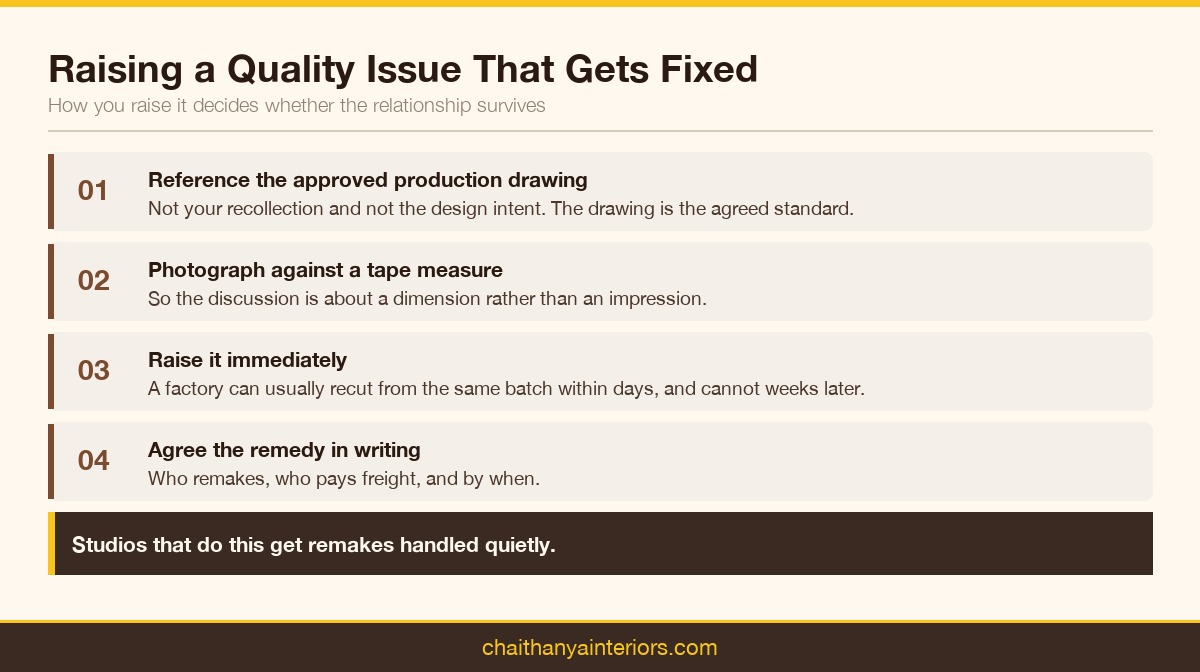
When something does come back wrong, how you raise it determines whether the relationship survives. Three things make these conversations productive.
- Reference the approved production drawing, not your recollection or the design intent
- Photograph the problem against a tape measure, so the discussion is about a dimension rather than an impression
- Raise it immediately, because a factory can usually recut a panel from the same batch within days and cannot do so weeks later
Studios that do this get remakes handled quietly. Studios that raise issues late, in general terms, and by escalation get defensiveness, and deservedly so.
Knowing when a partner is not working out
Not every relationship settles. The signals that it will not are fairly consistent: repeated dimensional errors after the specification has been tightened, no queries raised on drawings that clearly contain problems, dispatch without inspection, and lead times that are quoted confidently and missed routinely.
One bad order is information. Three bad orders after you have fixed your own specification is a pattern, and the cost of changing supplier is lower than the cost of continuing.
Setting expectations inside your own studio
Outsourcing changes what junior staff do, and it is worth being explicit about it rather than letting people work it out.
On site carpentry, a junior designer spends much of their week supervising. On factory production, that time moves to preparing schedules, checking production drawings and coordinating services. It is more valuable work and it requires different skills, particularly precision with documentation.
Firms that make this transition well train for it deliberately: one person owns the specification template, one owns the factory relationship, and drawings are checked by someone other than the person who drew them.

 Speak with an Expert
 Bar Counter
  Bed Room Interior
  Book Shelfes
  Centre Table
  Crockery Shelf
  Dinig Table
  Dressing Units
  False Ceiling
  LCD Units
  Living - Dining Partition
  Living Room
  Edge Banding
  Hinge Holl Drilling
  Profile Handle Fixing