

What Drives Interior Design Cost: A Factory-Side Breakdown
Most explanations of interior cost are written from the sales side, which means they explain what you are charged rather than what it costs to make. This one is written from the production side.
It is a more useful view, because once you know which inputs actually drive the number, you know which changes to your specification will move it and which will not.
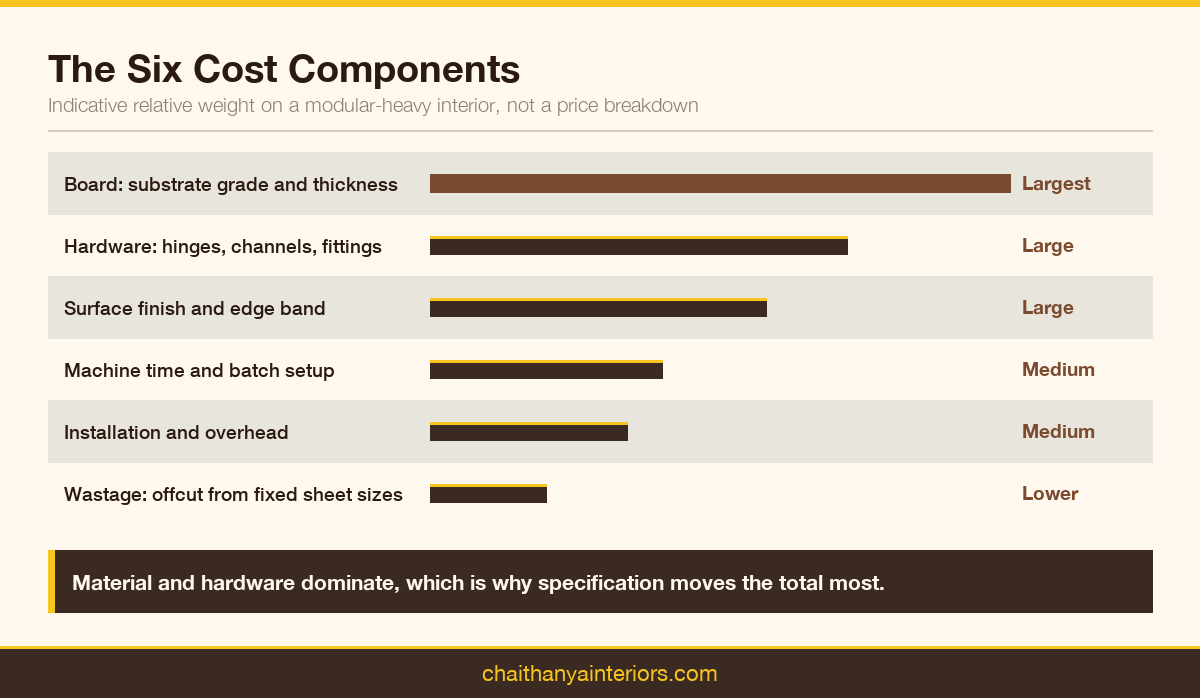
The six cost components
Every modular unit carries the same six, in roughly this order of weight.
1. Board
The substrate is usually the largest single material input. Grade drives it: marine-grade boiling-waterproof plywood sits well above commercial plywood, which sits above HDHMR and MDF, which sit above particle board.
Thickness matters too. An 18mm carcass costs more than a 16mm one and is meaningfully more rigid over a long span. Most reputable work uses 18mm for carcass sides and 18mm for shutters.
This is the input where specification changes move the total most, and it is also the least visible to the client, which is precisely why it is the most common place to economise quietly.
2. Hardware
Hinges, drawer channels, handles, lift-up fittings, wardrobe rails and locks. The spread here is enormous — a premium soft-close channel can cost several times a basic one — and it is the second largest driver in most units.
It is also the component that determines daily experience. A drawer that runs smoothly after five years is a hardware decision made at quoting stage. Specify the brand and series, not the adjective.
3. Surface finish
Laminate, acrylic, membrane or veneer, plus the edge band. Laminate is the workhorse; acrylic and veneer sit above it.
Balanced construction costs a backing laminate on every shutter, and it is the most commonly value-engineered item in a cheap quote. Removing it saves a small amount and causes shutters to cup.
4. Machine time
Cutting, edge banding, pressing, boring, grooving. Each panel occupies each machine for a period, and setup time is a fixed cost per batch rather than per unit.
This is why order size affects unit cost. A single wardrobe carries the whole setup burden; forty wardrobes spread it. It is also why a factory is cheaper than site carpentry at volume and not necessarily cheaper on one small job. You can see the machinery this refers to at the factory floor in Kochi.
5. Wastage
Boards come in fixed sheet sizes. Panels are nested across the sheet to minimise offcut, but some waste is unavoidable and it is a real cost carried in the rate.
Design choices affect it more than people expect. Dimensions that nest efficiently into a standard sheet produce less waste than dimensions that do not, and a designer who knows the sheet size can save material without changing the appearance.
6. Installation and overhead
Transport, site assembly, scribing to walls, and the firm's overhead and margin. Installation is more labour-intensive than clients assume, particularly in older buildings where nothing is square.
What this means for your specification
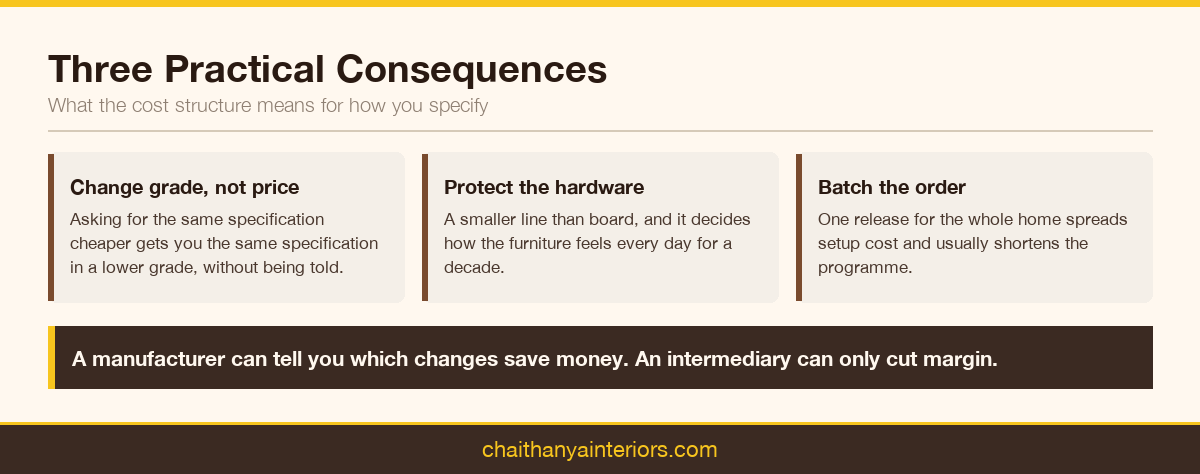
Three practical consequences follow.
First, changing material grade moves the total far more than negotiating a discount. If you need to reduce cost, reduce grade in dry zones or reduce extent — do not ask for the same specification cheaper, because what you will get is the same specification in a lower grade without being told.
Second, hardware is worth protecting. It is a smaller line than board and it determines how the furniture feels every day for a decade.
Third, batching saves real money. Doing the whole home in one release rather than four separate orders spreads setup cost and usually shortens the total programme.
Why a manufacturer can tell you this and a reseller often cannot
A firm that buys finished units from a supplier receives a single price. It can mark that price up, but it cannot break it down, because the breakdown belongs to the supplier.
A firm that manufactures knows what its own board, hardware, machine time and wastage cost, and can therefore tell a client honestly which changes will save money and which will only look like savings. That is the practical argument for choosing a manufacturer over an intermediary, beyond the quality control question.
Chaithanya Interiors has manufactured from its own unit in Kochi since 2002. You can review the full product range we produce, judge completed project photographs, or start a conversation about a specific home.
Why a lower quote is often the more expensive one
The relationship between quoted price and total cost of ownership is weaker than clients expect, because the components that fail early are the invisible ones.
A kitchen built on particle board with hand-applied edge banding and basic hardware can be quoted meaningfully below one built on boiling-waterproof plywood with machine banding and branded soft-close hardware. Both look similar on handover day. One of them is still working in ten years.
The honest way to present this to a client is not as an argument for spending more, but as a comparison over time. A cost that recurs is not a saving.
Where cost can be reduced without consequence
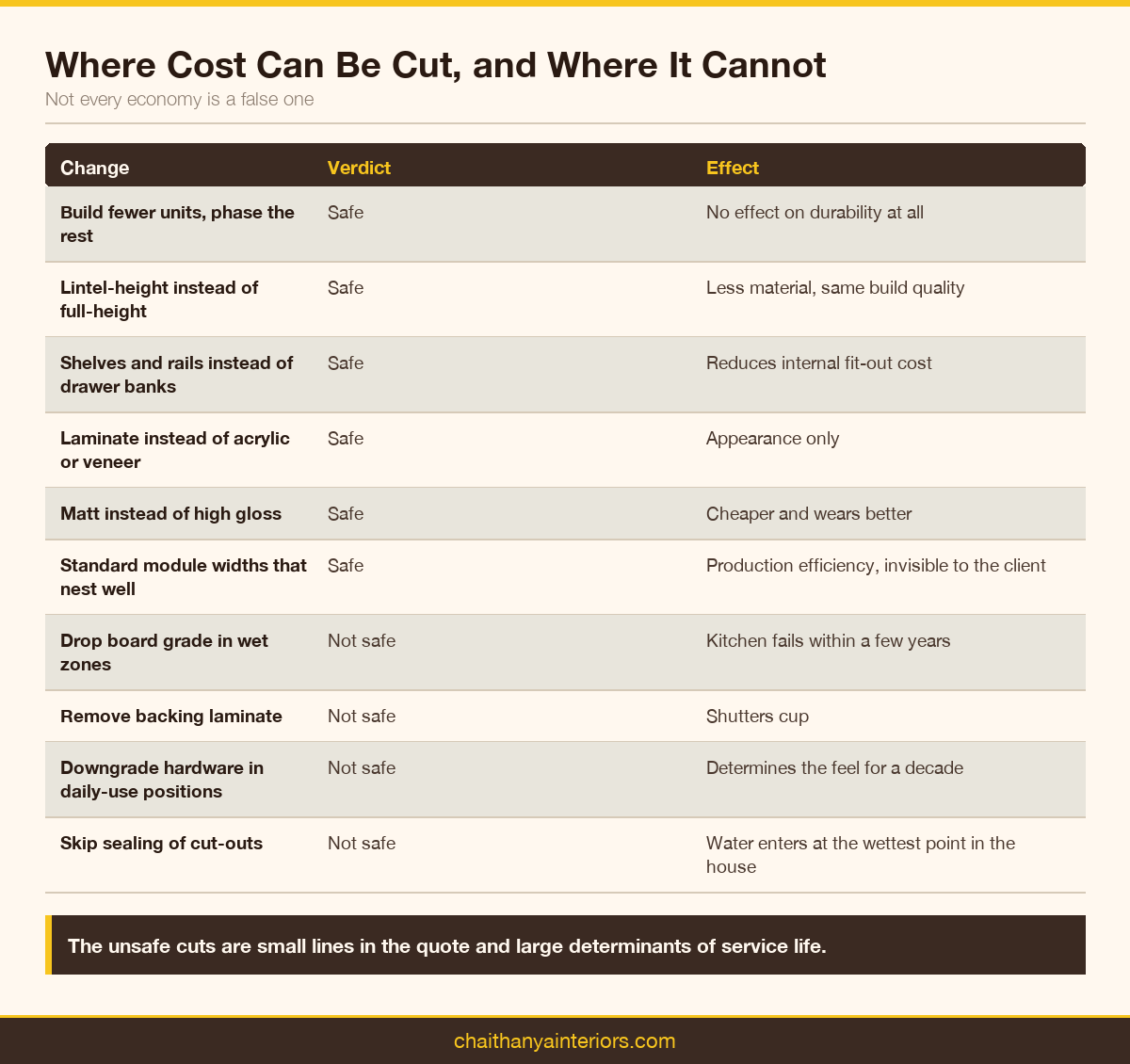
Not every economy is a false one. Several reduce cost with no effect on durability at all.
- Reducing extent: fewer units, phased over time
- Lintel-height wardrobes instead of full-height, where storage need allows
- Simpler internal fit-out: shelves and rails instead of drawer banks
- Laminate rather than acrylic or veneer
- Matt finishes, which cost less than high gloss and wear better
- Simpler ceiling profiles
- Standard module widths that nest efficiently into a board sheet
- Batching the whole home into one order rather than several
The last two are the ones clients never think of and that a manufacturer can advise on directly, because they are production efficiencies rather than specification compromises.
Where cost should not be reduced
- Board grade in kitchens, bathrooms and utility areas
- Machine edge banding on every edge
- Backing laminate on shutters
- Hardware in high-use positions: kitchen drawers and daily-use wardrobe doors
- Sealing of cut-outs and penetrations
- Plinths or legs that keep carcasses off the floor
Each of these is a small line in the quote and a large determinant of service life. Collectively they are usually a modest share of the total, and they are the first things a quote is thinned by when a client pushes purely on price.
How production efficiency reaches the client
Some of a manufacturer's cost advantages are structural and can be passed on; others cannot.
Nesting optimisation, batch setup and consistent machine time are real efficiencies that scale with order size, which is why a whole-home order is better value than four separate ones. Buying board and hardware in volume is another.
What does not scale is the fixed cost of doing the job properly: the sealing, the inspection, the balanced construction. Those are the same per unit at any volume, and a quote that is cheap because those were skipped is not benefiting from efficiency at all.
The practical takeaway
When you compare quotes, compare specifications first and totals second. When you need to reduce a total, reduce extent or step down finish, and protect the structural specification. And when a price looks surprisingly low for the same scope, assume something in the invisible half has changed, and ask what.
A firm that manufactures its own units can answer that question precisely. You can see our in-house production unit, review the full product range, or send an enquiry for a specification-level quote.
Explaining cost to a client without sounding defensive
Designers often find the cost conversation uncomfortable and respond either by discounting or by over-explaining. Neither works well.
What does work is showing the structure. When a client can see that board, hardware and finish account for most of the number, and that machine time and installation account for the rest, the price stops feeling arbitrary. Most clients are not trying to pay less; they are trying to understand what they are paying for, and they push on price because it is the only lever they have been offered.
Offer a different lever. Show them extent, tier and phasing, and let them choose. Clients given real choices generally choose sensibly, and they choose in ways that protect the build rather than degrade it.

 Speak with an Expert
 Bar Counter
  Bed Room Interior
  Book Shelfes
  Centre Table
  Crockery Shelf
  Dinig Table
  Dressing Units
  False Ceiling
  LCD Units
  Living - Dining Partition
  Living Room
  Edge Banding
  Hinge Holl Drilling
  Profile Handle Fixing