

White-Label Modular Furniture: How Interior Firms Scale Without Building a Factory
At some point a growing interior firm faces a capital decision: build a production unit, or find someone else's. Building one is a serious commitment — machinery, a shed, skilled operators, working capital tied up in board stock, and a fixed cost that does not care whether this month's order book is full.
White-label manufacturing is the alternative. Someone else's factory produces to your specification, under your brand, and you carry none of the fixed cost.
What white-label actually covers
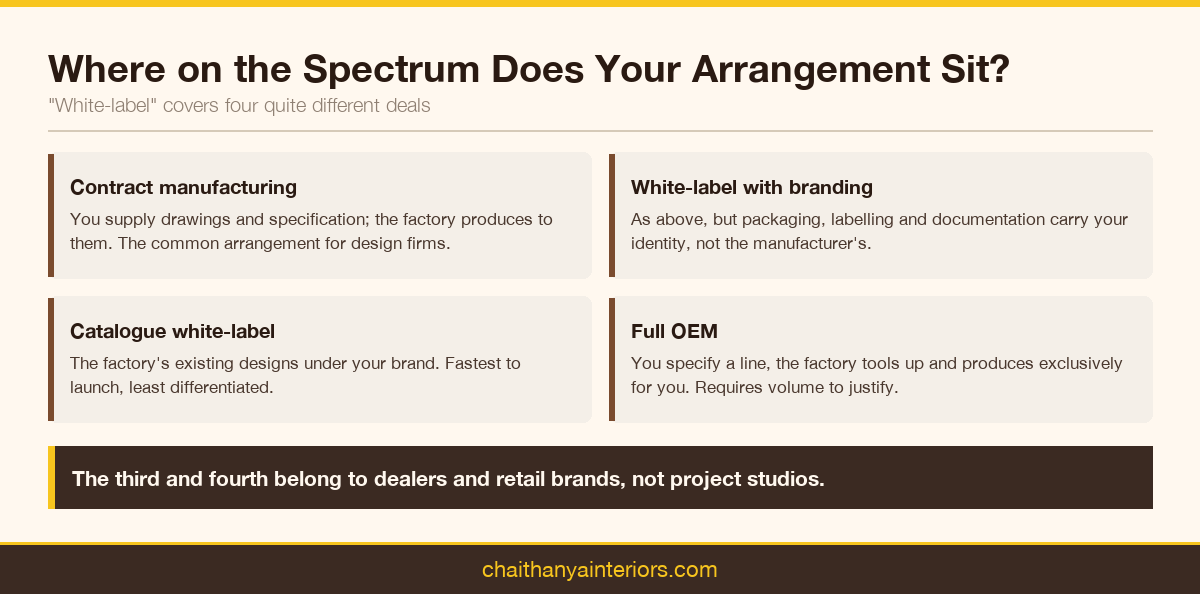
In practice the term covers a spectrum, and it is worth being precise about where on it an arrangement sits.
- Contract manufacturing: you supply drawings and specification, the factory produces to them. The most common arrangement for design firms.
- White-label with branding: as above, but packaging, labelling and documentation carry your identity rather than the manufacturer's.
- Catalogue white-label: the factory's existing designs produced under your brand. Fastest to launch, least differentiated.
- Full OEM: you specify a product line, the factory tools up for it and produces it exclusively for you. Requires volume to justify.
Most Kerala design studios need the first or second. The third and fourth belong to dealers and retail brands.
The economics against building your own unit
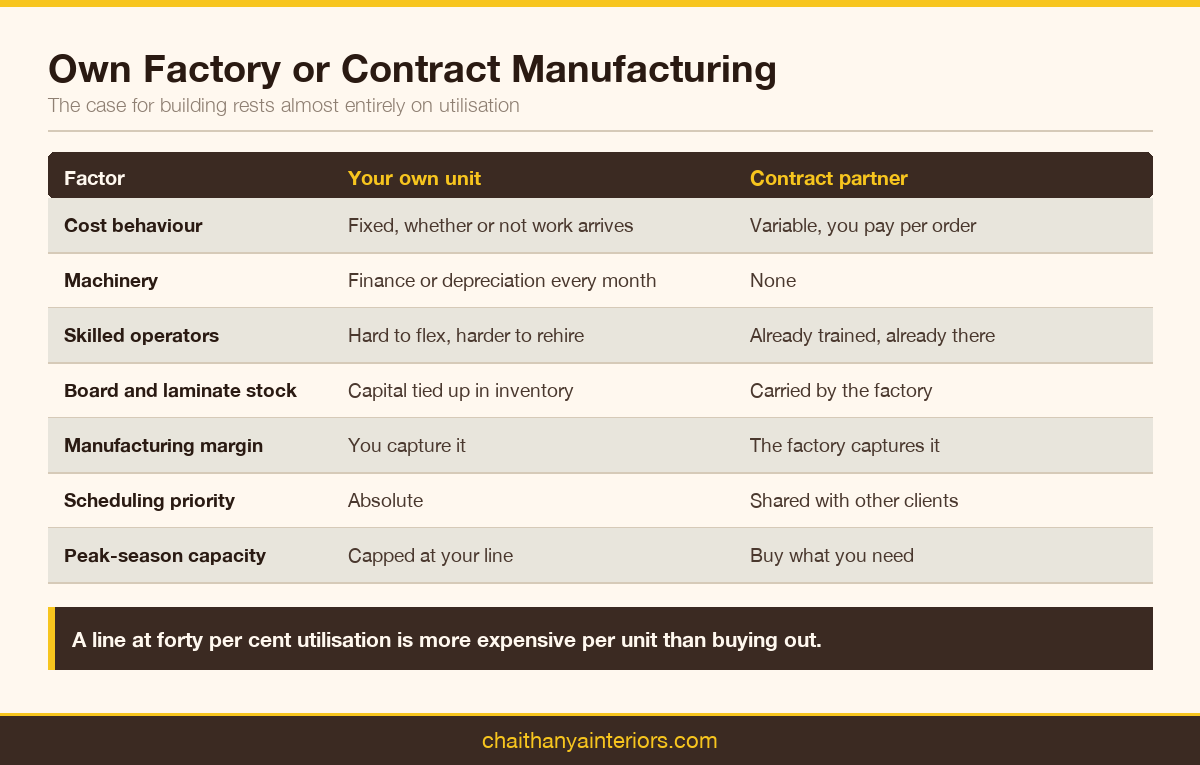
The case for your own factory rests almost entirely on utilisation. A production line that runs at capacity is cheaper per unit than buying out. One that runs at forty per cent is considerably more expensive, and most studio-owned units run well below capacity because order flow is lumpy.
The fixed costs that do not go away in a slow month:
- Machinery finance or depreciation
- Shed rent or the opportunity cost of owned premises
- Skilled operator salaries, which are hard to flex and harder to rehire
- Board and laminate stock sitting in inventory
- Maintenance, power, and consumables
Against that, a contract arrangement converts the whole lot into a variable cost per order. You pay when you have work.
The honest counter-argument is control and margin. Your own unit captures the manufacturing margin and answers to you alone. That is real, and it is why firms above a certain steady volume do eventually build. The question is whether you are at that volume yet, and most firms reach it later than they think.
What you give up
Three things, and they should be weighed properly.
Scheduling priority. You are one client among several. A factory with its own retail order book may prioritise it in a busy season, which is worth asking about directly.
Absolute finish control. You specify, and the factory executes. A specification discipline closes most of that gap but not all of it.
Margin. The manufacturing margin sits with the factory. You are buying capacity and predictability with it.
What to put in the agreement
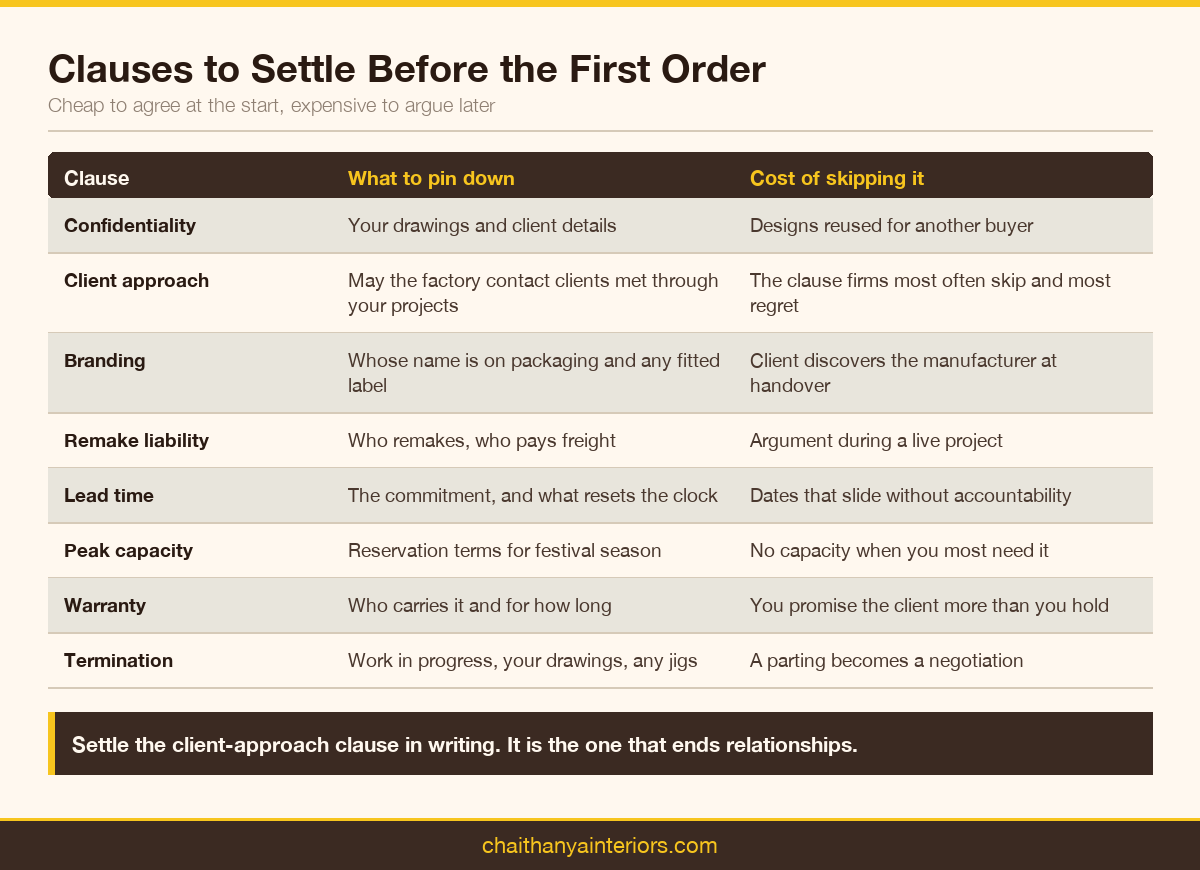
A contract manufacturing relationship runs on a handful of clauses that are cheap to agree at the start and expensive to argue later.
- Confidentiality over your drawings and client details
- Whether the factory may approach clients introduced through your projects
- Branding: whose name appears on packaging, documentation and any fitted label
- Remake liability and who pays freight
- Lead time commitment and what resets it
- Priority or capacity reservation in peak season
- Payment terms tied to production milestones rather than calendar dates
The client-approach clause is the one firms most often skip and most often regret. Settle it in writing.
How to start without betting the firm on it
Run a pilot. Take one project, ideally a straightforward one with a tolerant client, and put it entirely through the partner. That surfaces the gaps in your specification template, tests the factory's query discipline, and gives you a real lead time rather than a quoted one.
Then run a second. If the second goes better than the first, the relationship is working; if it goes the same, your specification is the constraint, not the factory.
Chaithanya Interiors manufactures for design firms, architects and builders from its own unit in Kochi alongside its direct residential work. You can see how the units are actually built, review the full product range, look through completed project photographs, or talk to the team about a pilot project.
Pricing your work when the manufacturing is bought in
Studios moving to bought-in production often mishandle pricing at first, usually by treating the factory invoice as their cost and adding a thin margin. That undercounts what the studio actually does.
The studio still carries design time, specification, client management, site measurement, coordination with other trades, installation supervision, snagging and warranty handling. None of that is in the factory invoice, and all of it is real cost.
Price the delivered result to the client and treat manufacturing as a direct project cost, exactly as you would treat any subcontract. That keeps the studio's own value visible in the quote rather than buried.
Managing risk across two or three partners
Firms that grow past a certain volume usually end up with more than one manufacturing partner, for capacity and for resilience. That brings its own discipline.
- Split by project, never within one, because finish matching across suppliers is unreliable
- Keep one specification template across all partners so quality is comparable
- Track lead time performance per partner, so the allocation decision is evidence-based
- Do not let a second partner become a lever in price conversations with the first; it damages the relationship that is working
What to watch for in the agreement
Beyond the clauses already listed, two provisions are worth particular attention in a white-label arrangement.
Warranty. Establish who carries it, for how long, and what it covers. A client who has bought from your studio will come to your studio, and you need to know what you can promise. Get the factory's warranty terms in writing and make sure yours to the client are not wider than theirs to you.
Termination and transition. If the relationship ends, what happens to work in progress, to your drawings held by the factory, and to any tooling or jigs made for your designs? A short clause settles it. Its absence turns a straightforward parting into a negotiation at the worst possible moment.
A realistic view of the trade-off
Contract manufacturing is not a way to get the benefits of a factory for free. You are exchanging margin and absolute control for flexibility and a much lower fixed cost base.
For most Kerala design studios, and for essentially all of them below steady high volume, that exchange is straightforwardly favourable. The firms it does not suit are the ones with predictable, high, year-round throughput and the capital to build properly. Those firms exist, and they should build. The mistake is assuming you are one of them before the order book says so.
Protecting the client relationship
A studio that outsources still owns the client relationship, and that means owning the problems too. When a unit arrives wrong, the client does not want to hear about the factory.
Practically, that means holding enough margin and enough schedule contingency to absorb a remake without it becoming the client's problem, and never introducing the manufacturer into a dispute as an explanation. The studio specified it, the studio approved the production drawing, and the studio carries it.
Firms that handle this well find the factory relationship strengthens, because the factory is not being asked to face a client it never sold to.

 Speak with an Expert
 Bar Counter
  Bed Room Interior
  Book Shelfes
  Centre Table
  Crockery Shelf
  Dinig Table
  Dressing Units
  False Ceiling
  LCD Units
  Living - Dining Partition
  Living Room
  Edge Banding
  Hinge Holl Drilling
  Profile Handle Fixing