

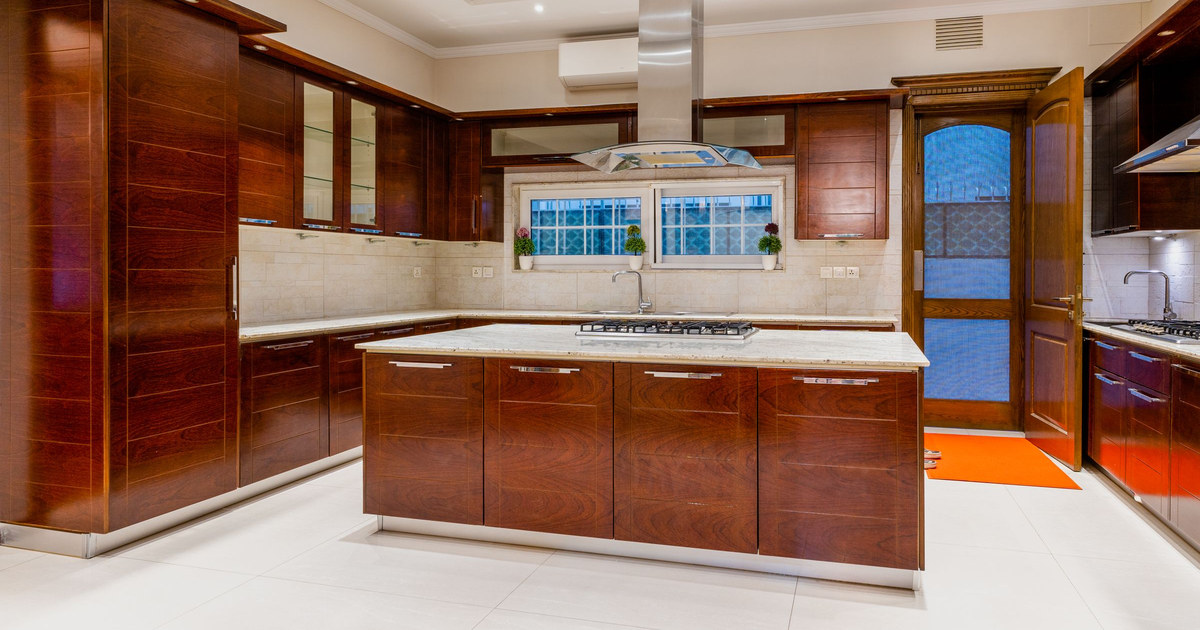
2027 Kerala Home Interiors: Why Modular, Sustainable Design Is Overtaking Custom Carpentry
Kerala homes are changing how they are built inside, and the shift is easy to see on any Kochi site this year. The UNEP Global Status Report for Buildings and Construction 2025 to 2026 finds that the building sector accounts for around 37 per cent of global CO2 emissions, and homeowners are starting to ask what their own renovation adds to that figure. Among the interior designers Kochi families consult, the question has moved from how a room will look to how it is made. If you are weighing modular against site carpentry for your home, talk to the Chaithanya Interiors team before the first drawing is fixed. This article explains why factory made, lower waste interiors are gaining ground heading into 2027, where traditional carpentry still fits, and how to plan a festive season refresh without surprises.
Key Takeaways
- Modular interiors are overtaking site carpentry in Kerala because factory panels are cut, sealed and drilled to an approved drawing, which suits monsoon humidity and fixed handover dates.
- Sustainability now shapes the brief. Less offcut, fewer site days and longer lasting units matter as much as finish, and the interior designers Kochi homeowners shortlist should be able to explain all three.
- Planning early helps anyone searching for a Diwali home renovation offer Kochi 2027 or a modular kitchen interior designer near me Kochi compare scope and specification, not just the headline price.
Why Kerala Homes Are Moving from Site Carpentry to Modular
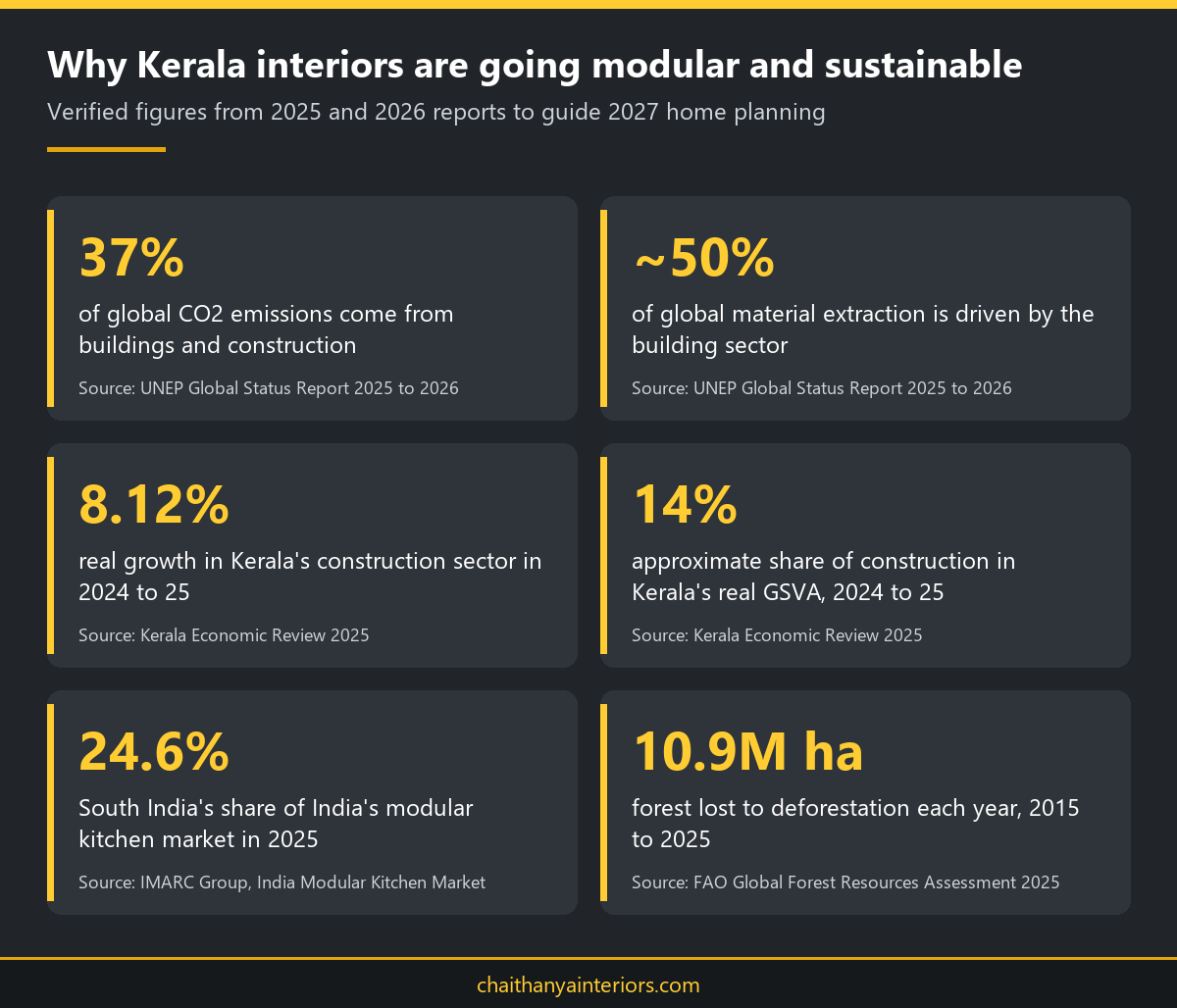
Kerala is building steadily, and the way interiors are made is changing with it. According to the Kerala Economic Review 2025 from the State Planning Board, construction grew 8.12 per cent in real terms in 2024 to 25 and made up about 14 per cent of the state's gross value added. More homes and flats mean more kitchens and wardrobes to fit, often against a fixed handover date.
The national picture points the same way. IMARC Group's India modular kitchen market analysis valued the market at USD 3.62 billion in 2025 and gives South India a 24.6 per cent share, supported by apartment ownership and steady interest in modern home interiors. Research firms disagree on how fast the market will grow, so treat any single projection with care, but the direction is consistent.
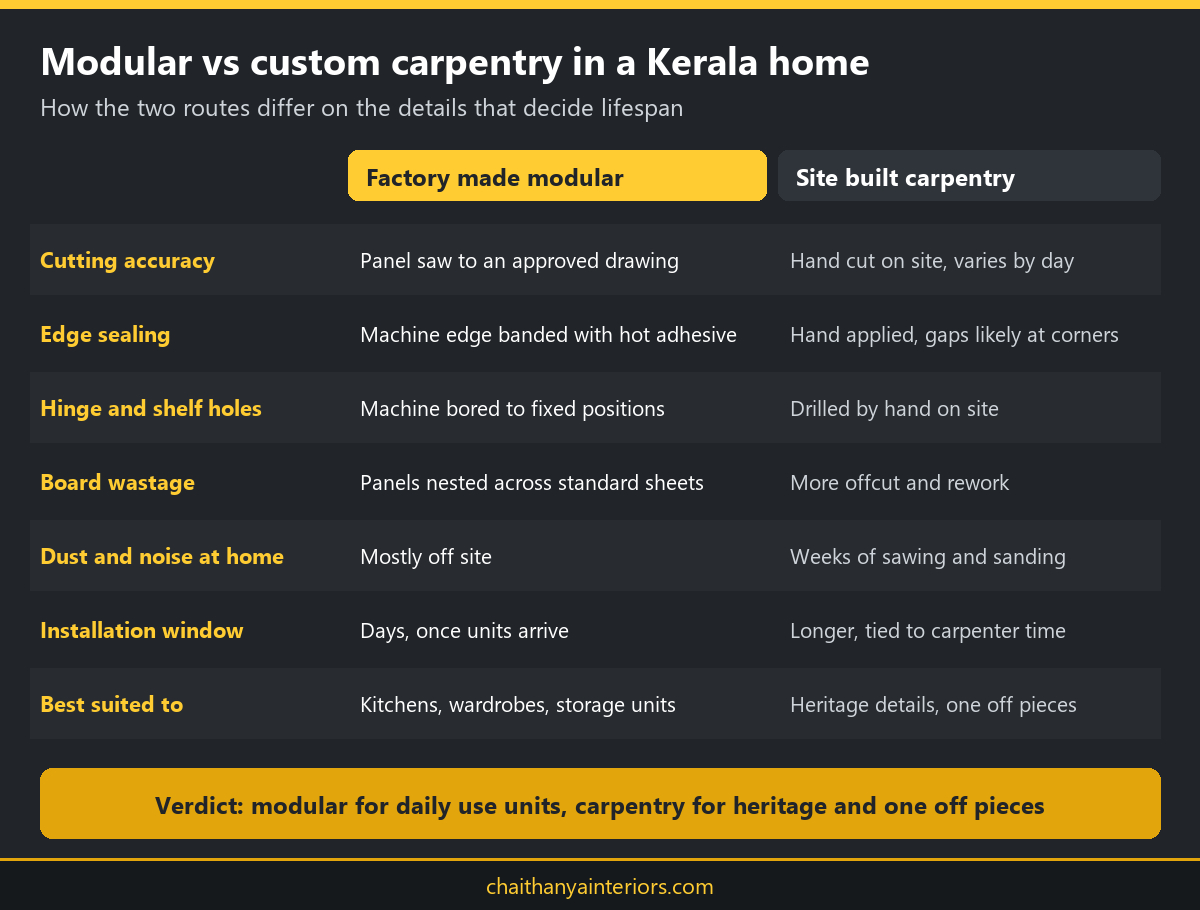
On the ground, the reason for the switch is simple. Site carpentry depends on one carpenter's skill on one day, in a house full of dust and noise. Modular units are cut, edge banded and drilled in a factory to an approved drawing, then installed in days rather than weeks. For busy families, and for the interior designers Kochi clients rely on to meet a handover date, that predictability is the real attraction. Apartment living adds another push, because standard module widths suit the repeatable room sizes of Kochi towers, and flat packed units travel up a service lift with little mess.
Sustainable Design Is Now Part of the Brief
Sustainability used to be a word on a brochure. Heading into 2027, it is becoming a practical line in the interior brief. The same UNEP report notes that buildings and construction drive nearly 50 per cent of global material extraction, which puts the spotlight on how much board, glue and timber each project consumes. There is progress to build on. UNEP also reports that green building certifications have nearly tripled over the last decade, a sign that owners increasingly expect proof of lower impact. For a single home, that proof is less about labels and more about knowing what your board is and how long it will last.
Wood supply is part of that story. The FAO Global Forest Resources Assessment 2025 estimates deforestation at 10.9 million hectares a year between 2015 and 2025. That rate is slower than in earlier decades but still high, and it is a good reason to use engineered boards efficiently rather than lose solid timber to offcuts and rework.
Modular production helps in three concrete ways. Panels are nested across standard sheets, so less board ends up as waste. Edges are sealed by machine, so units resist moisture and last longer before they need replacing. Most cutting also happens away from your home, which means less dust and a shorter installation. At Chaithanya Interiors, panels pass through edge banding, hot pressing and multi boring at our own manufacturing unit in Kochi, and our guide to board and laminate for Kerala humidity explains which materials belong in which zone.
A sustainable interior is, in the end, one you do not have to rebuild in five years. Durability is the greenest specification you can ask for, and it is where interior designers Kochi homeowners hire should spend the most time.
Where Custom Carpentry Still Makes Sense
Modular is not the answer for every piece of furniture, and an honest designer will say so. Custom carpentry still earns its place in a few situations.
- Heritage and traditional homes, where carved wood or solid timber details need repair or careful matching.
- Irregular spaces in older independent houses, where walls are far from square and a unit must be scribed by hand.
- One off statement pieces, such as a solid wood dining table or a hand finished pooja unit.
- Small repairs and additions to furniture that is already in place.
For the kitchen, wardrobes, TV units and storage that take daily use and monsoon humidity, the balance now favours factory production. Many Kerala homes end up with a hybrid: modular carcasses and shutters for the hard working units, plus a few crafted pieces for character. You can see how that mix looks in finished homes in our project gallery, and the walk through of edge banding and hot pressing shows why machine sealing matters so much in a wet climate.
Planning a Festive Season Refresh in Kochi
October and November are when many Kochi families plan home upgrades, often timed around Diwali and the year end holidays. If you are looking for a Diwali home renovation offer Kochi 2027, the smartest move is to fix your scope early, because production slots fill quickly before the festive season.
Start with the kitchen. It carries the most cabinetry, hardware and moisture exposure, so it is where specification matters most. A search for a modular kitchen interior designer near me Kochi will return plenty of names, so shortlist the ones who can show you their production process, not just renders. Our kitchen design service page sets out the usual flow: one to two weeks of design consultation, two to three weeks of manufacturing, and a few days to a week for assembly.
Before you sign with any of the interior designers Kochi has to offer, ask for these in writing.
- Board type and grade for each zone of the home.
- Hardware brand and series, not just the words soft close.
- Where the units will be made, and whether you can visit.
- A stage by stage timeline with a handover date.
- A clear list of exclusions, such as civil, electrical and painting work.
It also helps to phase the work sensibly. Do the kitchen and wet areas properly in the first phase, then wardrobes, then living and dining units. That order follows daily use and moisture exposure, and it keeps money where it does the most work early. If the budget is tight, reduce the number of units before you reduce the board grade.
Any seasonal offer is only worth having if the specification underneath it stays the same. A lower price on a lower board grade is not a saving.
Conclusion
Modular, sustainable design is overtaking custom carpentry in Kerala because it answers the questions homeowners now ask. Will it survive the monsoon? How much will it waste? Will it be ready on time? Custom craft still has a role, but for kitchens and wardrobes the factory route is the stronger default for 2027. Choose interior designers Kochi homeowners can hold to a written specification and a visible production process. Chaithanya Interiors was established in 2002, has completed interiors for more than 1000 homes and builds its modular units in house. Book a consultation with our design team to plan your home before the festive rush.

 Speak with an Expert
 Bar Counter
  Bed Room Interior
  Book Shelfes
  Centre Table
  Crockery Shelf
  Dinig Table
  Dressing Units
  False Ceiling
  LCD Units
  Living - Dining Partition
  Living Room
  Edge Banding
  Hinge Holl Drilling
  Profile Handle Fixing