


Budget vs Premium Interior Materials: An Interior Materials Cost Comparison by Cost Per Year
Every interior quote in Kerala eventually arrives at the same fork. One version of the kitchen and wardrobes uses the budget board, the standard laminate and the basic hinges. The other uses better board, a premium finish and soft-close hardware, and costs noticeably more. Most homeowners compare the two totals, wince at the gap and choose on the day. A proper interior materials cost comparison asks a different question: what does each option cost for every year you actually use it?
This guide explains that method and applies it, component by component, to the materials that make up a typical Kerala home interior. It does not quote rates, because rates move and vary by supplier. It gives you a way to compare any two quotes so the cheaper option on paper and the cheaper option over the life of the home are no longer confused.
Why the purchase price is the wrong number to compare
The price on a quote is a one-time number. The cost of a material is spread across every year it stays in service, plus whatever you spend keeping it working and, eventually, replacing it. Two wardrobes with very different prices can cost almost the same per year if the more expensive one lasts much longer. Two kitchens with similar prices can differ widely if one needs repairs within a few monsoons.
Kerala's climate makes this gap wider than in drier states. Long humid seasons, wet kitchen floors and external walls that take driving rain all shorten the working life of weaker board, poorly sealed edges and light-duty hardware. A material that would be perfectly adequate in a dry city can become the expensive choice here, because it is replaced sooner and takes surrounding parts with it when it fails.
There is also disruption, which never appears on a quote. Replacing a swollen sink cabinet means emptying the kitchen, disconnecting plumbing and living around the work. If you value your time and your kitchen, a failure costs more than the part.
How to run an interior materials cost comparison by cost per year
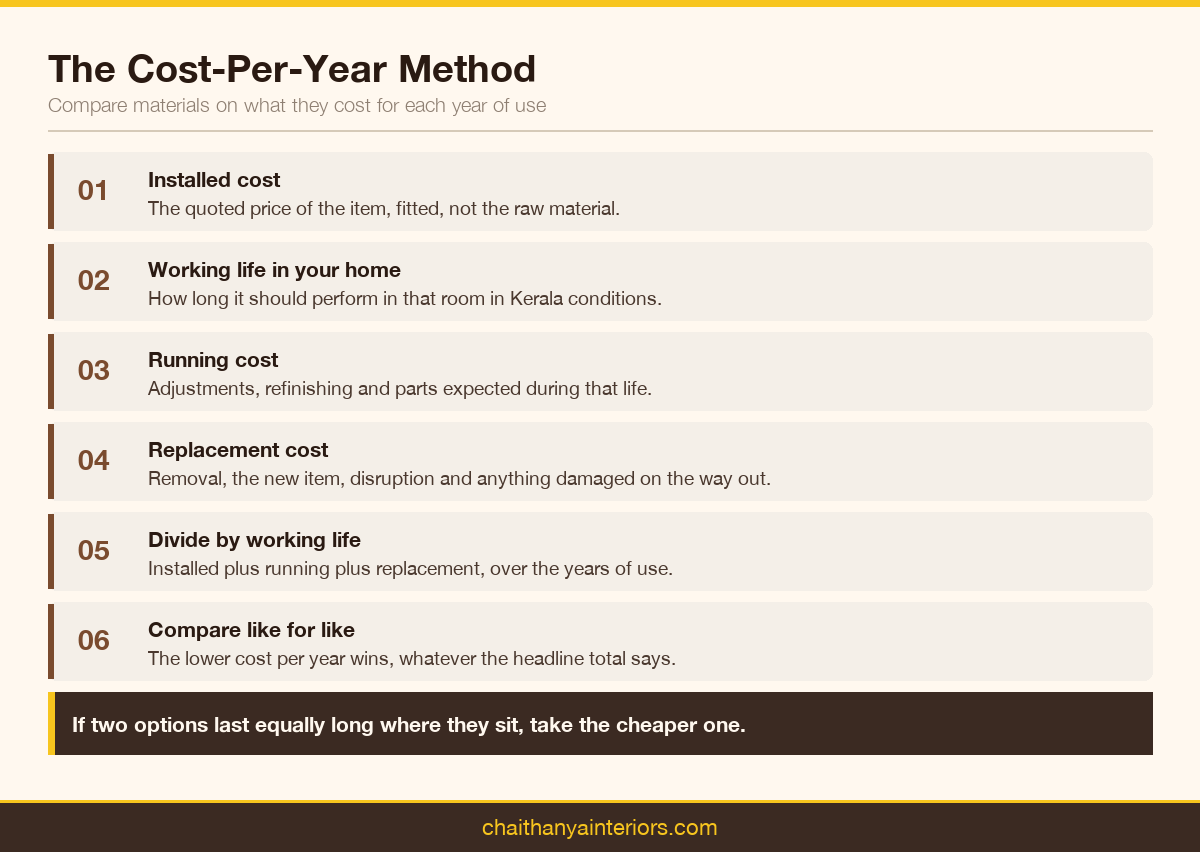
The method is simple enough to do on the back of a quote, and it works for any material, from carcass board to a countertop. You need four things for each option, and you should ask the firm quoting to help you with the ones you cannot estimate yourself.
- The installed cost: the price of the item as quoted, including fitting, not the raw material price.
- The expected working life in your conditions: how long it should perform in a Kerala kitchen, bathroom or bedroom, not in a showroom.
- The running cost: maintenance, adjustments, re-polishing or part replacements expected during that life.
- The replacement cost: what it takes to remove and replace it, including the disruption and any parts damaged on the way out.
Add the installed cost, the running cost and the replacement cost, then divide by the expected working life. The result is a cost per year of use. Do the same for the alternative, and you have a like-for-like comparison that the headline totals hide.
Be honest about the working life. Ask the firm why one option is expected to last longer than the other, and listen for specific reasons: board grade, edge sealing, hardware rating, surface hardness. A vague promise that premium simply lasts longer is not a reason. If the working life of two options is genuinely the same in your situation, the cheaper one wins and you should take it.
Our guide to what sits behind the numbers on an interior quote explains how materials, labour and production each contribute to the total, which makes it easier to see which lines are worth running through this method.
Carcass board: where budget and premium differ most
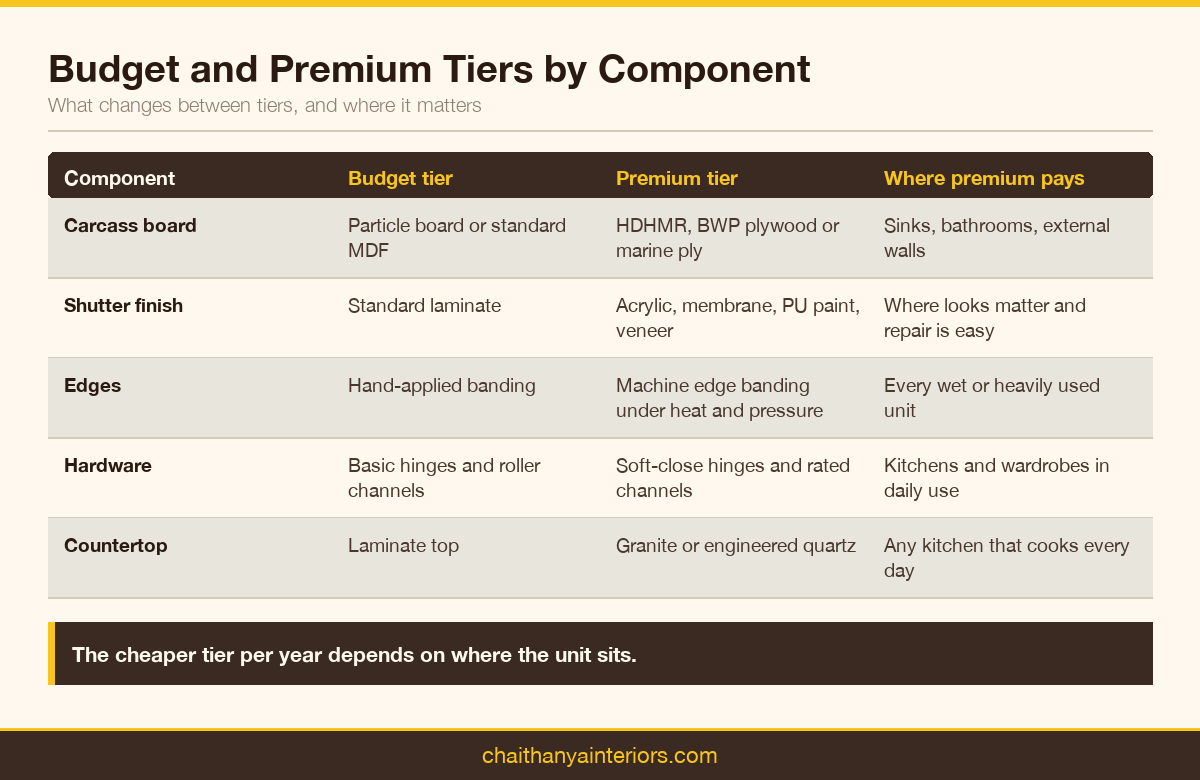
The carcass is the box behind every shutter, and it is the part you see least and depend on most. Budget options are usually particle board or standard MDF. Premium options are typically HDHMR board, boiling-water-resistant plywood or marine plywood, depending on where the unit sits.
In a dry bedroom, a well-made budget carcass can last a long time, and its cost per year can be very good. In a sink cabinet, a bathroom vanity or a wardrobe against an external wall, the picture changes. Board that takes on moisture swells at the edges and around cut-outs, hinges lose their grip, and the whole unit has to come out. The working life in that location falls sharply, and the cost per year rises with it.
That is why the most economical home is rarely all budget or all premium. It uses moisture-resistant board where water is a daily fact and saves in the rooms where it is not. Plywood grades are defined by the Bureau of Indian Standards, so ask for the grade by name on the quote rather than accepting a general description.
Our earlier piece on choosing board and laminate for a humid climate covers the board types in technical detail. For this comparison, the point is simply that the location of each unit decides which tier is the cheaper one per year.
Shutter finishes and surfaces
The shutter finish is what you see every day, and it is where the price range is widest. Standard laminates sit at the budget end. Acrylic, high-gloss laminate, membrane, PU paint and natural veneer sit progressively higher. Each has a different working life and a different kind of failure.
Standard laminate is hard-wearing, easy to clean and simple to replace panel by panel, which keeps its running cost low. Premium gloss finishes look striking, but some show scratches and fingerprints more readily, and a damaged shutter may need replacing rather than repairing. PU paint can be refinished, which extends its life, but refinishing is a cost and a disruption in its own right.
For the cost-per-year method, the useful questions are how the finish fails and what it costs to put right. A finish that scratches but can be replaced cheaply panel by panel may cost less per year than a finish that looks better for longer but must be replaced as a full set when it finally goes.
Edges matter as much as faces. A premium face with poorly sealed edges will fail at the edges first. Factory edge banding, applied by machine under heat and pressure, seals edges more consistently than hand application, which is one reason the production method belongs in the comparison alongside the material.
Hardware: the smallest line item that sets the lifespan
Hinges, drawer channels and lift-up mechanisms are a small share of a kitchen or wardrobe quote, and the part most likely to decide how long the unit feels new. Light-duty hardware can work well for a while and then sag, rattle or stop closing. Better hardware with soft-close action and a higher load rating keeps shutters aligned and drawers running smoothly for far longer.
Hardware is also where the cost-per-year method most often favours the premium option. The price difference is modest compared with the cost of the cabinets, and a failed hinge or channel in a budget unit often damages the board it is screwed into. Replacing the hardware then means repairing the board as well.
Ask for the hardware series to be written on the quote, not just a description such as soft-close. Two hinges described in the same words can perform very differently, and the quote is the only place you can hold a firm to what was promised.
Countertops and wet-area surfaces
The kitchen countertop takes more punishment than any other surface in the home: heat from vessels, cutting, spills, turmeric and regular scrubbing. Budget laminate tops are inexpensive but vulnerable to heat and to water at the joints. Natural granite is the long-standing Kerala choice for good reason, being hard, heat-tolerant and repairable. Engineered quartz and similar surfaces sit at the premium end, with consistent colour and low maintenance.
For a family that cooks daily, the working life of a laminate top can be short, which makes its cost per year higher than its price suggests. A granite or quartz top costs more on installation but, in normal use, rarely needs replacing for the life of the kitchen. That is a case where the premium tier is often the cheaper tier per year.
Wet-area surfaces in bathrooms follow the same logic. A vanity top, splashback or backsplash that resists water and staining will outlast a cheaper surface many times over in a room that is wet every day.
Where to spend and where to save, room by room
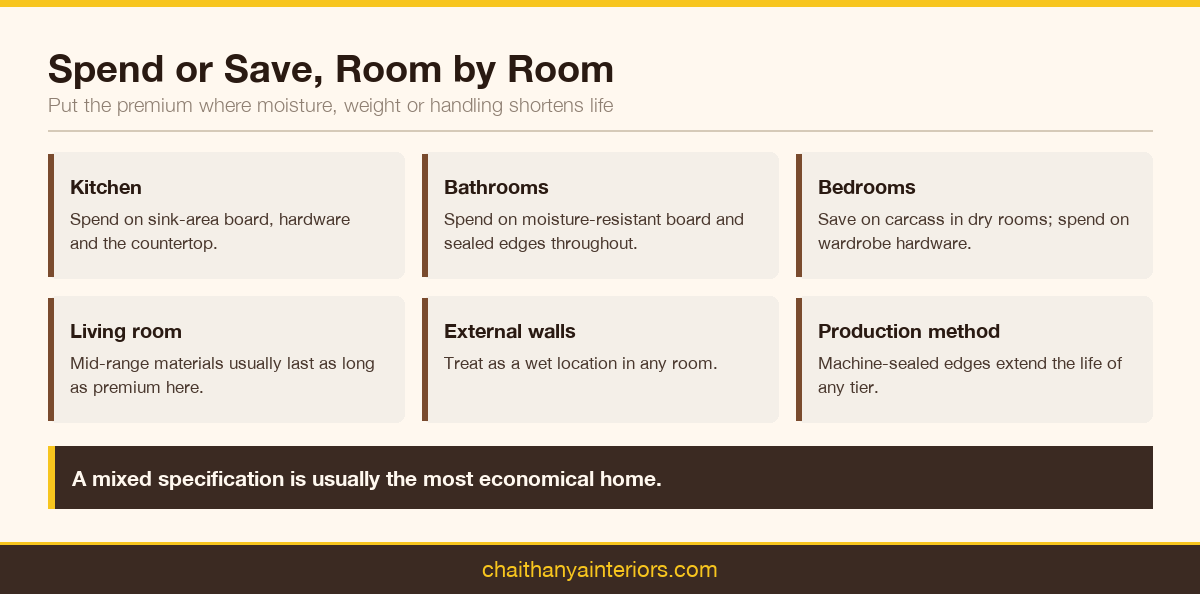
Once you have run the comparison on the main components, a pattern usually appears. Spend where moisture, weight or daily handling shortens the life of a budget material. Save where the budget material lasts as long as the premium one in that location.
- Kitchen: spend on carcass board around the sink, on hardware throughout and on the countertop. Save on decorative finishes for wall units if the budget is tight.
- Bathrooms: spend on moisture-resistant board and sealed edges for every vanity. There is very little to save safely here.
- Bedrooms: a budget carcass in a dry room can be a sound choice. Spend on wardrobe hinges and channels, which carry the most daily use.
- Living room: TV units and panelling see little moisture and light handling, so mid-range materials are usually enough.
- External walls in any room: treat them as a wet location for board selection, whatever the room.
A firm with its own production can make this kind of mixed specification simple, because each unit is cut and finished to its own schedule. You can see examples of the units we make for kitchens and bedrooms and completed homes in our gallery to judge how mixed specifications look once installed.
What changes when the units are factory-made
Material choice is only half the comparison. The other half is how the material is processed. A premium board cut by hand on site, with edges sealed by hand, can perform worse than a mid-range board cut, edge banded and drilled by machine in a factory. The working life in your comparison depends on both.
Chaithanya Interiors manufactures its modular units in its own Kochi factory, using German machinery for cutting, edge banding, hot pressing, hinge hole drilling, grooving, profile handle fixing and multi-boring. The production unit behind our kitchens and wardrobes is where those processes happen. Whoever you choose, ask how edges are sealed and how hinge holes are drilled, because both affect how long any material lasts.
If low-emission or responsibly sourced materials matter to you, ask for them by specification. Resources such as green building material guidance from the IGBC explain what to look for, and a firm should be able to tell you what its board and finishes are rated for.
If you would like help running this comparison on your own quote, our interior pricing and packages guide explains how to read each line, or you can talk to our design team about the specification for your home.

 Speak with an Expert
 Bar Counter
 Bed Room Interior
 Book Shelfes
 Centre Table
 Crockery Shelf
 Dinig Table
 Dressing Units
 False Ceiling
 LCD Units
 Living - Dining Partition
 Living Room
 Edge Banding
 Hinge Holl Drilling
 Profile Handle Fixing