

Interior Design Payment Stages in Kerala: What You Pay and When
Homeowners spend weeks choosing laminates and very little time reading the payment terms. Yet the interior design payment schedule decides how much leverage you have if something goes wrong, and it is one of the clearest signals of how a firm runs its projects.
This article explains how interior payments are usually staged in Kerala, what each stage actually pays for, and what you should have in hand before you release money. The split a particular firm uses is its own commercial decision, so this guide covers the structure and the safeguards rather than quoting percentages as if they were an industry standard.
Why interior payments are staged at all
A modular interior is made to measure. Once board is cut for your kitchen, it cannot be sold to anyone else. The firm therefore needs money before production to buy material, and you need protection so that you are never paying far ahead of the work actually done.
A good schedule balances those two needs. Each payment should follow a visible piece of progress, and the amount outstanding at any point should roughly match the work still to come.
The typical stage structure of an interior design payment schedule
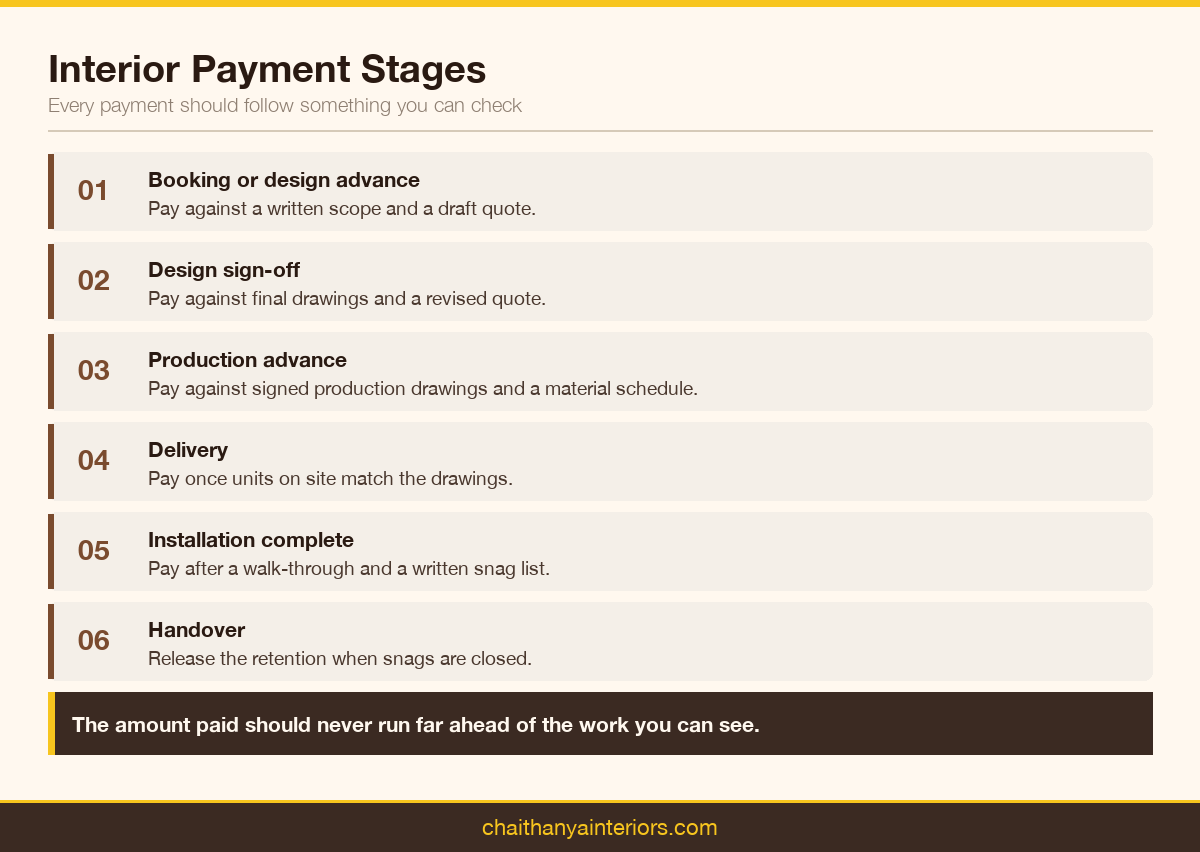
Most Kerala firms use some version of the stages below. Names differ; the logic is consistent.
| Stage | Triggered by | Have this in hand first |
|---|---|---|
| Booking or design advance | Agreeing to proceed with design | A written scope and a draft quote |
| Design sign-off | Approving drawings and 3D views | Final drawings and a revised quote |
| Production advance | Releasing the order to the factory | Signed production drawings and material schedule |
| Delivery | Units arriving on site | Units matching the drawings, inspected |
| Installation complete | Assembly finished | A walk-through and a written snag list |
| Handover | Snags closed | Warranty terms and care instructions |
Ask any firm for its own split against these stages. What matters most for you is the last column: every payment should be matched to a document or a physical result you can check.
What the advance actually pays for
The first payment is usually the one people worry about most, and rightly. It pays for design time, site measurement and the drawings. It should not, on its own, commit you to the whole project.
Ask what you receive for it and whether it is adjusted against the final bill. In many firms the design advance is credited in full once you proceed to production; in others it is a separate design fee. Either arrangement is reasonable, provided it is stated in writing before you pay, together with what happens to it if you decide not to proceed.
The production advance is different. It pays for board, laminate, edge band and hardware, which the factory buys or allocates for your order. This is the stage where the order becomes physical, which is why it should only be released against signed production drawings. How those drawings become cut panels is explained in the drawing-led manufacturing process.
Tie payments to milestones, not dates
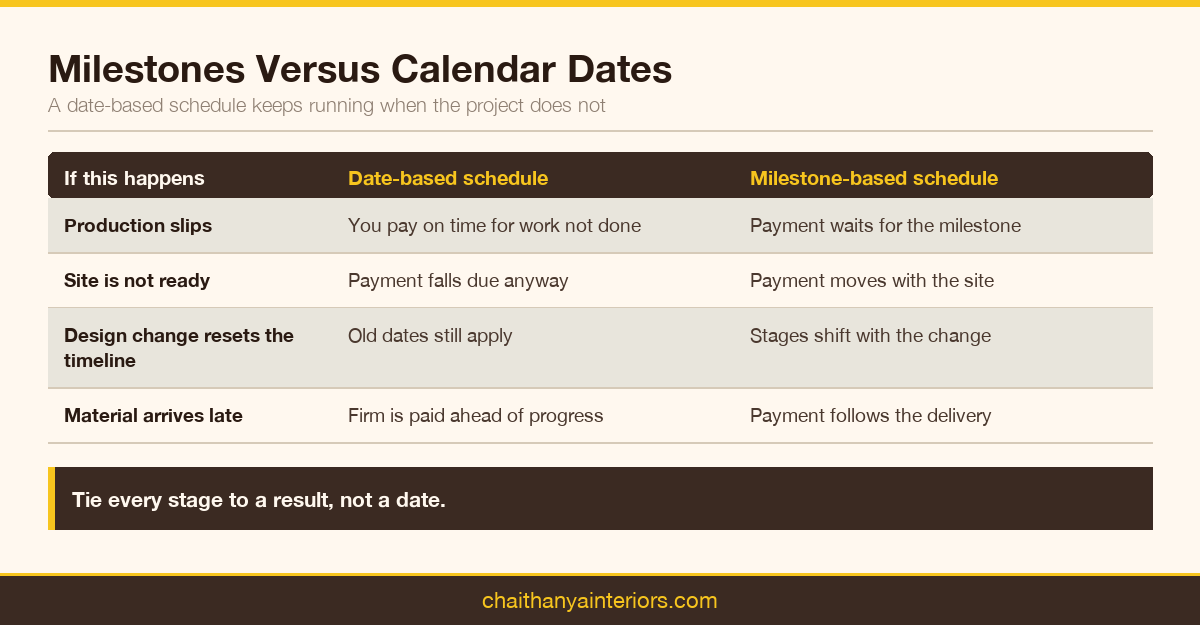
A schedule that says a certain amount on a certain date is convenient for the firm and risky for you. If production slips, you have paid on time for work that has not happened.
A milestone-based schedule moves with the project. Material arriving late, a site that is not ready, or a design change that resets the timeline all shift the payment with them. Realistic stage durations are covered in the lead time article; use them to sanity-check any dates in the contract.
Warning signs in a payment schedule
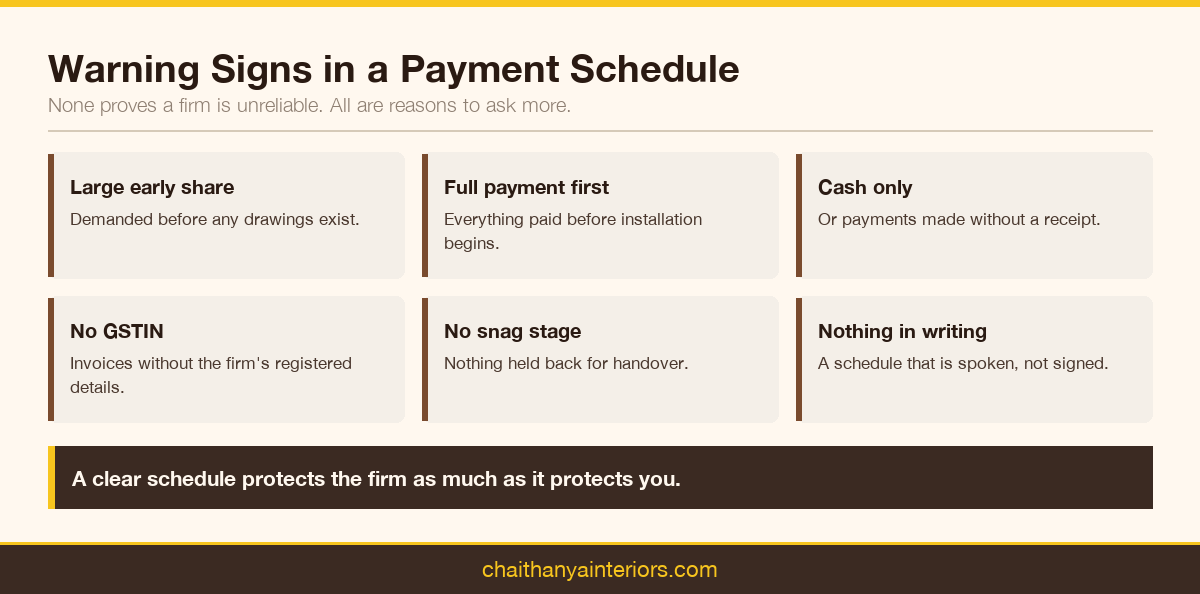
- A large share demanded before drawings exist. You are paying for work that has not been defined.
- Full payment before installation. You lose all leverage over snags and finishing.
- Payments requested in cash only, or without a receipt.
- Invoices without the firm's GSTIN or registered name.
- No stage linked to a snag list or handover.
- A schedule that is spoken rather than written into the agreement.
None of these proves a firm is unreliable. All of them are reasons to ask more questions before you pay. A well-run firm will usually be glad to explain its schedule, because a clear schedule protects it too: disputes over money at the end of a project cost the firm time it would rather spend on the next one.
It also helps to ask what happens if the firm is the one causing delay. If production slips by several weeks, does the next payment wait? A schedule that only moves in the firm's favour is worth renegotiating before you sign.
A single kitchen versus a full-home project
The stage structure scales with the job. A single modular kitchen is usually one production release, so the stages run close together: design, sign-off, production, delivery and installation within one programme. There is little reason for more than a handful of payments.
A full-home project is different. The kitchen, wardrobes, living units and false ceiling may reach site at different times, and other trades such as electricians, plumbers and painters work in between. Here it is sensible to link payments to each release rather than to the whole project, so that you are never paying for the wardrobes while only the kitchen has arrived.
Whichever applies, the principle is the same: the amount you have paid should never run far ahead of the work you can see. If a schedule for a full home asks for most of the money before any unit reaches site, it is written for a single-kitchen job and should be adjusted.
Changes and extras during the project
Most disputes over money are really disputes over change. A client adds a loft, upgrades a hinge, moves a unit, and the final invoice arrives larger than expected.
The fix is simple and rarely used: every change should be written as a variation, priced and approved before it is executed. It then gets added to the next milestone payment rather than surfacing as a surprise at the end. Scope changes also affect how different room counts are priced, which is covered in the 2 BHK and 3 BHK comparison.
Retention and the snag list
Keep a final amount back until the snag list is closed. Snags are normal on any interior: a shutter out of alignment, a missing handle, a scratch from installation. Holding the last payment until they are fixed is not a sign of distrust; it is how the final stage gets the same attention as the first.
Agree in writing what counts as a snag, how long the firm has to close it, and what warranty applies after handover.
Protecting yourself in practice
- Pay by bank transfer and keep every receipt.
- Ask for a tax invoice with GST at each stage.
- Put the payment schedule inside the signed agreement, stage by stage.
- Keep copies of the drawings and material schedule you approved at each stage.
- Inspect units at delivery before paying the delivery stage.
A firm that manufactures its own units can tie stages directly to what happens on its production floor, because it controls when material is bought and when panels are cut. Chaithanya Interiors runs production at its factory in Kochi. For the wider picture of how quotes and packages are structured, see how interior pricing actually works; for common questions, the FAQ page covers the basics, and you can ask us about our terms directly.

 Speak with an Expert
 Bar Counter
 Bed Room Interior
 Book Shelfes
 Centre Table
 Crockery Shelf
 Dinig Table
 Dressing Units
 False Ceiling
 LCD Units
 Living - Dining Partition
 Living Room
 Edge Banding
 Hinge Holl Drilling
 Profile Handle Fixing