

Modular Kitchen Hardware: Hinges, Channels and Why They Fail Early
A modular kitchen is judged on the day it is handed over by its looks: the finish, the countertop, the colour. It is judged a few years later by something much smaller. Does every shutter still close flush? Do the drawers still glide, or do they drop and scrape? Almost all of that comes down to the modular kitchen hardware: the hinges, channels and mechanisms hidden behind the shutters.
Hardware is a small share of what a kitchen costs and the most common reason a kitchen starts to feel tired early. This guide explains what each piece of modular kitchen hardware does, the specific ways it fails in Kerala homes, and what to write into a quote so the hardware you are promised is the hardware you get.
What modular kitchen hardware actually does
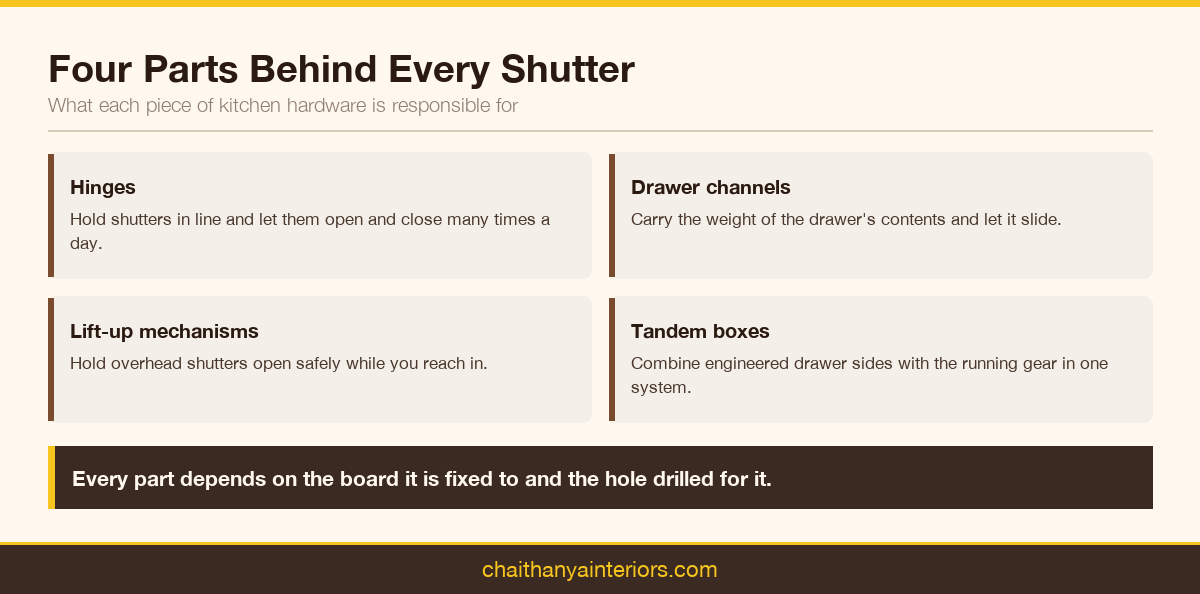
Every moving part of a kitchen depends on hardware. Hinges hold shutters in place and let them open and close. Drawer channels carry the weight of everything stored in a drawer and let it slide. Lift-up and flap mechanisms hold wall-unit shutters open above your head. Tandem boxes, sometimes called drawer systems, combine the channel and the drawer sides into one engineered unit.
Each of these carries load and movement many times a day. A kitchen drawer full of steel vessels is opened and closed far more often than any wardrobe drawer, and it carries more weight. That is why kitchen hardware is specified differently from bedroom hardware, and why light-duty parts that would be fine in a bedroom fail quickly in a kitchen.
Hardware also depends completely on the board it is fixed to and on the accuracy of the holes drilled for it. The best hinge, screwed into a swollen board or fitted to a hole drilled in the wrong place, will not perform. That connection between hardware, board and drilling is what most early failures come down to.
Hinges: types and how they fail
Overlay types
Concealed cabinet hinges come in three main overlay types. Full overlay hinges are used when the shutter covers the whole side of the cabinet. Half overlay hinges are used when two shutters share one partition. Inset hinges sit the shutter inside the cabinet frame. Using the wrong type leaves shutters that rub, gap or will not close.
Soft-close action
Soft-close hinges have a built-in damper that slows the shutter in the last part of its travel, so it closes quietly instead of slamming. Beyond comfort, this protects the shutter, the carcass and the hinge itself from repeated impact, which is one of the main reasons standard hinges loosen over time.
How hinges fail
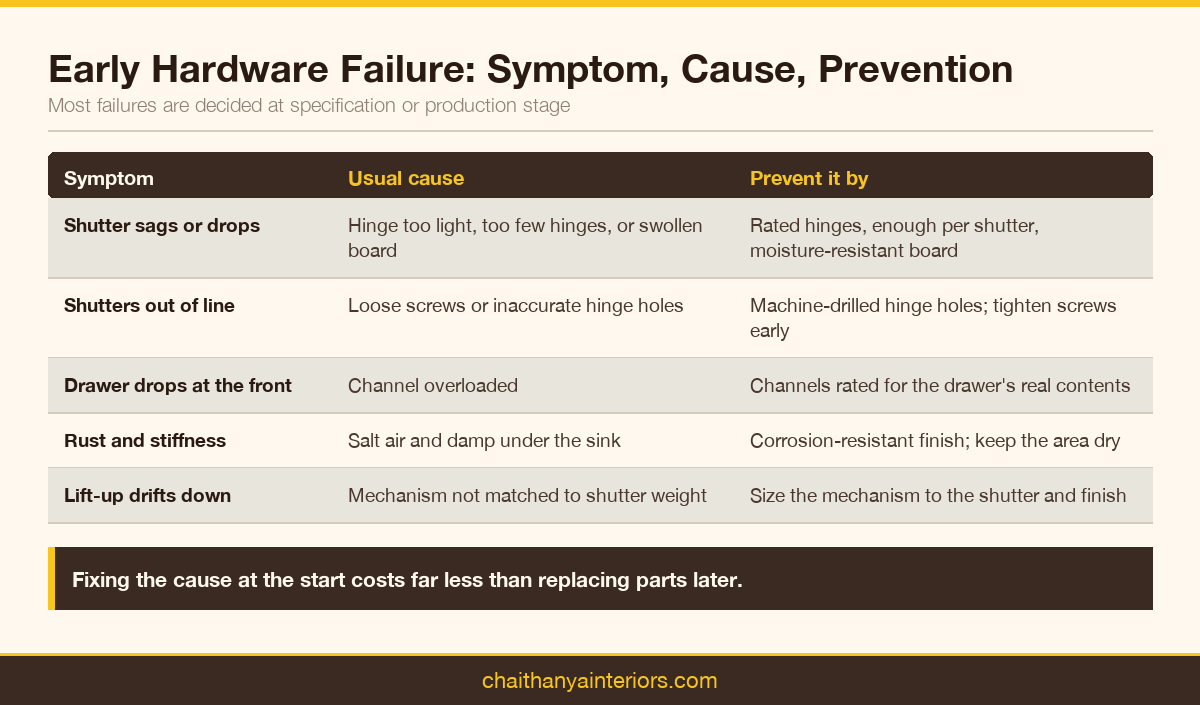
The most common hinge failures are sagging shutters, shutters that no longer line up with their neighbours, and hinges pulling out of the shutter or carcass. Sagging usually means a hinge that is too light for the shutter's size and weight, or too few hinges on a tall shutter. Misalignment often starts with loose fixing screws. Pull-out almost always means the board around the hinge cup has weakened, often from moisture.
Rust is the other enemy. In coastal Kerala, salt-laden air reaches hinges inside cabinets as well as outside, and the area under the sink is damp by nature. Hinges with a proper corrosion-resistant finish matter much more here than in a dry inland city.
Drawer channels and tandem boxes
Drawer channels come in a few broad kinds. Basic roller channels are the cheapest and the most likely to wobble and wear. Ball-bearing telescopic channels run more smoothly and carry more weight. Concealed under-mount channels sit beneath the drawer and support it across its width. Tandem boxes combine engineered metal drawer sides with the running gear.
Soft-close channels add a damper at the end of travel, in the same way soft-close hinges do. For a kitchen in daily use, soft-close channels are worth the difference, because they reduce the impact load on the drawer joints and on the channel itself every time a drawer is shut.
Channels fail by sagging at the front, grinding, sticking partway, or losing their soft-close action. Most of this comes from overloading. A drawer rated for light cutlery cannot carry a stack of steel plates or a pressure cooker for long. Ask for each drawer's channel to be rated for what will actually go in it, and keep heavy vessels in deep drawers specified for weight.
Our earlier article on how kitchen size and specification shape the final quote explains where drawers and channels sit in the overall cost. Here, the point is that drawers carrying weight need to be specified for weight.
Lift-up and flap mechanisms for wall units
Wall units above the counter often use lift-up shutters, which swing upward and stay open while you reach in. These depend on gas struts or spring mechanisms sized to the weight of the shutter. A mechanism that is too weak will not hold the shutter open; one that is too strong will make it fly up.
Lift-up failures are easy to spot: shutters that drift down, refuse to stay open or close with a bang. Because they are overhead, they are also a safety question. Ask for the mechanism to be matched to the shutter material and size, especially if you choose a heavy finish such as glass or a thick lacquered panel.
Why modular kitchen hardware fails early in Kerala
Early failures in Kerala kitchens almost always trace back to one of five causes. They are worth knowing, because each one can be prevented at the specification or production stage rather than fixed afterwards.
- Moisture in the board: swollen board around the sink or near a wet floor loses its grip on hinge screws and channel fixings.
- Salt air and damp: in coastal districts, hardware without a corrosion-resistant finish rusts and stiffens.
- Overloading: drawers carrying heavy vessels on channels rated for light loads.
- Inaccurate drilling: hinge cups and channel holes drilled by hand at slightly wrong positions, leaving shutters and drawers under constant strain.
- Light-duty parts: hardware chosen to save a small amount on the quote that cannot carry daily kitchen use.
The first and fourth causes are production questions as much as hardware questions. Board choice by location is covered in our guide to kitchen board choices for the monsoon. Drilling accuracy is a factory question: machines that drill hinge holes and multi-bore panels to fixed positions put every part where the hardware expects it.
Chaithanya Interiors drills hinge holes and multi-bores its panels on German machinery in its own Kochi factory, so every hinge cup and channel fixing sits at the position the hardware was designed for. You can see how that fits into the wider process in our article on what happens on a modular factory floor.
How to specify hardware in a kitchen quote
Hardware is where descriptions on a quote are most likely to be vague. Soft-close, premium and heavy-duty mean different things to different suppliers. These are the details to ask for in writing before you sign.
- The hinge type and series for every shutter, including how many hinges each tall shutter carries.
- The channel type, length and load rating for every drawer, with heavy drawers identified separately.
- The lift-up mechanism for each overhead shutter, matched to the shutter's size and finish.
- Whether soft-close is included on hinges, channels or both.
- The finish of the hardware, especially in coastal homes, and what the supplier's warranty on the hardware covers.
With those details written down, two quotes can be compared on hardware like for like. Without them, a lower total may simply mean lighter hardware. Our kitchen planning guide for Kerala homes shows where hardware decisions fit in the overall order of planning.
Looking after hinges and channels
Good hardware still needs light care. None of it is difficult, and a few minutes every few months keeps a kitchen feeling new for much longer.
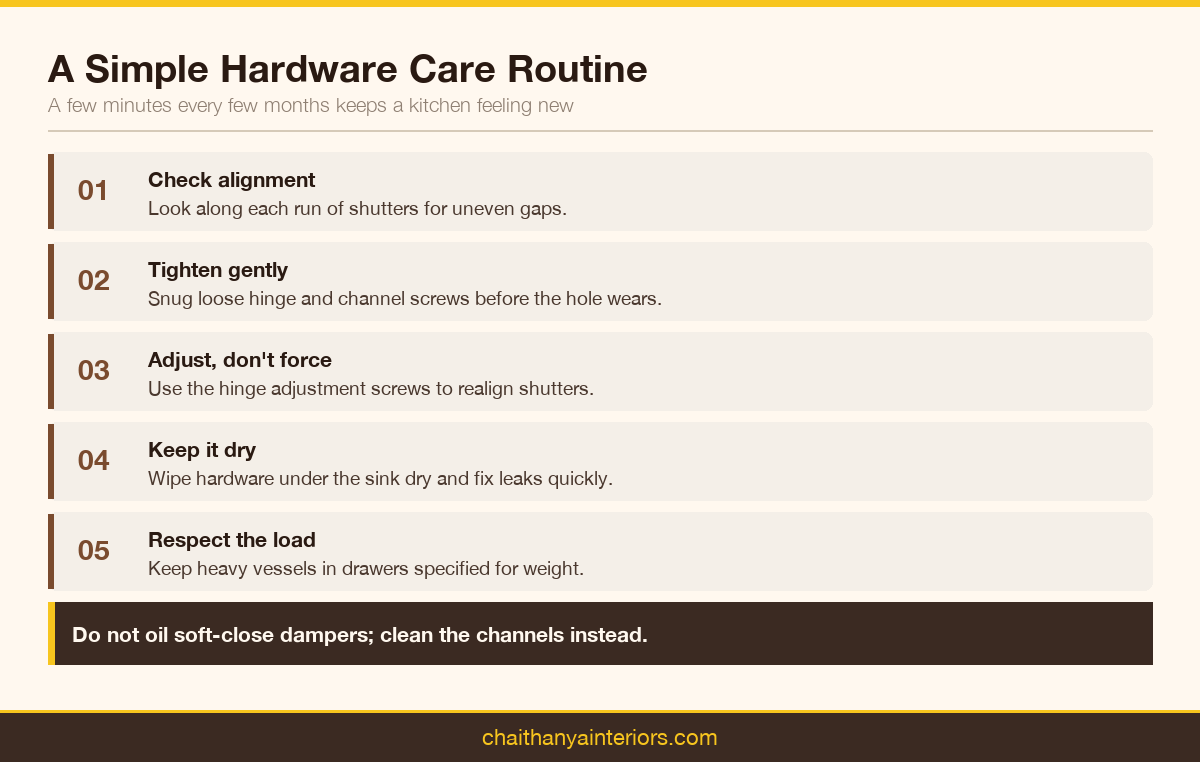
- Tighten hinge and channel screws gently if a shutter or drawer starts to move out of line, before the hole wears.
- Use the hinge adjustment screws to realign shutters rather than forcing them.
- Wipe hinges and channels under the sink dry after any leak, and fix leaks quickly.
- Keep drawer loads within what the channel is rated for.
- Clean dust and food residue from channels, and avoid oiling soft-close dampers.
If something does fail, replace like for like or better, and ask whether the board around the fixing needs attention too. Our answers to common interior questions cover more of the practical side of looking after a modular kitchen, and you can see how we handle kitchen projects from planning through to installation.
If you are planning a new kitchen and want help specifying hardware that suits how your family cooks, send us an enquiry and our team will go through the options with you.

 Speak with an Expert
 Bar Counter
 Bed Room Interior
 Book Shelfes
 Centre Table
 Crockery Shelf
 Dinig Table
 Dressing Units
 False Ceiling
 LCD Units
 Living - Dining Partition
 Living Room
 Edge Banding
 Hinge Holl Drilling
 Profile Handle Fixing