

Modular Kitchen Materials for Kerala Monsoon: Marine Ply, MDF and HDHMR Compared
Every Kerala homeowner has seen it, in a relative's house if not their own. The sink cabinet door no longer closes flush. The bottom edge of the carcass has puffed up and gone soft. The laminate at the corner has lifted. The kitchen is five years old and looks fifteen, and nobody is quite sure why.
It is almost always a question of modular kitchen material for Kerala conditions, plus detailing, and it is almost always predictable. The monsoon does not damage every cabinet equally. It finds the weakest board in the wettest spot, and it finds the unsealed edge. Knowing where those spots are is most of the battle, and it costs nothing to learn before you order.
This is a homeowner's guide, taken zone by zone through the kitchen. For the technical specification, with standards and laminate thicknesses, our specifier's guide to board and laminate for Kerala humidity covers that. This one is about where each board belongs, and how to make sure you receive what you paid for.
Modular kitchen material for Kerala: the four boards you will be offered
Marine plywood, properly called boiling-waterproof or BWP plywood, is made of wood veneer layers bonded with a waterproof adhesive. It resists sustained water better than any other common cabinet board, which is why it is the default for wet areas. It is also the most expensive of the four, and the one most often promised and not delivered.
Commercial plywood, sometimes sold as moisture-resistant or MR plywood, has the same layered construction with a less water-resistant adhesive. It is perfectly adequate in dry parts of the house, and in the drier parts of a kitchen. Under a sink or against a wet floor it will eventually delaminate, particularly once an edge is open.
HDHMR is a dense engineered board that is very flat and machines cleanly, which makes it a favourite for shutters and for any surface where flatness shows. It is moisture-resistant, not waterproof. It performs well above the counter and in dry positions, and less well anywhere it may sit in standing water for long.
MDF is a fine fibre board that takes paint and routed profiles beautifully, which is why it suits painted shaker-style shutters. It also swells permanently if water gets into it, and it does not shrink back. In a kitchen it belongs on painted shutters in dry positions and nowhere near the sink.
You will sometimes see particle board in the lowest-priced packages. It has a place in dry, low-load furniture, but not in a Kerala kitchen carcass, where one open edge and one monsoon are usually enough to finish it. If a quote does not name the board at all, ask, because silence often means particle board.
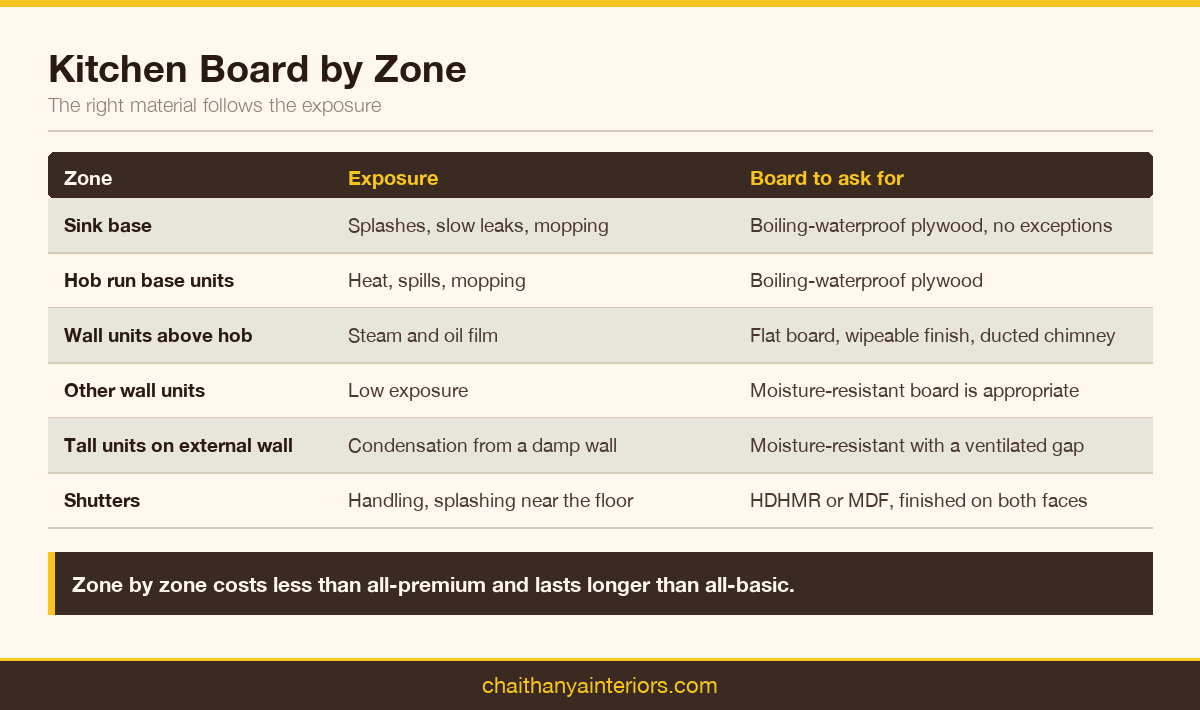
The important idea is that no single board is right for the whole kitchen. Each zone has a different exposure to water, heat and humidity, and the right material follows the exposure. A kitchen specified zone by zone costs less than one built entirely from the most expensive board, and performs better than one built entirely from the cheapest.
The wet zones: sink base and hob run
The sink base
The sink base is the wettest place in the house after the bathroom floor. Water splashes over the counter edge, drips from hands and vessels, and sooner or later a trap or hose leaks into the cabinet itself, often slowly and unnoticed for weeks. Everything about this cabinet should assume that water will reach it.
Its carcass should be boiling-waterproof plywood without exception, including the base panel that sits closest to any leak. The cut-outs for the waste pipe and water lines should be sealed, because a raw cut edge is the easiest entry point for water in the entire kitchen, and it is hidden behind the pipes where nobody looks.
Many households also line the base of the sink cabinet with a removable tray or sheet, so that a leak collects where it can be seen and wiped rather than soaking into the board. It is a small addition that turns a slow, invisible leak into an obvious one that can be fixed before any damage is done.
The hob run
The base units under and beside the hob do not take standing water, but they take heat, steam from vessels lifted off the flame, oil splashes, and daily mopping at floor level. In a Kerala kitchen they should also be boiling-waterproof plywood, because spills and wet mops reach them as surely as they reach the sink base.
The wall units above the hob take more steam than anything else in the kitchen. They need a board that stays flat and a finish that tolerates repeated wiping of oil film. Their best protection, though, is not the board at all but a ducted chimney that removes steam before it condenses on the underside of the cabinet.
The drier zones: tall units, wall units and shutters
Tall units, such as pantry towers and oven or refrigerator housings, usually stand away from direct water. Their risk is different. They are often placed against an external wall, and in Kerala an external wall takes driving rain for weeks at a time. Moisture comes through the masonry and condenses in the closed space behind the unit.
A moisture-resistant board is usually adequate here, provided a small ventilated gap is left behind the unit rather than sealing it tight against a damp wall. If the wall is known to be damp, step up to waterproof plywood and have the wall itself treated, because no cabinet board will stay healthy against a wet wall indefinitely.
Wall units away from the hob are among the safest places in the kitchen. They are above splash height, away from the floor, and well ventilated. This is where a moisture-resistant board is entirely appropriate, and where some budget can reasonably be saved to spend on the sink base and the base units instead.
Shutters, the doors and drawer fronts, are what you see and touch. Their main job is to stay flat and keep their finish. HDHMR is often used because it is flat and machines cleanly; MDF suits painted and routed shutters in a show kitchen; plywood shutters are robust but can move slightly if the two faces are not balanced.
Whichever board is used, both faces of a shutter should be laminated or finished. A shutter finished on the show face only absorbs moisture unevenly through its two sides and slowly cups, so that it no longer sits flat against the carcass. It is a common saving in low-priced kitchens and a common cause of complaints.
The shutters just below the sink and those nearest the floor take the most splashing from washing and mopping. They are where edge sealing matters most, and where a lower-grade shutter shows its weakness first. If you have to prioritise, make these the best-finished shutters in the kitchen.
Edges, countertop joints and the plinth
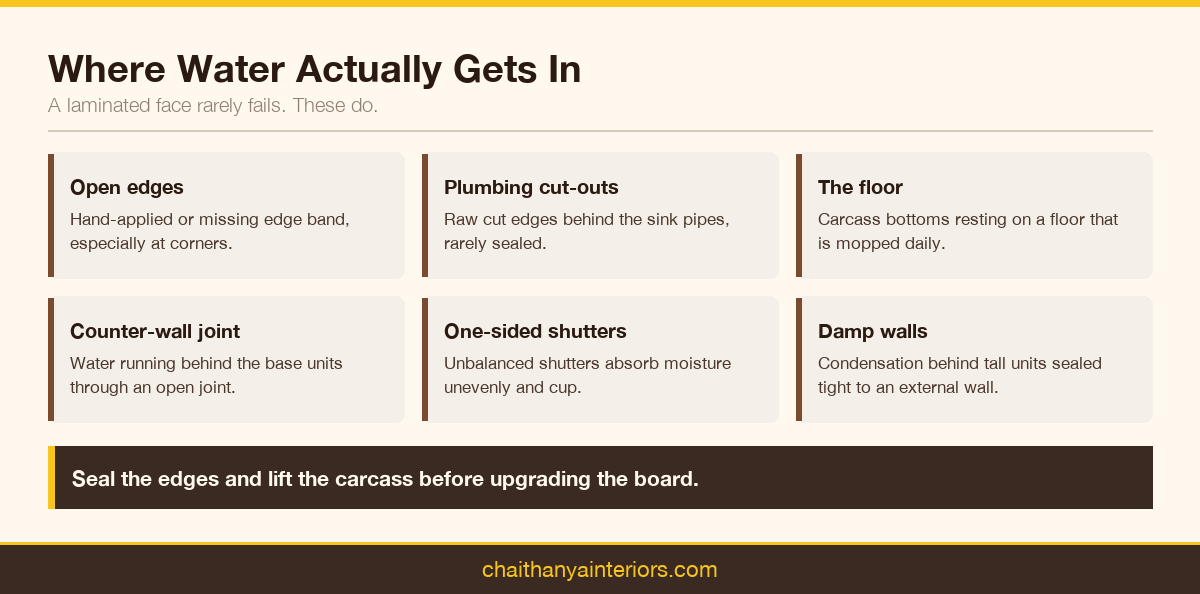
A laminated face is effectively waterproof. Almost all moisture damage enters through an edge, a drilled hole or a cut-out. That is why edge treatment matters as much as the board grade, and why two kitchens built from the same board can age so differently over the same number of monsoons.
In a factory, the edge band is applied with hot adhesive under roller pressure and sealed along its full length, including at the corners. On site, a hand-applied edge can leave small gaps, especially at corners and around cut-outs, and each gap is an entry point. Our walk-through of edge banding and hot pressing inside a factory shows the difference in detail.
The countertop itself is usually stone, and stone does not mind water. The joint where the counter meets the wall, and the edge where it overhangs the base units, are a different matter. Water running along the back of the counter finds its way behind the base units unless the joint is properly sealed.
Seal the counter-to-wall joint, make sure the front edge has a drip profile so that water falls clear of the shutters, and check the joint again after the first monsoon. Buildings move slightly as they dry out and settle, and a joint that was tight at handover can open a hairline gap within a year.
The bottom of the kitchen is where most carcass damage starts, because the floor is mopped every day. A carcass bottom sitting directly on a wet floor soaks water up through its edge. Base units should stand on adjustable legs or a raised plinth, never directly on the floor.
The plinth or skirting in front of those legs is the part that meets the mop, so it should itself be waterproof: a waterproof board with sealed edges, or an aluminium or PVC skirting that does not absorb water at all. It is a small line on the quote and one of the most useful in a Kerala kitchen.
How to check that the board delivered is the board you were quoted
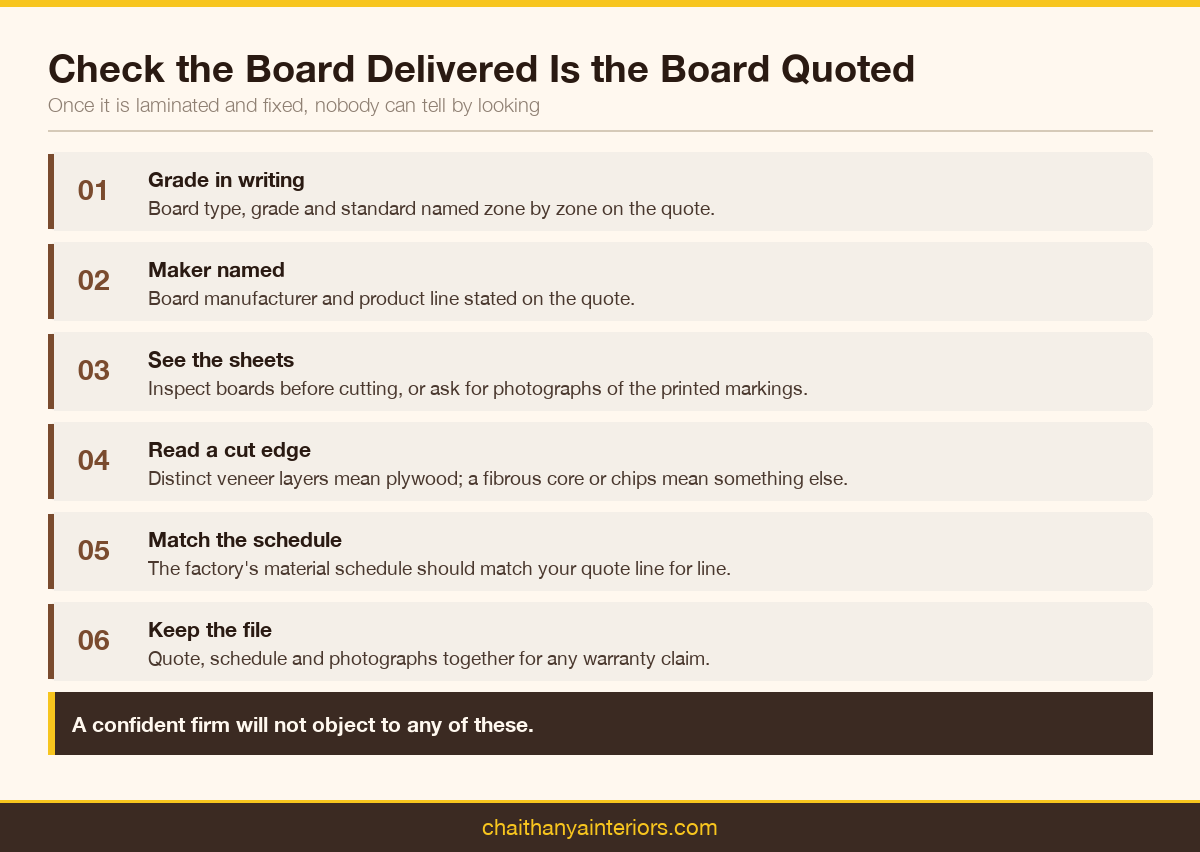
This is the step most homeowners skip, and the one where money is most often quietly lost. The quote says marine plywood, and what arrives is commercial plywood with a similar-looking face. Once it is laminated and fixed nobody can tell by looking, until the sink base swells in its second or third monsoon.
- Ask for the board type, grade and standard in writing on the quote, zone by zone, not just the words "waterproof ply".
- Ask for the board manufacturer's name and product line on the quote.
- Ask to see the boards before they are cut, or for photographs of the sheets with their printed markings visible.
- Look at an exposed cut edge. Plywood shows distinct veneer layers; HDHMR and MDF show a uniform fibrous core; particle board shows visible chips.
- For a factory-made kitchen, ask for the material schedule the factory is working to, and check it against the quote.
- Keep the quote, the schedule and the photographs together for any future warranty claim.
A firm that is confident about its materials will not object to any of these. Hesitation over putting the board grade in writing is worth noticing. Factory production makes these checks easier, because the material schedule is written down before cutting; the overview of outsourcing to a modular factory explains why that paperwork exists.
If budget forces a choice, spend on the sink base and the other base units, on machine edge banding, and on raising carcasses off the floor. Save more safely on wall units away from the hob and on shutter finish. The planning guide to Kerala kitchens and the comparison of kitchen layouts show how layout decides which runs take the most water.
You can see our approach to kitchen design, look at finished kitchens in our gallery, or ask for a material schedule for your kitchen before you commit to a quote.

 Speak with an Expert
 Bar Counter
 Bed Room Interior
 Book Shelfes
 Centre Table
 Crockery Shelf
 Dinig Table
 Dressing Units
 False Ceiling
 LCD Units
 Living - Dining Partition
 Living Room
 Edge Banding
 Hinge Holl Drilling
 Profile Handle Fixing