

Modular Kitchen Cost in Kerala 2026: Price by Size, Layout and Material
Modular kitchen cost in Kerala is almost always the largest single line in a home interior, and the one where quotes vary most. Two firms can price the same kitchen very differently and both be telling the truth, because they are not quoting the same kitchen.
This guide sets out how a modular kitchen is actually priced, what moves the number, and how to check a quote before you sign. Rates move with board and hardware prices and differ from firm to firm, so this guide explains the structure behind a price rather than quoting figures that would date quickly.
If you are still at the design stage, start with the complete kitchen planning guide, then come back here to cost the plan.
How a modular kitchen is measured
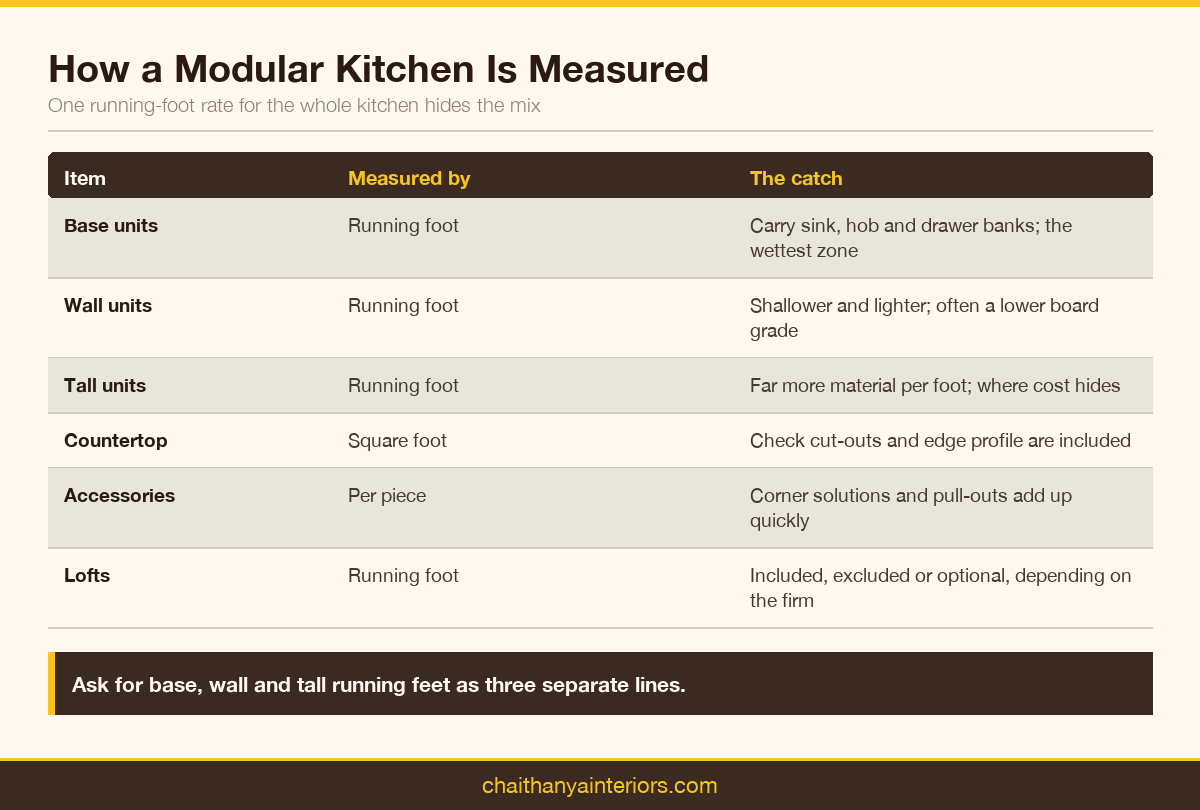
A modular kitchen is priced per running foot, but not as a single run. A proper quote counts three things separately.
- Base units: the cabinets under the counter, carrying the sink, hob and drawer banks.
- Wall units: the cabinets above the counter, shallower and lighter.
- Tall units: full-height pantry, oven or refrigerator housings, which carry far more material per running foot.
Then come the items priced separately: the countertop per square foot, accessories per piece, and lofts if you want them. A quote that gives one running-foot rate for the whole kitchen is hiding the mix, and tall units are usually where it hides.
Modular kitchen cost in Kerala by kitchen size
Size is the most obvious driver and the least interesting one. Once you know your running feet, the real questions are layout and specification. The table gives the structure; ask any firm to price each row against your own plan.
| Kitchen size | Typical setting | Typical scope |
|---|---|---|
| Compact | Kochi apartment, single wall or small L | Base and wall units, no tall unit |
| Standard | Larger apartment or independent house, L or parallel | Base, wall, one tall unit |
| Large | Villa or new house, U or island | Base, wall, tall pantry, appliance housing |
| Work area addition | Kerala second kitchen or utility | Base units in waterproof board, open shelving |
The last row is particular to Kerala. Many homes keep a work area or second kitchen for heavy cooking, grinding and washing, and it needs to be priced and specified as a wet zone in its own right.
Cost by layout
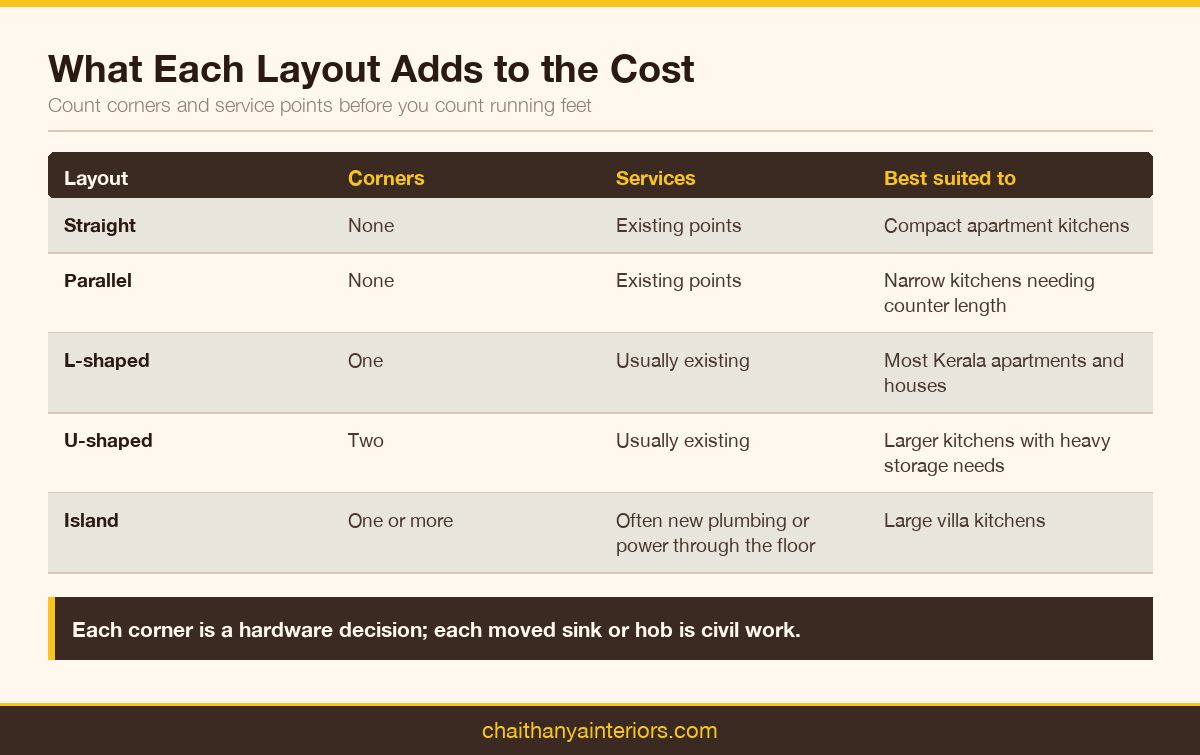
Layout changes cost through three mechanisms: total running feet, corner units, and services.
Straight and parallel
The simplest to build and the cheapest per running foot. No corners, so no corner hardware. A parallel kitchen doubles the counter but keeps each run simple.
L-shaped
Adds one corner. A blind corner with a basic shelf costs little; a corner carousel or magic-corner pull-out adds a noticeable amount, and it is one of the most useful upgrades in a Kerala kitchen full of heavy vessels.
U-shaped
Two corners, the most counter length and usually the most storage. It is the layout where corner hardware decisions matter most to the total.
Island
An island adds a free-standing unit finished on all sides, and if it carries a hob or sink, it needs plumbing and electrical work through the floor. That civil work is often outside the modular quote. Islands suit large villa kitchens; they rarely suit Kochi apartment kitchens.
Whichever layout you choose, count the corners and the service points before you count the running feet. Each corner is a hardware decision, and each sink or hob moved away from its existing position is a plumbing or electrical line that usually sits outside the modular price. You can see how these layouts look when built in kitchens we have designed.
Kerala cooking and what it does to the specification
A kitchen in Kerala works harder than the catalogue kitchens most modular ranges are designed around. Daily cooking involves heavy vessels, a mixer grinder that runs for long periods, coconut scraping, deep frying and a lot of water. Each of those shows up somewhere in the specification, and therefore in the cost.
Heavy vessels need drawers with channels rated for the load, not the lightest series on offer. A pressure cooker and a stack of steel vessels in a wide drawer is a real test of hardware, and cheap channels sag within a couple of years. This is one of the places where spending more is a saving.
Water use means the sink base and the cabinets either side of it need boiling-waterproof board, sealed cut-outs and a plinth that keeps the carcass off a wet floor. Steam from cooking means the wall unit above the hob needs a finish that tolerates heat, and a chimney that actually extracts.
Counter sockets matter more than people expect. A mixer grinder, a rice cooker, an induction plate and a kettle all want power at counter height, and planning those points before the units are made is far cheaper than chasing walls afterwards. None of this is exotic, but a quote written for a generic kitchen often leaves it out, and the missing items then arrive later as extras.
Cost by material
The carcass
In Kerala, the carcass under the sink and around the hob sits in the wettest part of the house. Boiling-waterproof plywood is the sensible standard for base units, and it is where cutting cost does the most damage. Wall units can step down to a good moisture-resistant grade. The trade-offs are set out in the board and laminate guide.
The shutter finish
| Finish | Relative cost | Kerala suitability |
|---|---|---|
| Laminate, matt | Lower | Very good. Hides wear, tolerant of humidity if edges are sealed. |
| Laminate, gloss | Lower to mid | Good, but shows fingerprints and scratches. |
| Membrane (PVC wrapped) | Mid | Use with care near the hob; heat can lift the wrap. |
| Acrylic | Mid to higher | Good. High gloss, needs careful handling on site. |
| Painted (PU) or veneer | Higher | Good if well sealed; demands more maintenance. |
The relative cost column is a ranking, not a rate. Edge banding and a backing laminate on the inside face belong in every tier; a quote that omits the backing laminate saves a little and produces shutters that cup in the monsoon.
The items that decide the final number
After size, layout and material, a handful of line items account for most of the remaining difference between quotes.
- Hardware: hinges, drawer channels and lift-up fittings. Specify brand and series, not the words soft-close.
- Accessories: tandem drawer boxes, cutlery organisers, bottle pull-outs, tall pantry pull-outs, corner solutions.
- Countertop: granite remains common in Kerala; quartz costs more and suits some homes better. Check which is included.
- Sink and tap: often a default model with an upgrade price.
- Appliances: chimney, hob and built-in oven are usually outside the modular price.
- Lighting: under-cabinet strips and their wiring are sometimes included, sometimes not.
Dealers versus manufacturers
Many modular kitchen dealers in Kochi sell units made elsewhere. There is nothing wrong with that, but it changes what you are paying for. A dealer receives a finished price from a supplier and adds a margin; the dealer cannot tell you what the board or hardware inside that price cost, because it never saw the breakdown.
That matters most when you want to change something. Ask a dealer what it saves to drop the tall unit to a lower board grade, or what it costs to move from a basic channel to a better series, and the answer often has to wait for the supplier. The price of the change is then a new quote rather than a known figure.
A manufacturer can answer on the spot. Chaithanya Interiors cuts, edge-bands, presses and bores its kitchen panels on German machinery at its own unit in Kochi, so a change in specification can be priced accurately rather than estimated. You can see finished examples on the modular kitchen page.
Neither route is automatically cheaper. A dealer with a large supplier may buy hardware well; a manufacturer avoids a layer of margin. The useful question is not which type of business you are dealing with, but whether they can show you, line by line, what you are paying for.
How to read a kitchen quote before you sign
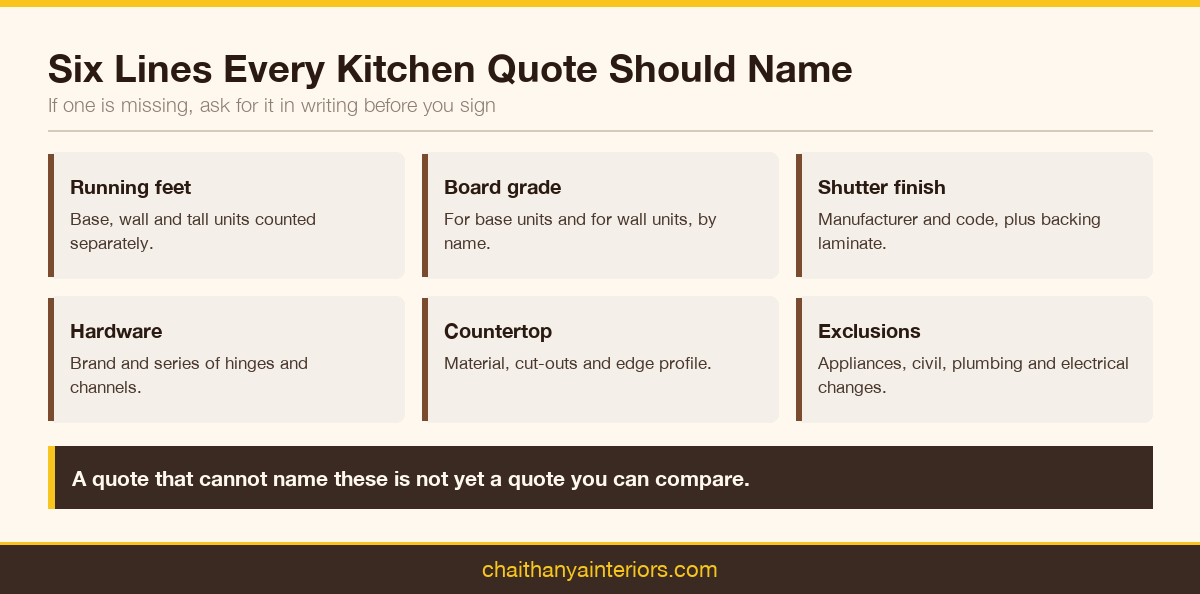
Check that the quote states each of the following. If any is missing, ask for it in writing.
- Running feet for base, wall and tall units, separately
- Board type and grade for base units and for wall units
- Shutter finish, manufacturer and code
- Edge band thickness and whether backing laminate is included
- Hardware brand and series for hinges and channels
- Each accessory listed by type
- Countertop material and whether the price includes cut-outs and edge profile
- What is excluded: appliances, civil, plumbing and electrical changes
For a quote against your own drawing, send us the kitchen plan.

 Speak with an Expert
 Bar Counter
 Bed Room Interior
 Book Shelfes
 Centre Table
 Crockery Shelf
 Dinig Table
 Dressing Units
 False Ceiling
 LCD Units
 Living - Dining Partition
 Living Room
 Edge Banding
 Hinge Holl Drilling
 Profile Handle Fixing