

Modular Furniture Quality Control: The Checks That Stop Units Being Rejected on Site
Every interior firm in Kerala has a story about the wardrobe that arrived on site and could not be installed. The carcass was a few millimetres too deep for the niche. The shutters were drilled for the wrong hinge. The edge band on one panel had already started to lift. The installation team stood around for half a day, the client watched, and the unit went back to be remade. Good modular furniture quality control is what keeps that story from repeating.
This guide is written for design studios, architects, builders and turnkey contractors who buy factory-made modular units, whether from their own workshop or from a manufacturing partner. It sets out where rejections actually come from, which checks catch them, who should own each check, and how to build a short inspection routine into every order without slowing the project down.
Why units get rejected on site
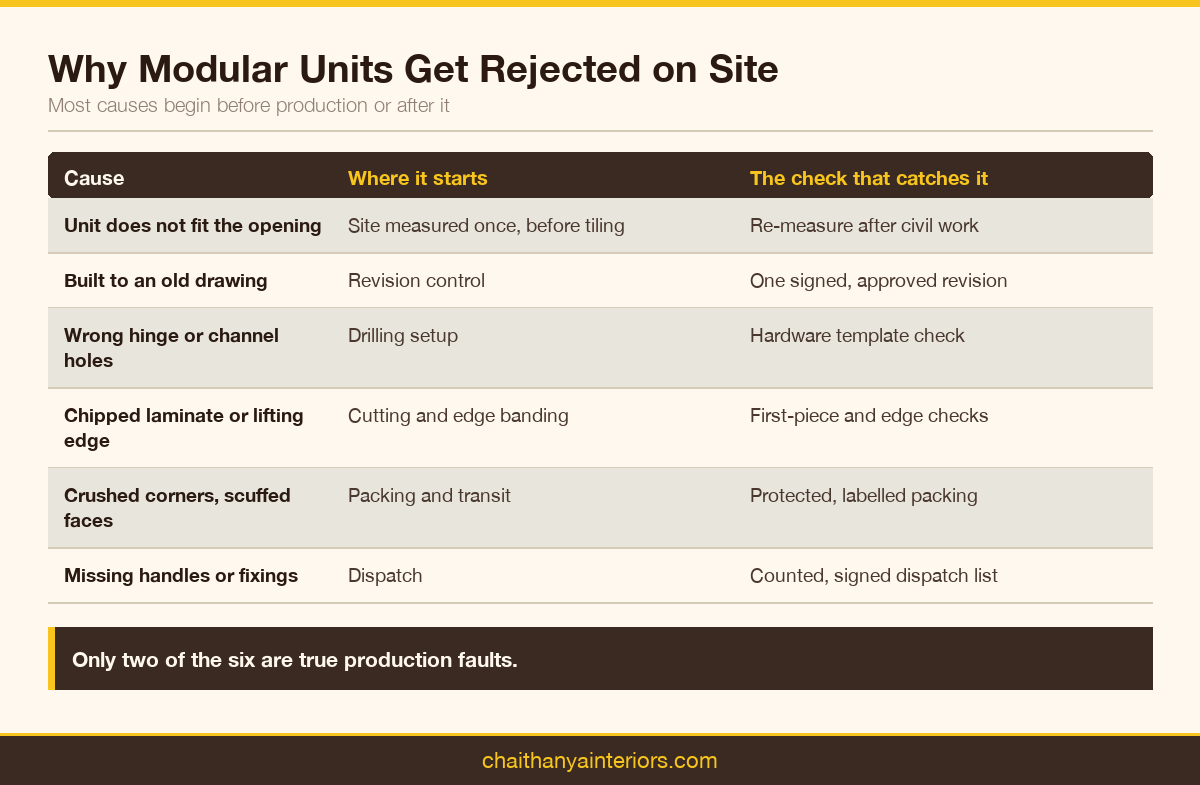
A rejected unit is rarely a mystery. When firms trace site rejections back, the same handful of causes appear again and again. Most of them were visible long before the truck left the factory, which is exactly why they are worth listing.
- Dimension errors: the unit does not fit the opening because the site was measured once, early, and never re-checked after plastering or tiling.
- Drawing mismatch: the factory built what the drawing said, but the drawing was an older revision than the one the client approved.
- Hardware errors: hinge holes drilled for a different hinge series, or drawer channels that do not match the drawer depth.
- Finish defects: chipped laminate at the cut edge, lifting edge banding, scratches, or grain running in different directions on adjacent shutters.
- Transit damage: corners crushed or faces scuffed because units were stacked or strapped without protection.
- Missing parts: a handle set, a skirting length or a fixing kit left behind, which stops installation as surely as a defect.
Only two of those six are true production faults. The rest begin before production or after it, in measurement, drawing control, packing and dispatch. That changes where you should spend your inspection effort.
Where modular furniture quality control actually happens
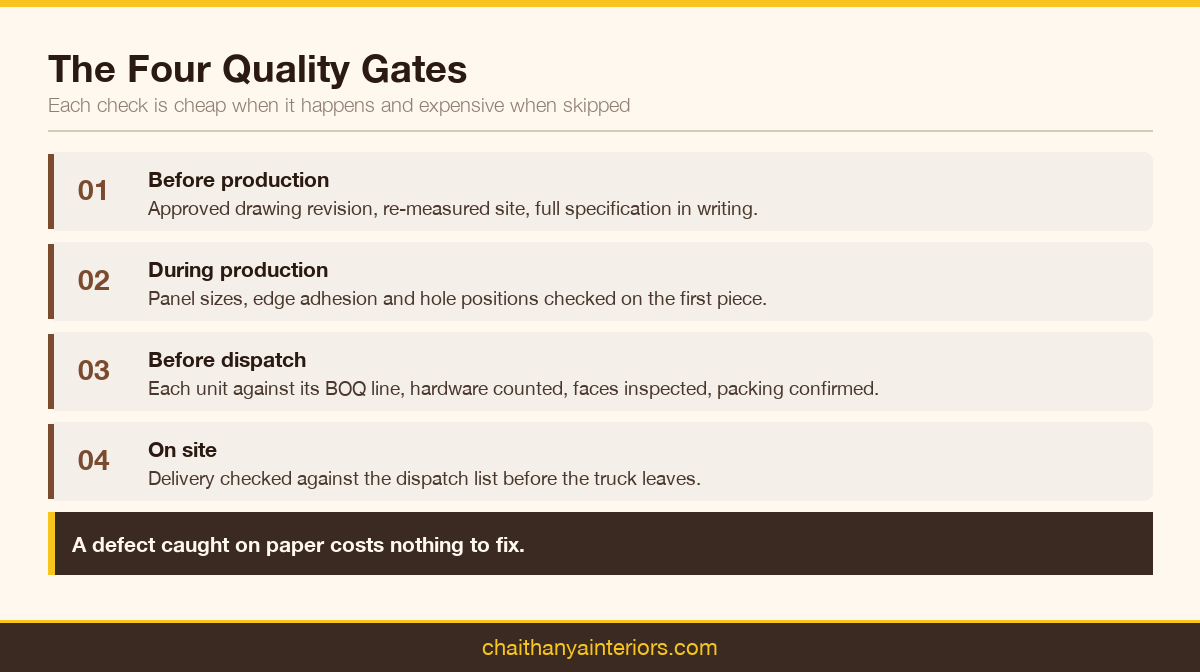
It is tempting to think of quality control as a final inspection at the end of the line. In practice it is a sequence of small checkpoints, each one cheap at the moment it happens and expensive if it is skipped. A useful way to think about it is in four gates: before production, during production, before dispatch and on site.
If you have read our walk-through of how a panel moves through a modular factory, you will recognise the machine stages. This article is not about the machines. It is about the checks that sit between them, and the paperwork that tells everyone a check was actually done.
Gate 1: before production
The cheapest defect to fix is the one caught on paper. Before any board is cut, three things should be confirmed in writing: the final approved drawing revision, the site dimensions re-measured after civil and tiling work, and the full specification of board, laminate, edge band and hardware for each unit.
A clean order process, of the kind described in our article on turning a drawing and BOQ into delivered units, makes this gate straightforward. The point is that one person on each side signs off the same revision, so the factory never builds from a drawing the client has already changed.
Gate 2: during production
Inside the factory, the checks are about consistency. Panels should be checked for size after cutting, edges checked for adhesion and flushness after edge banding, and hole positions checked against the hardware template after drilling. A first-piece check on each new setting, before the whole batch runs, is what separates controlled production from hoping for the best.
For Kerala work, moisture deserves its own attention. Edges, cut-outs and the underside of base units are where humidity gets in, so the board grade and edge sealing in wet zones should match the specification exactly. Our guide to selecting board and laminate for a humid climate explains why the specification matters before anyone starts checking against it.
Gate 3: before dispatch
Pre-dispatch inspection is the last moment when a defect costs only the factory's time. Each unit should be checked against its line in the BOQ, its hardware counted, its faces inspected under good light, and its packing confirmed. A simple dispatch checklist, signed and photographed, protects both the factory and the firm receiving the units.
Gate 4: on site
On arrival, someone from the design firm or the installer should check the delivery against the dispatch list before the truck leaves. Damage noted at the door is a transit question. Damage discovered three days later, after other trades have been through the room, becomes an argument nobody wins.
A furniture QC checklist your team can use
A checklist only works if it is short enough to be used on every order. The list below covers the checks that catch most rejections. It can sit on one page, travel with the job card, and be signed at each stage by the person responsible.
- Drawing revision number matches the client-approved revision.
- Site dimensions re-measured after plastering, tiling and any false ceiling work.
- Board grade, laminate code, edge band colour and hardware series listed for every unit.
- Cut panel sizes checked against the cutting list on the first piece of each batch.
- Edge banding flush, sealed and free of glue lines, with no lifting at the corners.
- Hinge, channel and handle holes checked against the hardware template.
- Shutters dry-fitted on a carcass to confirm even gaps and alignment.
- Faces inspected for chips, scratches and grain direction under good light.
- Hardware, fixings and accessories counted and packed with the unit they belong to.
- Corners and faces protected, units labelled by room and position.
None of these checks needs special equipment. They need ownership, a light, a tape, a template and the discipline to sign only what has actually been checked.
Who should own each check
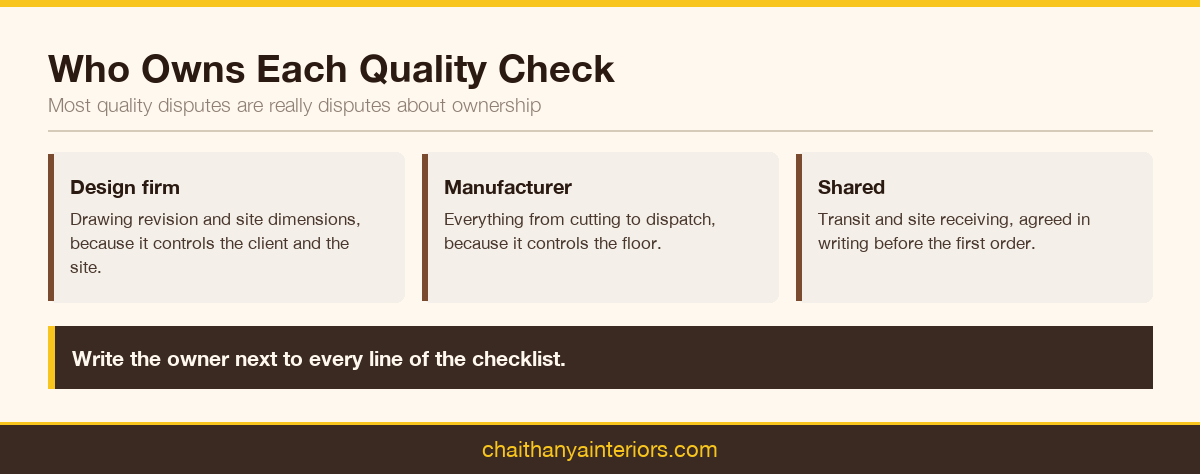
Most quality disputes between design firms and manufacturers are really disputes about ownership. The factory assumes the firm confirmed the dimensions. The firm assumes the factory would have caught an odd drawing. Writing down who owns each check removes that gap entirely.
As a rule, the design firm owns the drawing revision and the site dimensions, because it controls the client and the site. The manufacturer owns everything between cutting and dispatch, because it controls the floor. Transit and site receiving are shared, and should be agreed before the first order. Our article on keeping finish quality when production is outsourced covers how to set out that split with a partner.
Modular unit site rejection: what to do when it still happens
Even with good checks, a unit will occasionally fail on site. What matters then is speed and evidence. Photograph the defect with the unit label visible, note which gate should have caught it, and send both to the factory the same day. A clear record turns a rejection into a quick remake rather than a negotiation.
Rejections should also feed back into the process. If two units in a month fail for the same reason, the checklist needs a new line or a check needs a new owner. Over a few months, that feedback loop does more for quality than any single inspection.
Remakes also affect the programme. A rejected kitchen unit holds up the countertop, the plumber and the electrician behind it, which is why realistic buffers matter. Our guide to planning realistic production timelines explains where to build in time for exactly this kind of slip.
Kitchens and wet areas need tighter checks
In a Kerala kitchen, the defects that cause rejections are often the ones that would have caused failures later. A sink base with an unsealed plumbing cut-out, a base unit sitting directly on a wet floor without a plinth, or an edge band that has not bonded fully will all look acceptable on the day and swell within a monsoon or two.
For that reason, kitchen and bathroom units deserve an extra check on edge sealing, cut-out sealing and board grade before dispatch. The reasoning behind those choices is set out in our guide to how kitchen boards cope with the monsoon. For board standards, the Bureau of Indian Standards publishes the plywood and board specifications that most Indian suppliers quote against.
How Chaithanya Interiors approaches quality control
Chaithanya Interiors runs its own modular factory in Kochi, with German machinery for cutting, edge banding, hot pressing, hinge hole drilling, grooving, profile handle fixing and multi-boring. Controlled machinery makes consistency possible, but it is the checks between the machines that make it reliable, and those are what any partner should be able to show you.
If you are evaluating us, or any other manufacturer, ask to see the unit and ask to see a job card part-way through production. You can find out about the production unit behind our kitchens and wardrobes, look at finished installations in our gallery, or see how we handle kitchen projects.
If you would like to discuss quality checks for an upcoming project, or send a drawing set for review before production, talk to the team.

 Speak with an Expert
 Bar Counter
 Bed Room Interior
 Book Shelfes
 Centre Table
 Crockery Shelf
 Dinig Table
 Dressing Units
 False Ceiling
 LCD Units
 Living - Dining Partition
 Living Room
 Edge Banding
 Hinge Holl Drilling
 Profile Handle Fixing