


In-House vs Outsourced Furniture Manufacturing: A Cost Comparison for Kerala Design Firms
Sooner or later, every growing interior design firm in Kerala faces the same question. Do we keep building our furniture with our own carpenters, invest in our own workshop or machinery, or hand production to a factory partner? The answer usually gets framed as a question of quality. For most firms, it is really a question of cost structure, and the in-house vs outsourced furniture manufacturing decision looks very different once every cost is on the table.
This guide sets out those costs side by side for a design firm, not a homeowner. It looks at fixed overheads, the price of rework, what happens to capacity in a busy month, and how each route affects cash flow. It does not give rupee figures, because those depend on your city, your volume and your specification. It gives you a structure to put your own numbers into.
The three routes design firms actually use
In practice, Kerala firms tend to work in one of three ways, and many move between them as they grow. Each has a different cost shape, so it helps to name them clearly before comparing anything.
- In-house carpentry: the firm employs or retains carpenters who build units on site or in a small workshop, buying board and hardware itself.
- In-house factory: the firm invests in its own production unit, with panel saws, edge banding and drilling machinery, and staffs it.
- Outsourced manufacturing: the firm designs and manages the project, and a factory partner produces the units to its drawings and specification.
Our guide for firms choosing a factory partner explains how the outsourced route works operationally. Here, the focus is purely on what each route costs the firm to run.
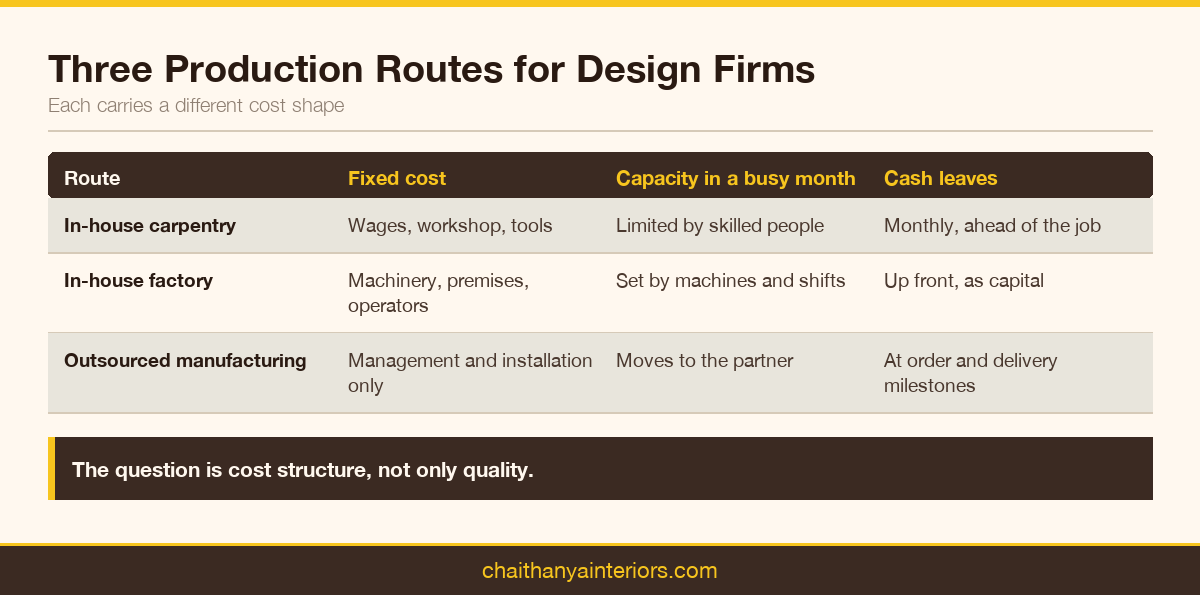
In-house vs outsourced furniture manufacturing: the fixed costs
The biggest difference between the routes is how much cost you carry whether or not there is work on the floor. Fixed costs feel invisible in a busy quarter and very visible in a slow one.
In-house carpentry
Carpenters on the payroll, or on a regular retainer, are a fixed cost that continues between projects. So is the workshop rent, the hand and power tools, their maintenance, and the time a supervisor spends allocating work. The capital outlay is modest, but the monthly commitment is real.
An in-house factory
A factory turns a modest commitment into a large one. Machinery, a building with power and dust extraction, trained operators, maintenance, spares and software for cutting optimisation all sit on the books before the first panel is cut. That investment pays back only if the floor stays busy, which for most design firms means taking in outside work to fill the gaps.
Outsourced manufacturing
With a factory partner, almost all of those costs become variable. You pay for the units you order. Your fixed cost shrinks to the people who manage drawings, orders and installation. The trade-off is less direct control of the floor, which has to be replaced by clear specifications and checks.
The hidden cost of rework
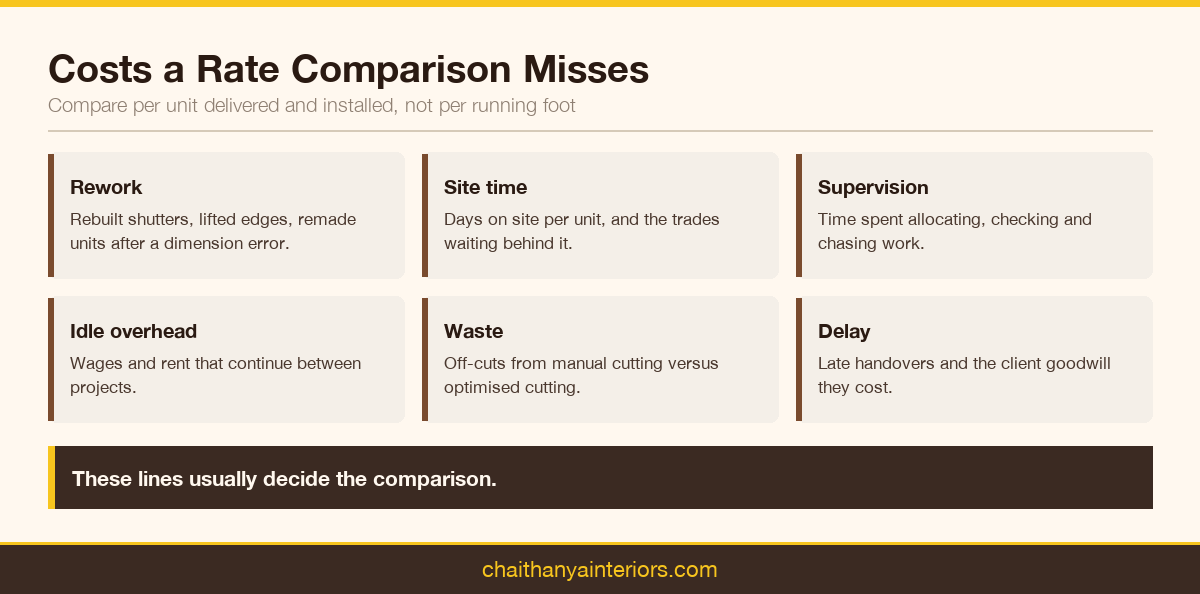
Rework is where many cost comparisons go wrong. A carpenter's daily rate looks lower than a factory's unit price, but the comparison only holds if both produce the same first-time quality. When a site-built shutter warps, an edge lifts in the monsoon or a unit has to be rebuilt after a dimension error, the cost is not just the material. It is the carpenter's time, the delayed handover, the other trades waiting and the client's patience.
Factory production with controlled machinery reduces some of that risk, because cutting, edge banding and drilling are repeatable. It does not remove it. A partner still needs a clear quality routine, which is why we wrote a separate guide on the checks that keep finish quality intact when you outsource.
When you model the routes, add a rework line to each. Use your own last year of projects: how many units were rebuilt, repaired or remade, and what did each one cost in time, material and delay? That number is often the one that changes the decision.
Capacity in a busy month
Interior work in Kerala is seasonal. Handovers bunch around festivals, the end of the financial year and the months before the monsoon, when clients want to move in. A firm's production capacity has to cope with the peak, not the average.
With in-house carpenters, peak capacity is the number of skilled people you can keep or find. Good carpenters are already busy in a busy month, and new hands bring new quality risks. With an in-house factory, peak capacity is set by the machines and the shifts you can run, but a factory sized for the peak sits half idle the rest of the year.
Outsourcing moves the capacity question to the partner. That only works if the partner can say clearly how long production takes at each stage and how far ahead you need to book. Our article on how long modular production really takes explains how to read a partner's lead time, stage by stage.
Cash flow and working capital
Cost is one thing. When the cost is paid is another, and for a growing design firm it is often the more important of the two. Each route pulls cash out of the business at a different moment.
- In-house carpentry: wages are paid monthly, and board and hardware are usually bought ahead of the job, so cash leaves well before the client's stage payments arrive.
- In-house factory: the largest outflow happens up front, as capital spent on machinery and premises, followed by ongoing wages, power and raw material stock.
- Outsourced manufacturing: payments to the partner can usually be aligned to order and delivery milestones, which makes it easier to match them to the client's own payment stages.
For a firm registered as a micro or small enterprise, the Ministry of MSME's registration and support schemes are worth checking before any capital purchase, because they affect how investment in machinery is financed.
Carpentry vs modular cost: what you are really comparing
Firms often compare a carpenter's rate per running foot with a factory's price per unit and stop there. That comparison misses most of what the firm is paying for. A fair comparison puts every cost on the same basis, per unit delivered and installed to the agreed standard.
Board and laminate cost roughly the same whoever buys them, though a factory buying in volume may get better pricing and less waste from optimised cutting. Hardware is the same if the specification is the same. The real differences lie in labour time, rework, supervision, site time and the fixed overhead each route carries. Our factory-side breakdown of what drives interior pricing shows how those elements stack up in a typical project.
A simple way to model your own costs
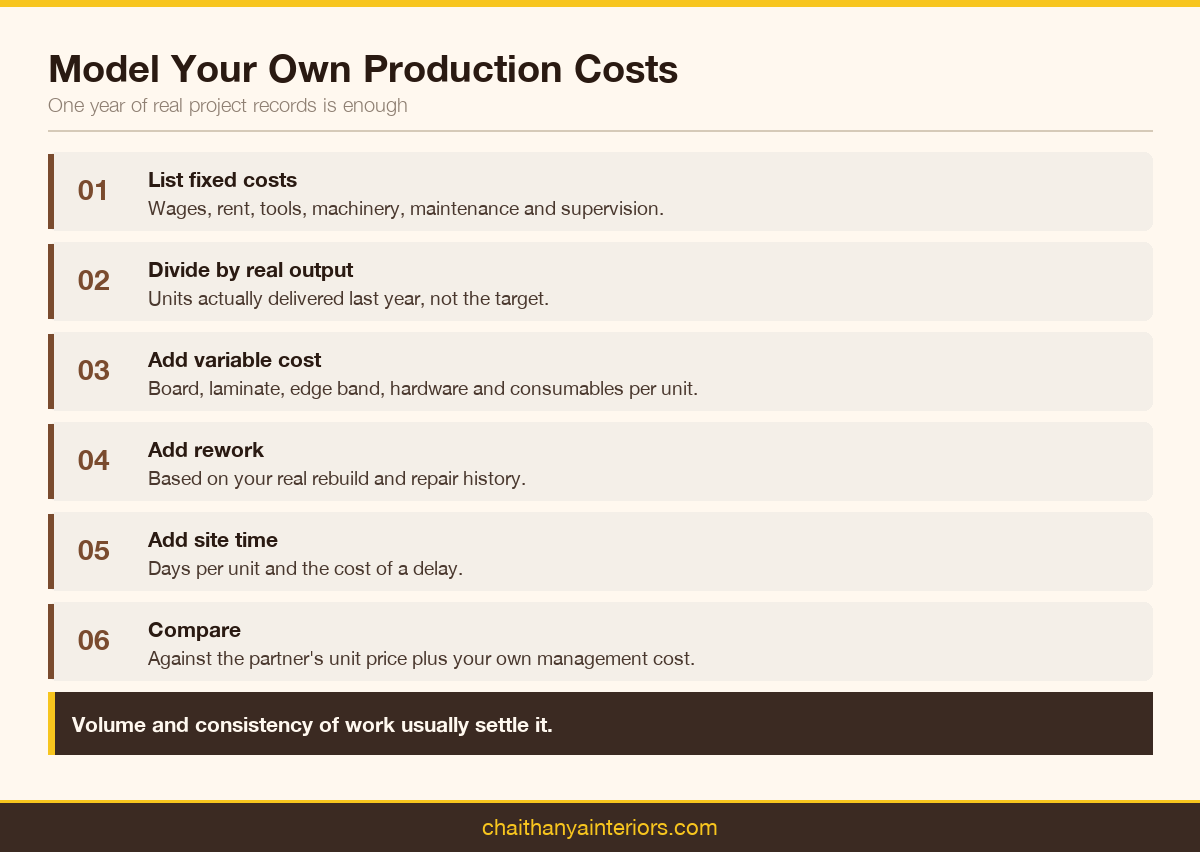
You do not need a consultant to compare the routes. You need a year of your own project records and an honest afternoon. Work through the steps below for each route, and compare the results per unit delivered.
- List every fixed cost: wages or retainers, rent, tools, machinery, maintenance and supervision time.
- Divide those fixed costs by the number of units you actually delivered last year, not the number you hoped to deliver.
- Add the variable cost per unit: board, laminate, edge band, hardware and consumables.
- Add a rework allowance based on your real rebuild and repair history.
- Add site time: days on site per unit, and what a delay costs in other trades and client goodwill.
- Compare that total with the outsourced unit price plus your own management and installation cost.
Most firms find the answer depends on volume and consistency of work. A steady, high-volume pipeline can justify investment in production. An uneven pipeline usually favours keeping fixed costs low and buying production as you need it.
When each route makes sense
There is no single right answer, but some patterns hold. Keeping a small in-house carpentry team makes sense for repairs, site modifications and small custom pieces, even when the main units are outsourced. An in-house factory makes sense for firms with a steady pipeline large enough to keep machines busy most of the year. Outsourcing makes sense for firms that want to grow design capacity without carrying production overhead.
Many firms land on a hybrid: design and project management in-house, a factory partner for kitchens, wardrobes and other modular units, and a carpenter or two for site work. For firms that want to resell factory-made units under their own name, our article on scaling through white-label production covers that model separately.
How Chaithanya Interiors works with design firms
Chaithanya Interiors runs its own modular factory in Kochi with German machinery for cutting, edge banding, hot pressing, hinge hole drilling, grooving, profile handle fixing and multi-boring. We manufacture to drawings from interior design companies, architects, builders and turnkey firms, as well as to our own designs.
You can read about our in-house production unit, browse the full product range, or look through common questions answered. To compare a factory price against your current costs on a real project, send an enquiry with your drawings.

 Speak with an Expert
 Bar Counter
 Bed Room Interior
 Book Shelfes
 Centre Table
 Crockery Shelf
 Dinig Table
 Dressing Units
 False Ceiling
 LCD Units
 Living - Dining Partition
 Living Room
 Edge Banding
 Hinge Holl Drilling
 Profile Handle Fixing