


How to Choose an Interior Design Company in Kerala: A Decision Guide
Search for the best interior designer company in Kerala and you get a wall of lists. Top ten here, best five there, each one written by a company that somehow ranks itself first. None of it helps with the decision you actually face, which is narrower and harder: of the three or four firms you are talking to, which one should you trust with your home and a large share of your savings?
This guide is about that decision. It does not rank anyone. It sets out what kinds of provider exist, how to shortlist them, what to look for in a portfolio and in a finished home, how to check whether a firm really makes what it sells, and what the quote, contract and payment terms should say before you sign.
It is written from the position of a Kochi firm that designs interiors and manufactures its own modular units. Where manufacturing matters to the decision, it says so plainly. Where it does not, the advice applies just as well to a studio, a freelancer or a carpenter, and you should hold us to the same standard as anyone else.
Start with what you are actually buying
An interior project is really three services bundled together, and most disappointment comes from assuming a firm is strong at all three when it is only strong at one. Before comparing anybody, it helps to separate them, because each is judged against different evidence and each fails in a different way.
- Design: space planning, the layout of storage, lighting, the material and colour scheme, and the drawings that turn all of that into something buildable.
- Production: the physical manufacture of kitchens, wardrobes, TV units and panelling, either in a factory, in a workshop, or on site by carpenters.
- Execution: site coordination with electricians, plumbers and painters, installation, snagging and handover, and the after-sales support that follows.
A firm with a strong design studio can still deliver a poor kitchen if its production is weak or bought in without control. A good carpenter can build beautifully and still leave you with a layout that does not suit the way your family cooks, stores and lives. Strength in one service does not carry over to the others.
So decide which of the three your project depends on most. A full-home interior for a new flat leans heavily on production, because most of the value sits in kitchens and wardrobes. A renovation of an older Kerala house, with uneven walls and existing services to work around, leans on design and execution. Knowing this shapes every question you ask later.
The kinds of interior provider in Kerala
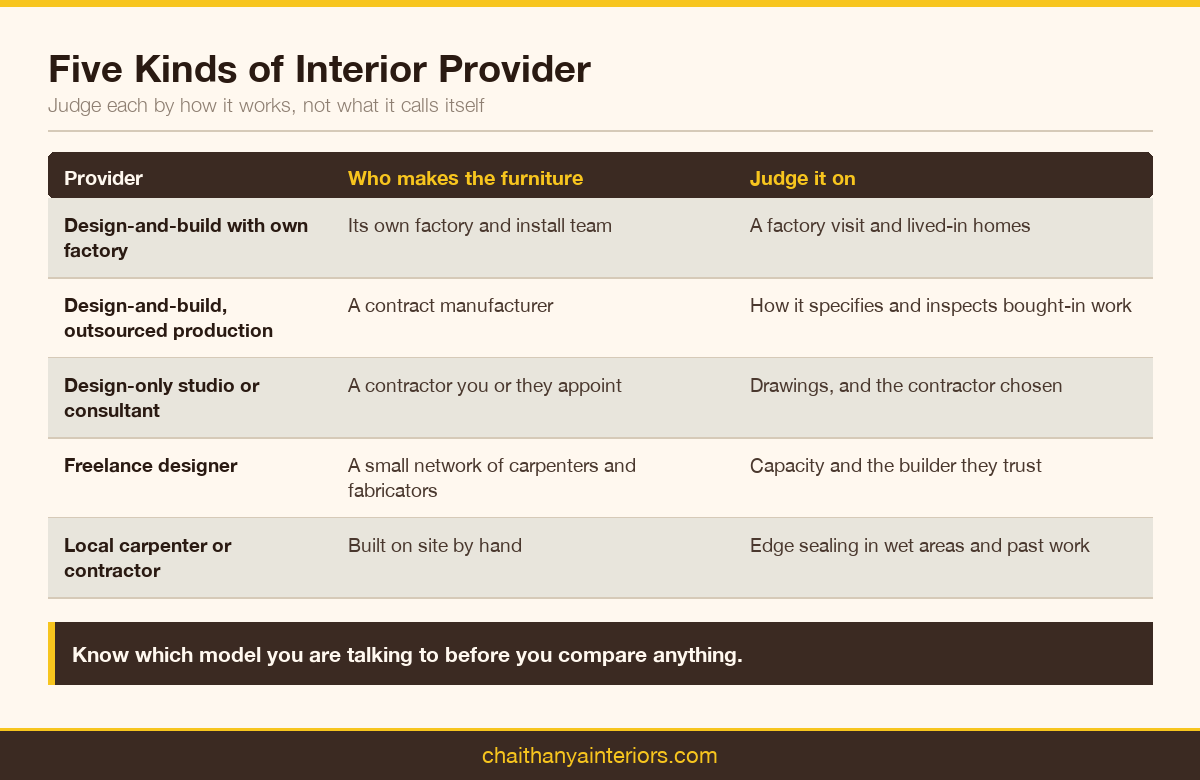
Five broad models operate across Kochi, Thrissur, Kottayam and the rest of the state. The names overlap in marketing, and the same words appear on very different businesses, so judge each firm by how it actually works rather than by what it calls itself.
Design-and-build firms with their own manufacturing
The firm designs the space, manufactures the modular units in its own factory, and installs them with its own team. Accountability sits in one place: if a shutter is misaligned or a drawer runs rough, there is nobody else to blame, and the fix comes from the same people who made the part in the first place.
The trade-off is that you work within the board, finishes and hardware that factory is set up to handle. For most homes that is no restriction at all, but if you have fallen for a very specific imported finish, ask early whether the factory can work with it.
Design-and-build firms that outsource production
The firm designs and manages the project but buys the furniture from a contract manufacturer. This can work very well, and many good studios operate this way. The quality depends entirely on how tightly the firm specifies and checks the work it buys in, which is covered in our article on keeping finish quality when production is outsourced.
Design-only studios and consultants
Some architects and interior consultants produce the design and drawings, then either hand them to you to tender or supervise contractors on your behalf for a fee. You get independent design advice, but you take on more coordination, and the final quality depends on the contractor you or they appoint.
Freelance designers
An individual designer, usually working with a small network of carpenters and fabricators. Often very good value on design, with a personal level of attention that larger studios struggle to match. Capacity and continuity are the questions to ask, especially on a large home or a project that runs for several months.
Local carpenters and contractors
Site-built furniture made by a carpenter or small contractor, with or without drawings. Flexible, familiar and still the default for many Kerala homes. The limits are consistency of finish, edge sealing in wet areas, and the absence of a design layer unless you bring one in separately.
None of these models is right for everyone. The point is to know which one you are talking to, because a freelancer and a factory-backed firm should be judged against different evidence. Our side-by-side comparison of the three most common routes will follow in this series.
Decorator, designer or architect: what the titles mean
The titles are used loosely in Kerala, so it helps to know what each normally means before the first meeting. An interior decorator works mainly with surfaces and furnishings: colour, curtains, lighting fixtures, loose furniture and styling. A decorator rarely changes the layout of a room or builds anything into it.
An interior designer plans how the space works, including storage, circulation, the lighting layout and the built-in furniture, and produces drawings that can be manufactured and installed. A home interior architect, or an architect who takes on interiors, usually works at a deeper level again, including structural and services changes.
For a new flat or a full-home project with a kitchen and wardrobes, you need design and production, not decoration alone. For a home that is already furnished and simply needs refreshing, a decorator may be exactly right, and paying for full design would be money spent on work you do not need.
How to shortlist the best interior designer company for your home
Three to four firms is enough. More than that and comparison becomes guesswork, because nobody can hold six sets of drawings and quotes in their head at once. Fewer and you have no benchmark for what a reasonable answer, price or timeline looks like.
- Start from work you have seen in person, in a friend's flat or a relative's house, rather than from advertising.
- Check that the firm regularly works in your district, and ask how site visits and after-sales calls will be handled there.
- Read Google reviews for pattern, not score. Several reviews describing late handover matter more than the average.
- Ask each firm the same opening question: who designs, who makes, and who installs?
- Drop any firm that will not visit the site before quoting on anything beyond a single unit.
The last point matters more in Kerala than in many places. Older homes rarely have square walls or level floors, and even new apartments vary from the builder's drawing. A quote made from a floor plan alone will change once someone measures, and it is better to learn that before you shortlist than after you sign.
A clear answer to the opening question, given in the first conversation and repeated consistently afterwards, is one of the best early signs you will get. Hesitation or a different answer from each person you meet is worth noting.
Reading a portfolio and seeing finished work
Every firm's portfolio looks good, because every firm chooses what goes into it. The skill lies in reading past the styling to the evidence underneath, and then checking that evidence against a home that has been lived in for a while.
Separate renders from photographs
A 3D render shows what a designer intended, not what was built. It is useful for judging design taste and useless for judging finish. Ask to see photographs of completed homes, ideally taken some time after handover, and be cautious of any portfolio that turns out to be mostly renders.
Look at the details a render hides
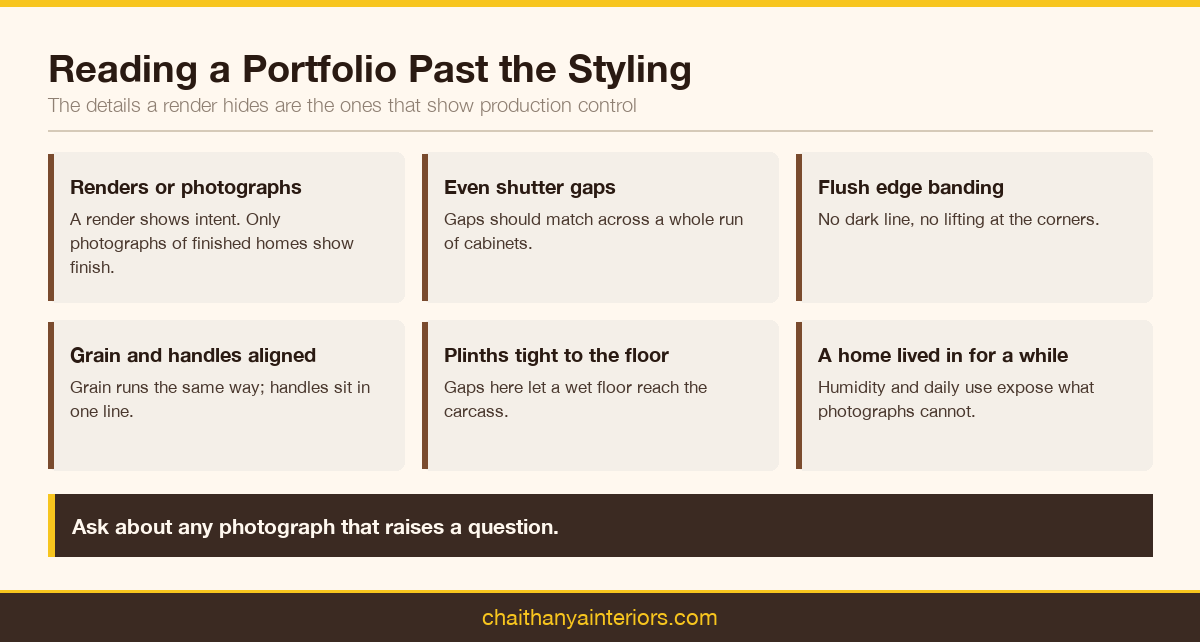
Shutter gaps should be even across a run of cabinets. Edge banding should be flush, with no dark line or lifting at the corners. Laminate grain should run the same way across adjacent shutters, handles should line up, and plinths should sit tight to the floor. These are the marks of controlled production.
You can see how our own completed work reads against those checks in our gallery of finished homes. Judge it by exactly the standard you apply to anyone else, and ask about any photograph that raises a question.
Visit a home finished a year or two ago
If a firm can arrange a visit to a home it completed some time ago, take the offer. Time and Kerala humidity expose what photographs cannot. Open the sink cabinet and look for swelling around the plumbing cut-out, run every drawer, and look for bowing on wardrobe shutters against external walls.
Ask the owner how after-sales requests were handled and how long they took. Some owners prefer privacy, so hesitation is not in itself a warning. A firm that can never arrange a single visit, across many years of work, is telling you something.
Verifying manufacturing claims
Almost every firm in Kerala now says it has a factory, in-house manufacturing or its own production unit. Some do. Some rent space in a shared workshop. Some mean they have a carpenter on retainer. The claim matters because production is where finish quality and moisture resistance are decided, so it is worth checking rather than accepting.
The simplest test is to ask to visit. A firm with a real factory can show you panel cutting, edge banding, hot pressing and drilling happening on its own floor, with machinery set up for repeatable work rather than hand tools alone. Our article on what happens on a modular factory floor explains each stage, so you know what you are looking at.
Ask who owns the machines, how long they have been running, and whether the units for your home would be made there or sent elsewhere. Ask to see a carcass or shutter part-way through production. None of these questions should be difficult for a firm that genuinely manufactures.
Chaithanya Interiors runs its own modular interior factory in Kochi, with German machinery for cutting, edge banding, hot pressing, hinge hole drilling, grooving, profile handle fixing and multi-boring. You are welcome to see the production unit behind our kitchens and wardrobes before you commit to anything, and our guide for firms that partner with a factory shows the same process from the trade side.
Any firm that makes the same claim should be equally willing to open its doors. A dedicated guide to verifying a firm's manufacturing claims is part of this series and will follow later.
Comparing quotes on scope, not on the total
Once you have two or three proposals, the comparison has to be done on scope and specification rather than the bottom line. Firms quote in different ways, some per running foot, some per square foot of carpet area, some as a fully itemised bill of quantities, and the headline totals are rarely comparable as they stand.
Our explainer on how interior pricing and packages work in Kerala covers the models, and the companion piece on why quotes for the same home vary so widely gives a step-by-step method for putting two quotes on the same footing before you judge either one.
At minimum, a quote worth comparing names the board type and grade for each element, the laminate or finish and its code, the edge band thickness, the hardware brand and series, and a written list of exclusions. If any of those is missing, ask for it in writing before you compare anything at all.
Resist the urge to negotiate on the total before the specifications match. A discount on a quote that uses a lower board grade in the kitchen is not a saving, and a firm that cuts its price without changing anything written is worth asking why.
Contract, payment stages and warranty
What the contract should contain
The contract is where a good relationship is protected. It should repeat the specification from the quote, attach the approved drawings, state the handover date and what happens if it slips, and set out how changes are priced and approved. Never sign against renders alone, because approved drawings are the only record of what you agreed.
How payment should follow progress
A schedule tied to real milestones, such as design sign-off, production start, delivery to site and installation, protects both sides. A large share demanded before any drawings are approved does not. Our guide to what you pay and when on a Kerala interior project explains the usual stages and what each should release.
Warranty and after-sales support
Interiors are used hard. Hinges need adjusting, a drawer channel may need replacing, a shutter may need realigning as the building settles. Ask what the warranty covers for board, hardware and workmanship, for how long, who you call after handover, and whether the firm can replace a damaged panel to match.
A firm that manufactures its own units can usually replace a damaged shutter or carcass panel to match, because it holds the material and the production data. Get every warranty term in writing and attached to the contract, not described in a conversation you will both remember differently.
Red flags worth walking away from
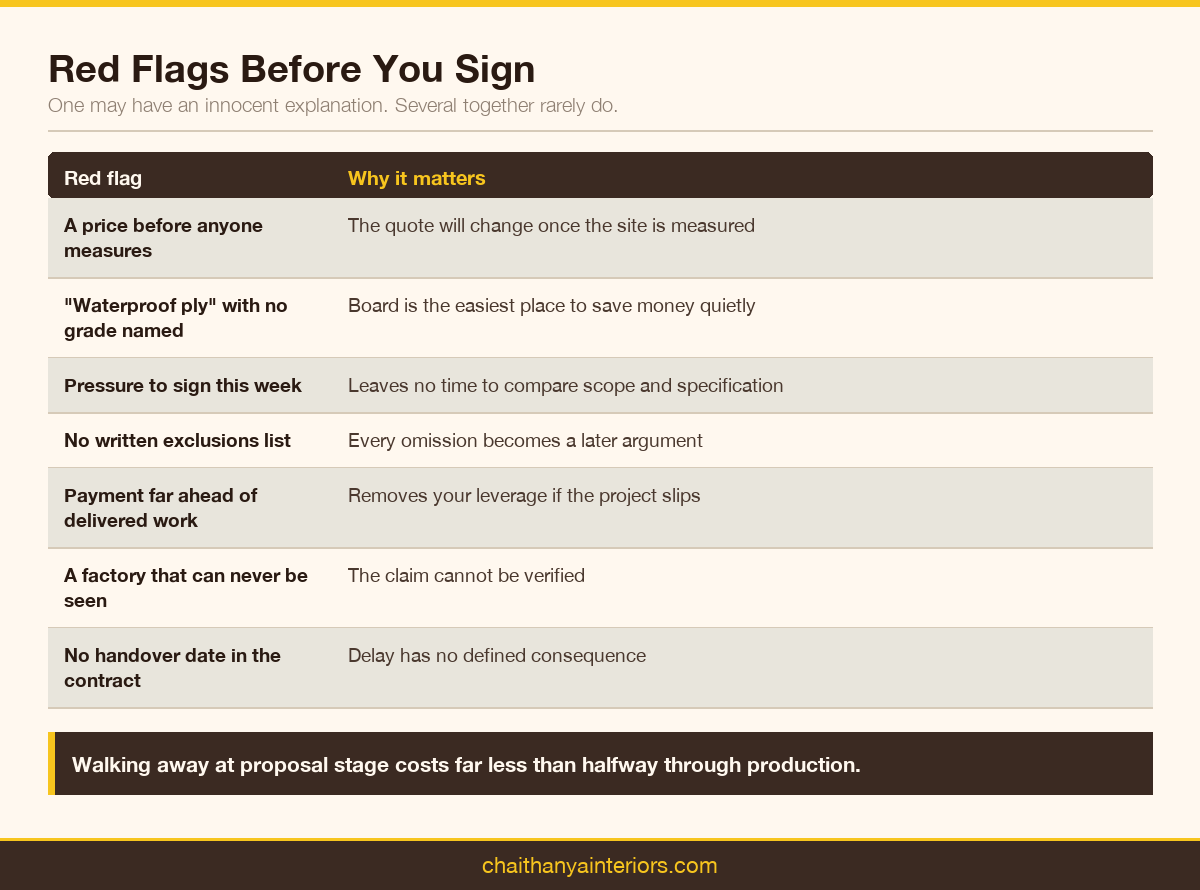
Most firms in Kerala are honest and capable, and most problems come from misunderstanding rather than bad faith. Even so, a few patterns show up again and again in projects that go wrong, and they are usually visible before anyone signs.
- A price given before anyone has measured the site.
- Board described only as "waterproof ply" or "good quality", with no grade or standard named.
- Pressure to sign quickly because an offer expires this week.
- No written exclusions list.
- A payment schedule front-loaded far ahead of any delivered work.
- A manufacturing claim that can never be seen.
- Reluctance to put the handover date in the contract.
- Every portfolio image is a render.
One red flag may have an innocent explanation, and it is fair to ask about it directly. Two or three together usually do not, and it is far cheaper to walk away at the proposal stage than halfway through production.
Making the final call on the best interior designer company
By this stage the choice is rarely between a good firm and a bad one. It is usually between two capable firms with different strengths. Go back to the three services you started with, design, production and execution, and ask which firm is strongest on the one your project depends on most.
Then weigh the working relationship. You will be in regular contact with this firm for months. The one that listened in the first meeting, answered specifically, and put things in writing without being asked is usually the one that will handle a problem well when one comes up.
If two firms are still level, ask each for a physical sample of the exact finish and edge band proposed for your kitchen, and compare them side by side in daylight. It is a small test, but it tells you a great deal about how carefully each one works.
If you would like to see how we work before shortlisting, you can browse our design and manufacturing services, look through answers to questions clients ask us most, or talk to the team about your project.

 Speak with an Expert
 Bar Counter
 Bed Room Interior
 Book Shelfes
 Centre Table
 Crockery Shelf
 Dinig Table
 Dressing Units
 False Ceiling
 LCD Units
 Living - Dining Partition
 Living Room
 Edge Banding
 Hinge Holl Drilling
 Profile Handle Fixing