


Questions to Ask a Kerala Interior Firm Before You Sign the Contract
By the time a contract is on the table, most homeowners have already chosen. The design looks right, the conversation has been friendly, and the pressure is to sign and get started. That is exactly the moment to slow down for one more meeting, with a written list of questions to ask an interior designer before anything is signed.
The questions below separate a smooth project from a difficult one, grouped by the part of the project they protect. For each there is a note on what a good answer sounds like, because specificity matters more than the answer itself. If you are still shortlisting, start with our decision guide to choosing an interior firm in Kerala first.
Questions about scope
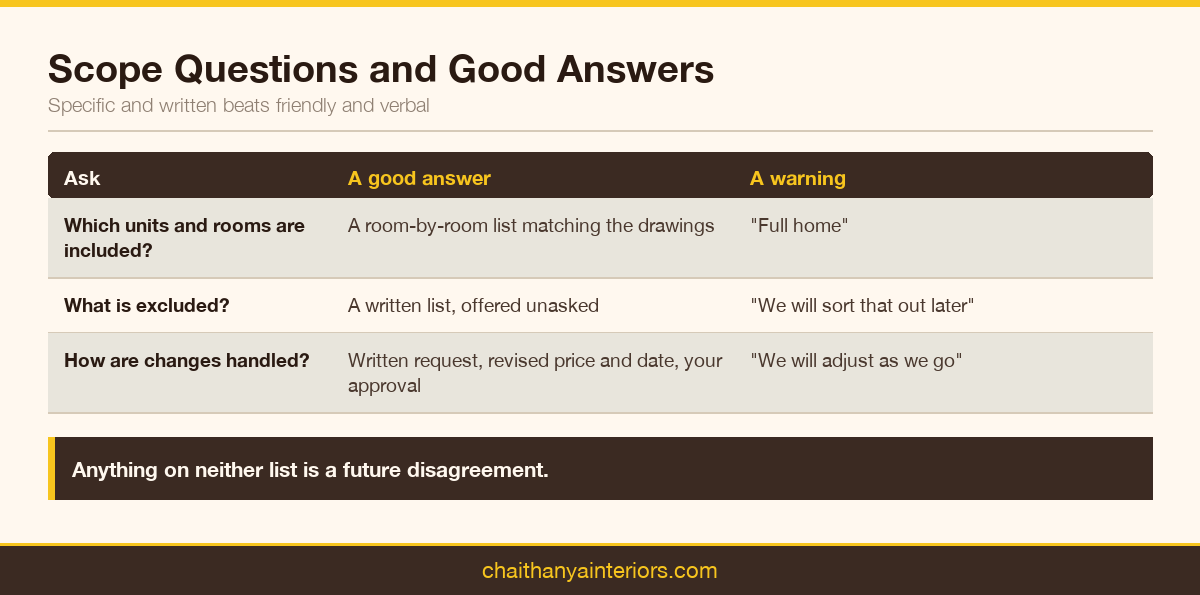
Exactly which units and rooms are included?
Most disputes on Kerala interior projects start with an assumption. The homeowner assumed the loft storage was included; the firm assumed it was not. Neither was lying, and neither wrote it down. A scope question asked before signing costs nothing and prevents the most common argument of all.
A good answer is a written list, room by room, that matches the drawings exactly. "Full home" is not a scope. Ask specifically about loft storage, the pooja unit, the crockery unit, the shoe rack and the study table, which are the items most often assumed by one side and not quoted by the other.
What is excluded?
Exclusions are where two quotes that look similar turn out to be very different. Civil work, false ceiling, painting, countertops, appliances, lighting fixtures and loose furniture are the usual candidates, and each can add a significant amount once the project is underway and you have little choice.
A good firm hands you an exclusions list without being asked, and is happy to price any excluded item separately if you want it. Anything that appears on neither the inclusions nor the exclusions list is a future disagreement waiting to happen, so ask about it before you sign, not after.
How are changes handled once we have signed?
Changes are normal. You will see the site differently once work starts, and some decisions only become clear when the walls are open. What matters is that each change is priced, dated and agreed in writing before the work goes ahead, so neither side is surprised.
Listen for a process: a written change request, a revised price and a revised date, approved by you before production proceeds. A verbal "we will adjust as we go" is pleasant to hear at the start and expensive to live with at the end.
Questions about materials
What board is used for each element, and to what standard?
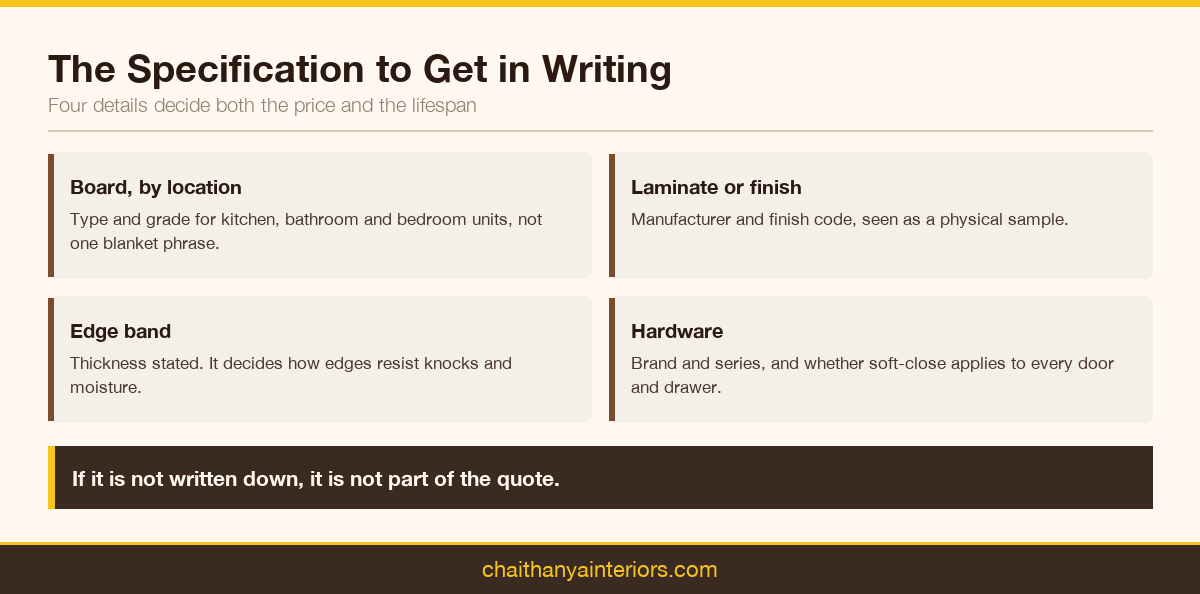
Board is the single biggest driver of both cost and lifespan in a Kerala home, and it is invisible once the laminate is on. It is also the easiest place for a quote to save money quietly, so this is the question to press hardest and to have answered in writing.
The answer should name the board type and grade by location, for example boiling-waterproof plywood for kitchen base units and a stated grade for bedroom wardrobes. "Waterproof ply" alone is not a specification. Our guide to board and laminate choices for Kerala humidity explains what each option does in a wet climate.
Which laminate, which finish code, and what edge band?
Two laminates with the same colour name can differ in thickness, scratch resistance and how they age in sunlight. Edge band thickness decides how well the panel edge resists knocks and moisture, and it is rarely mentioned unless you ask for it by name.
A good answer names the manufacturer and finish code, and states the edge band thickness. You should be able to see a physical sample of the exact finish, ideally with the edge band applied, rather than choosing from a printed catalogue swatch under showroom lighting.
Which hardware brand and series?
Hinges and drawer channels are the parts you touch every day, and the parts most likely to fail early. Quality varies enormously within a single brand, because most brands sell several series at very different levels. "Branded soft-close hardware" on its own tells you very little.
Ask for the series, not only the brand, and ask whether soft-close applies to every door and drawer or only some. Ask also whether the hardware carries its own manufacturer warranty, and whether the firm handles any claim on your behalf or leaves you to deal with the supplier.
Questions about production
Who makes the furniture, and where?
There are three honest answers: our own factory, a contract manufacturer we specify and inspect, or carpenters on site. All three can produce good work. What you need to know is which applies, because each carries different risks for finish, timeline and moisture resistance in your home.
If the firm says it has its own factory, ask to visit it before you sign. You can compare what you see against the way factory production actually works in a properly equipped modular unit, from cutting and edge banding to drilling and final checks.
How are the units checked before they leave production?
Problems found in the factory cost minutes to fix. Problems found on site cost days, and problems found after handover cost goodwill on both sides. A firm that checks its work before dispatch saves you most of the snagging that makes the last weeks of a project stressful.
A good answer describes a check, not a promise: dimensions against the drawing, edge banding quality, hinge boring positions, shutter alignment on a dry assembly. A firm that can describe its checks in detail is usually a firm that actually does them on every order.
Questions about timeline and payment
What is the timeline, stage by stage?
One number for the whole job is a warning sign. A good answer separates design sign-off, production, delivery and installation, and says which of those depend on you. Our article on realistic lead times for factory-made furniture in Kerala explains where time is usually lost.
Ask what happens if the handover date slips for reasons within the firm's control, and what counts as a delay caused by you, such as late decisions or an unready site. Both should be in the contract, so neither side can reinterpret them later when tempers are shorter.
What is the payment schedule, and what does each payment release?
Each instalment should be tied to a milestone you can see, such as approved drawings, production started or units delivered to site. Be wary of a schedule that asks for most of the value before anything is delivered. Our explainer on the stages at which Kerala interior projects are paid sets out a fair structure.
Ask too whether the price is fixed for the agreed scope and specification, and which few things could change it, such as conditions found once walls are opened. If you hold a competing quote, ask the firm to explain the difference line by line. Our method for putting two interior quotes on the same footing helps you prepare.
Questions about the site and after-sales
Who is responsible for the site day to day?
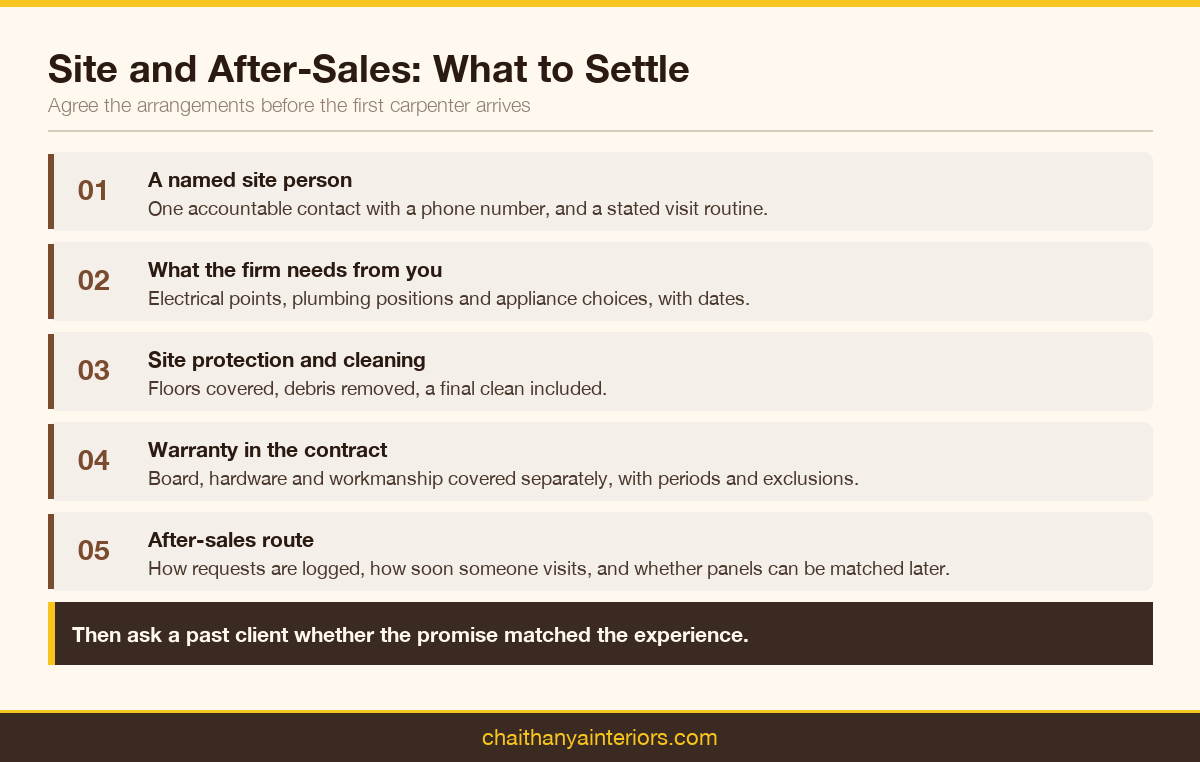
You want a named person, with a phone number, who is accountable for coordination between carpenters, electricians and plumbers. Ask how often they will be on site, how you will be updated, and what the firm needs from you and when: final electrical points, plumbing positions and appliance choices.
Ask also about protection of floors and existing finishes, debris removal and a final clean. These are small items that are often excluded without anyone saying so, and they shape how the last week of the project feels far more than their cost would suggest.
What does the warranty cover, and who do we call?
A good answer distinguishes board, hardware and workmanship, states the period for each, and names exclusions, all written into the contract. Hinges need adjusting in the first months as a building settles, so ask how requests are logged and how soon someone usually visits.
Finally, ask whether a damaged shutter can be replaced to match years later. A firm that holds its own production data and materials usually can. Then ask a past client whether the after-sales experience matched what was promised, because that is the only answer you can really rely on.
How to use the questions to ask an interior designer
Ask every firm the same questions, in writing if you can, and compare how they answer as much as what they say. Specific, written, unhurried answers are the best predictor of how a firm will behave when something goes wrong. Vague answers, or answers that change between meetings, deserve attention.
If you would like to put these questions to us, you can book a meeting with our design team or see how our units are made in Kochi before signing anything.

 Speak with an Expert
 Bar Counter
 Bed Room Interior
 Book Shelfes
 Centre Table
 Crockery Shelf
 Dinig Table
 Dressing Units
 False Ceiling
 LCD Units
 Living - Dining Partition
 Living Room
 Edge Banding
 Hinge Holl Drilling
 Profile Handle Fixing